
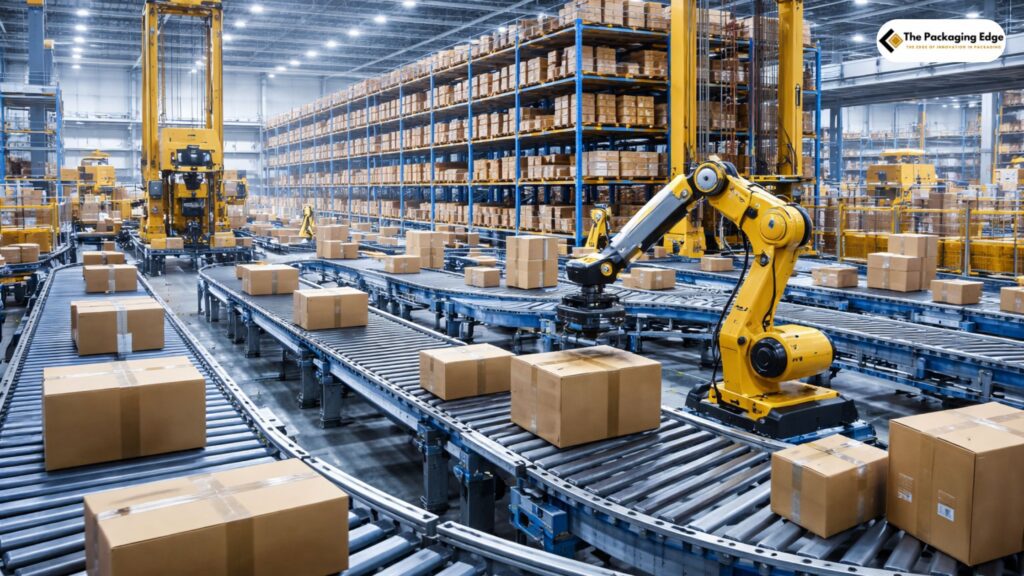
Introduction: Why Automated Material Handling Systems Are No Longer Optional
Across manufacturing, warehousing, fulfillment, and packaging operations worldwide, one reality is becoming impossible to ignore: manual material handling is no longer sustainable at scale. Rising labor costs, workforce shortages, increased safety regulations, demand for faster order fulfillment, and pressure to reduce operational errors are converging into a single mandate—automation.
At the center of this transformation is the automated material handling system. Once viewed as a capital-intensive luxury reserved for global enterprises, automated material handling systems are now essential infrastructure for organizations of all sizes that want to remain competitive.
At The Packaging Edge, we work with companies globally to design, integrate, and optimize automated material handling systems that directly improve throughput, accuracy, safety, and profitability. This guide is written from a strategic and practical perspective—built to help decision-makers understand what automated material handling systems are, how they work, and how to deploy them correctly for long-term success.
This is not theory. This is operational reality.
What Is an Automated Material Handling System?
An automated material handling system is an integrated network of equipment, software, and controls designed to move, store, protect, and manage materials throughout a facility with minimal human intervention.
Unlike standalone machines, automated material handling systems function as a cohesive ecosystem. Each component communicates with others to ensure materials flow efficiently from receiving through processing, packaging, storage, and shipping.
Core Objectives of an Automated Material Handling System
An automated material handling system is implemented to achieve several critical objectives:
- Increase throughput without increasing labor
- Improve accuracy and eliminate manual handling errors
- Enhance worker safety and reduce injury risk
- Maximize space utilization
- Enable scalability and future growth
- Reduce operational costs over time
When implemented correctly, automation does not replace people—it elevates them. Employees move from repetitive, injury-prone tasks to higher-value roles such as monitoring, optimization, and quality control.
Key Components of an Automated Material Handling System
A comprehensive automated material handling system typically includes multiple subsystems working together. The exact configuration depends on product type, volume, facility layout, and business goals.
1. Conveying Systems
Conveyors form the backbone of many automated material handling systems. They enable continuous, predictable movement of materials between workstations.
Common conveyor types include:
- Belt conveyors for cartons and packages
- Roller conveyors for cases and pallets
- Chain conveyors for heavy-duty loads
- Modular plastic conveyors for hygienic environments
At The Packaging Edge, conveyor systems are engineered not just for movement, but for system intelligence—integrating sensors, diverting logic, and accumulation zones to optimize flow.
2. Automated Storage and Retrieval Systems (AS/RS)
AS/RS solutions automate the storage and retrieval of goods within high-density racking systems. These systems dramatically reduce footprint requirements while increasing inventory accuracy.
Key AS/RS technologies include:
- Unit-load AS/RS for pallets
- Mini-load AS/RS for totes and cartons
- Shuttle-based systems
- Vertical lift modules
An automated material handling system incorporating AS/RS enables real-time inventory visibility and rapid order fulfillment.
3. Robotics and Robotic Cells
Industrial robotics are now a cornerstone of modern automated material handling systems.
Applications include:
- Robotic palletizing and depalletizing
- Case packing and unpacking
- Pick-and-place operations
- Collaborative robots (cobots) for flexible tasks
Robotic integration requires precision engineering. The Packaging Edge specializes in aligning robotics with upstream and downstream material handling equipment for seamless performance.
4. Automated Guided Vehicles (AGVs) and Autonomous Mobile Robots (AMRs)
AGVs and AMRs provide flexible material transport without fixed infrastructure.
- AGVs follow predefined paths
- AMRs navigate dynamically using sensors and AI
These vehicles are ideal for facilities requiring adaptable layouts or phased automation strategies.
5. Sortation Systems
High-speed sortation is critical for e-commerce, distribution, and high-SKU environments.
Sortation technologies include:
- Shoe sorters
- Cross-belt sorters
- Tilt-tray systems
- Pop-up diverters
An automated material handling system with intelligent sortation ensures rapid, error-free order routing.
6. Software and Controls
No automated material handling system is complete without advanced control software.
This includes:
- Warehouse Control Systems (WCS)
- Warehouse Execution Systems (WES)
- PLC controls and sensors
- Integration with WMS, ERP, and MES platforms
The Packaging Edge emphasizes software-driven automation, ensuring systems remain adaptable as business needs evolve.
Benefits of an Automated Material Handling System
The value of an automated material handling system extends far beyond labor savings. When strategically implemented, automation becomes a growth engine.
Increased Productivity and Throughput
Automated systems operate continuously, consistently, and at speeds unattainable by manual processes. This translates into higher output with fewer bottlenecks.
Improved Accuracy and Quality
Automation eliminates variability caused by fatigue, training gaps, or human error. Barcode scanning, vision systems, and software validation ensure precision at every step.
Enhanced Workplace Safety
Manual material handling is a leading cause of workplace injuries. Automated material handling systems significantly reduce lifting, repetitive motion, and forklift traffic.
Space Optimization
Vertical storage, compact conveyors, and intelligent routing maximize usable space—often allowing facilities to delay or eliminate costly expansions.
Scalability and Flexibility
A properly designed automated material handling system grows with your business. Modular components allow for phased expansion and technology upgrades.
Long-Term Cost Reduction
While initial investment is required, automation delivers strong ROI through:
- Reduced labor dependency
- Lower error-related costs
- Decreased product damage
- Improved energy efficiency
Industries That Benefit from Automated Material Handling Systems
Automated material handling systems are not industry-specific—they are performance-specific.
Packaging and Manufacturing
Automation ensures consistent material flow between production, packaging, and palletizing operations.
Warehousing and Distribution
High-volume distribution centers rely on automated material handling systems for order accuracy and speed.
E-Commerce and Fulfillment
Same-day and next-day delivery demands make automation essential for order processing efficiency.
Food and Beverage
Hygienic conveyors, robotic handling, and traceability systems ensure compliance and safety.
Pharmaceuticals and Healthcare
Precision, validation, and cleanroom compatibility make automation critical in regulated environments.
Designing the Right Automated Material Handling System
The biggest mistake organizations make is purchasing equipment instead of designing a system.
At The Packaging Edge, system design begins with understanding business objectives—not machinery catalogs.
Step 1: Operational Assessment
We analyze:
- Current workflows
- Throughput requirements
- SKU profiles
- Labor constraints
- Facility limitations
Step 2: Data-Driven Modeling
Simulation tools model system performance before implementation, reducing risk and optimizing ROI.
Step 3: Scalable Architecture
Systems are designed to scale—supporting future volumes, new SKUs, and emerging technologies.
Step 4: Seamless Integration
Automation must integrate with existing equipment and software ecosystems.
Step 5: Installation and Optimization
Commissioning does not end at startup. Continuous optimization ensures peak performance.
Common Challenges and How to Avoid Them
Underestimating Change Management
Automation success depends on workforce engagement and training.
Over-Automation
Not every process should be automated. Strategic balance is essential.
Poor Vendor Coordination
Fragmented suppliers create fragmented systems. A single expert integrator eliminates this risk.
The Packaging Edge acts as a unified solution provider—designing, integrating, and supporting complete automated material handling systems.
ROI: Measuring the True Value of Automation
Return on investment should be measured across multiple dimensions:
- Labor savings
- Throughput increases
- Error reduction
- Space utilization
- Safety improvements
- Customer satisfaction
Most automated material handling systems achieve payback within 18–36 months when properly designed.
Why The Packaging Edge Is the Authority in Automated Material Handling Systems
Automation is not about machines—it is about outcomes.
At The Packaging Edge, we bring:
- Deep industry expertise
- Vendor-agnostic system design
- End-to-end project execution
- Global implementation capability
- Long-term partnership mindset
We do not sell equipment. We engineer performance.
Our automated material handling systems are custom-built to solve real operational challenges—not theoretical ones.
The Future of Automated Material Handling Systems
Emerging trends include:
- AI-driven system optimization
- Predictive maintenance
- Increased use of AMRs
- Greater software intelligence
- Sustainability-focused designs
The future belongs to operations that invest strategically today.
Conclusion: Take the Edge in Automation
An automated material handling system is no longer a competitive advantage—it is a business requirement. Organizations that delay adoption risk falling behind in efficiency, safety, and customer satisfaction.
The Packaging Edge exists to help you navigate this transition with confidence. From initial strategy through system optimization, we deliver automated material handling systems that work—today and tomorrow.
If you are ready to improve throughput, reduce costs, and future-proof your operation, now is the time to act.
Contact The Packaging Edge today and take control of your material handling future. Email us directly at thepackagingedge@gmail.com to start the conversation with experts who understand your challenges and deliver real solutions.
Related Articles
- Milk Powder Packaging Machine: The Definitive Guide for Manufacturers Seeking Efficiency, Quality, and Scale
- Automatic Tea Packing Machine: The Complete Buyer’s & Implementation Guide for Scalable Tea Packaging
- Plastic Wrapping Machine for Boxes: The Complete Global Buyer’s Guide to Faster, Safer, and Smarter Packaging
- Automatic Plastic Wrapping Machine: The Definitive Guide to Smarter, Faster, and More Profitable Packaging
- Carton Box Sealing Machine: The Complete Industrial Guide to Faster, Smarter, and More Reliable Packaging
- Automatic Box Packing Machine: The Definitive Guide to Smarter, Faster, and Scalable Packaging
- The Ultimate Guide to Choosing the Right Carton Box Packing Machine for Modern Packaging Operations
- Powered Roller Conveyor Systems: The Complete Expert Guide to Smarter, Faster, and More Reliable Material Handling
- Gravity Roller Conveyor Systems: The Ultimate Guide to Efficient, Scalable Material Handling
- Vertical Bagging Machine: The Definitive Guide for High-Efficiency Packaging Operations