
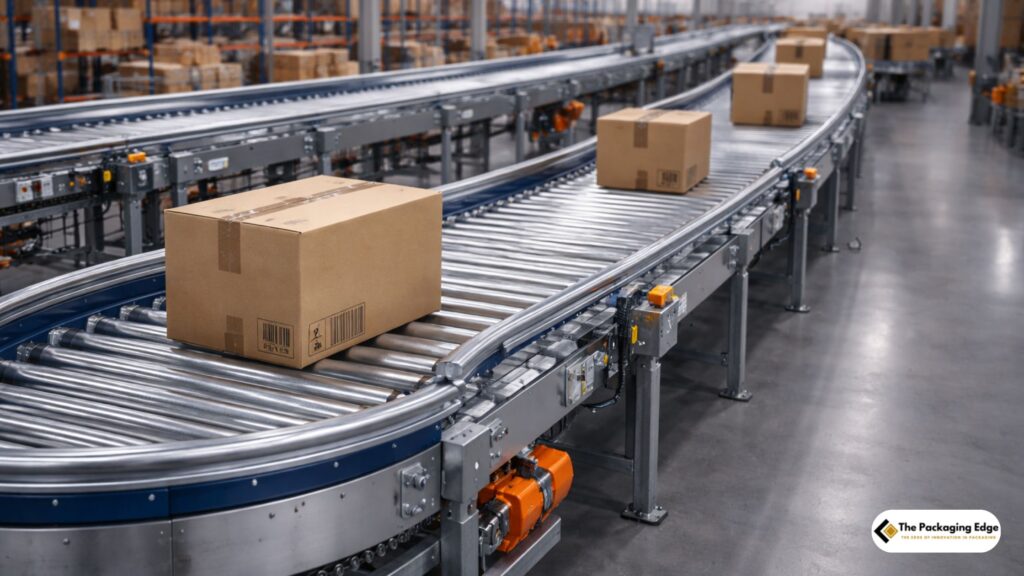
In today’s hyper-competitive global manufacturing, warehousing, and fulfillment landscape, efficiency is no longer optional—it is the foundation of profitability. Companies across industries are under constant pressure to move products faster, safer, and more accurately while controlling labor and operational costs. At the heart of this challenge lies one critical piece of infrastructure: the live roller conveyor.
A live roller conveyor is far more than a simple transport mechanism. When designed and implemented correctly, it becomes a strategic asset—one that increases throughput, reduces downtime, improves workplace safety, and scales seamlessly with business growth. When implemented poorly, however, it can become a bottleneck that drains productivity and capital.
As Senior Content Strategist and SEO Specialist for The Packaging Edge, this comprehensive guide is designed to help decision-makers, engineers, operations managers, and logistics professionals worldwide fully understand live roller conveyor systems—and how to deploy them for maximum return on investment.
This article goes far beyond surface-level explanations. You will gain practical insights, real-world applications, technical considerations, and strategic guidance, all while learning why The Packaging Edge is the trusted expert partner for conveyor solutions that actually deliver results.
What Is a Live Roller Conveyor?
A live roller conveyor—also referred to as a powered roller conveyor—is a conveyor system in which the rollers are driven by a motorized mechanism rather than gravity. Each roller (or groups of rollers) is powered, allowing products to move automatically along the conveyor path at controlled speeds.
Unlike gravity roller conveyors, live roller conveyors provide precise control over movement, accumulation, spacing, and direction of products. This makes them ideal for high-volume, automated, and complex material handling environments.
Key Components of a Live Roller Conveyor System
Understanding the anatomy of a live roller conveyor is essential to appreciating its capabilities:
-
Powered Rollers – Rollers are driven via belts, chains, or internal motors.
-
Drive Mechanism – Typically belt-driven, chain-driven, or motorized roller (MDR).
-
Frame Structure – Heavy-duty steel or aluminum frames provide durability and load support.
-
Control Systems – PLCs, sensors, and automation software regulate speed, accumulation, and routing.
-
Zones and Accumulation Sections – Enable zero-pressure or controlled accumulation to prevent product damage.
-
Side Guides and Supports – Maintain product alignment and stability.
When engineered properly, these components work together to deliver consistent, reliable, and intelligent product flow.
Live Roller Conveyor vs. Gravity Conveyor: Why Power Matters
One of the most common questions businesses ask is whether they truly need a live roller conveyor or if a gravity system will suffice.
Gravity Roller Conveyor: The Limitations
Gravity conveyors rely on slope and weight to move products. While they are cost-effective and simple, they come with serious limitations:
-
Inconsistent product movement
-
Limited control over speed and spacing
-
Risk of product collisions and damage
-
Not suitable for inclines, declines, or complex routing
-
Higher labor involvement
Live Roller Conveyor: The Strategic Advantage
A live roller conveyor system eliminates these constraints by offering:
-
Controlled movement regardless of product weight
-
Automated accumulation without product contact
-
Bidirectional flow and complex routing
-
Integration with automated systems
-
Improved safety and reduced labor costs
For operations prioritizing efficiency, scalability, and automation, the live roller conveyor is the clear winner.
Types of Live Roller Conveyors
Not all live roller conveyors are the same. Selecting the right type depends on load requirements, layout constraints, and operational goals.
1. Belt-Driven Live Roller Conveyor (BDLR)
This system uses belts to drive rollers and is ideal for:
-
Light to medium loads
-
Quiet operation
-
Clean environments
-
High-speed applications
2. Chain-Driven Live Roller Conveyor (CDLR)
Chain-driven systems are built for heavy-duty applications:
-
Pallet handling
-
Industrial manufacturing
-
High-impact loads
-
Rugged environments
3. Motorized Drive Roller (MDR) Conveyor
MDR systems place motors inside individual rollers:
-
Energy-efficient operation
-
Modular and scalable design
-
Advanced zone control
-
Lower maintenance requirements
At The Packaging Edge, we specialize in matching the correct live roller conveyor technology to your exact operational needs—ensuring performance without overengineering.
Key Benefits of Live Roller Conveyor Systems
A properly designed live roller conveyor delivers measurable advantages across your entire operation.
Increased Throughput and Productivity
By automating product movement and reducing manual handling, live roller conveyors significantly increase throughput. Products flow smoothly without interruption, even during peak demand.
Reduced Labor Costs
Automation reduces dependence on manual labor, allowing teams to focus on higher-value tasks while minimizing fatigue and injury risk.
Enhanced Product Protection
Controlled accumulation prevents collisions, tipping, and crushing—critical for fragile, high-value, or irregular products.
Improved Workplace Safety
Live roller conveyors eliminate manual pushing, lifting, and awkward movements, reducing workplace injuries and compliance risks.
Scalable and Flexible Design
As your operation grows, live roller conveyor systems can be expanded, reconfigured, or integrated with new technologies.
Common Applications of Live Roller Conveyors
Live roller conveyors are used across a wide range of industries worldwide.
Warehousing and Distribution Centers
-
Order fulfillment
-
Sortation and routing
-
Packing and shipping lines
-
Automated storage and retrieval systems (AS/RS)
Manufacturing Facilities
-
Assembly lines
-
Workstation feeding
-
Quality inspection zones
-
End-of-line packaging
E-Commerce and Retail Fulfillment
-
High-speed order processing
-
SKU accumulation
-
Returns handling
-
Automated packing stations
Food, Beverage, and Pharmaceutical
-
Controlled product movement
-
Hygienic conveyor designs
-
Temperature-sensitive environments
Regardless of industry, The Packaging Edge designs live roller conveyor solutions that align with your workflow, space, and compliance requirements.
Design Considerations for a High-Performance Live Roller Conveyor
One of the biggest mistakes companies make is treating live roller conveyors as off-the-shelf equipment. In reality, design customization is critical.
Load Characteristics
-
Product weight and dimensions
-
Package material (cartons, totes, pallets)
-
Load stability and center of gravity
Conveyor Speed and Throughput
-
Required units per hour
-
Integration with upstream/downstream equipment
-
Variable speed requirements
Accumulation Requirements
-
Zero-pressure vs. minimum-pressure accumulation
-
Product sensitivity
-
Buffer zones for peak loads
Facility Layout
-
Available floor space
-
Elevation changes
-
Turns, merges, and diverts
Controls and Automation Integration
-
PLC compatibility
-
Sensors and photo-eyes
-
Warehouse management systems (WMS)
At The Packaging Edge, our engineering-driven approach ensures every live roller conveyor system is purpose-built—not generic.
Maintenance and Longevity: Protecting Your Investment
A live roller conveyor is a long-term investment. Proper maintenance ensures optimal performance and minimizes downtime.
Preventive Maintenance Best Practices
-
Regular inspection of rollers and belts
-
Lubrication of chains and bearings
-
Sensor and control calibration
-
Electrical system checks
Common Maintenance Mistakes
-
Ignoring minor wear until failure
-
Using incorrect replacement parts
-
Poor documentation and training
Our team at The Packaging Edge provides maintenance guidance and system support to maximize equipment lifespan and ROI.
Energy Efficiency and Sustainability
Modern live roller conveyor systems are increasingly designed with sustainability in mind.
Energy-Saving Features
-
Motorized drive rollers with sleep modes
-
Zone-based activation
-
Low-friction roller designs
-
Smart controls
These features not only reduce energy consumption but also lower operating costs—an increasingly important factor for global operations.
Cost Considerations: What Influences Live Roller Conveyor Pricing?
Understanding cost drivers helps businesses make informed decisions.
Key Pricing Factors
-
Conveyor length and layout complexity
-
Load capacity requirements
-
Type of drive system
-
Control and automation level
-
Custom engineering needs
While initial costs may be higher than gravity systems, the long-term savings in labor, efficiency, and reduced damage often make live roller conveyors the more cost-effective solution.
Why Choosing the Right Partner Matters
A live roller conveyor is only as good as the expertise behind it. Poor design leads to bottlenecks, downtime, and wasted capital.
Why The Packaging Edge Is the Trusted Expert
-
Deep industry knowledge across applications
-
Engineering-led design approach
-
Custom solutions—not one-size-fits-all
-
Proven results in real-world operations
-
End-to-end support from concept to commissioning
At The Packaging Edge, we don’t just sell conveyor systems—we solve operational problems.
The Future of Live Roller Conveyor Technology
As automation and data-driven operations continue to evolve, live roller conveyors are becoming smarter:
-
AI-driven routing decisions
-
Predictive maintenance analytics
-
Seamless integration with robotics
-
IoT-enabled performance monitoring
Partnering with an experienced provider ensures your system is future-ready, not obsolete.
Final Thoughts: Turn Your Conveyor Into a Competitive Advantage
A live roller conveyor is not merely a piece of equipment—it is a strategic investment in efficiency, scalability, and operational excellence. When designed intelligently and implemented by experts, it transforms material handling from a cost center into a competitive advantage.
If your operation demands speed, accuracy, safety, and growth-readiness, the answer is clear. The Packaging Edge brings the expertise, engineering precision, and solution-driven mindset required to design live roller conveyor systems that actually perform in the real world.
Take the Next Step
Whether you’re upgrading an existing system or designing a new facility from the ground up, now is the time to work with experts who understand the full picture. Let The Packaging Edge help you engineer a smarter, faster, and more resilient operation.
Email us directly at thepackagingedge@gmail.com and start the conversation today. Your future-ready conveyor solution begins with the right partner—and that partner is The Packaging Edge.
Related Articles
- Automated Material Handling Systems: The Definitive Guide for Modern Packaging & Logistics
- Milk Powder Packaging Machine: The Definitive Guide for Manufacturers Seeking Efficiency, Quality, and Scale
- Automatic Tea Packing Machine: The Complete Buyer’s & Implementation Guide for Scalable Tea Packaging
- Plastic Wrapping Machine for Boxes: The Complete Global Buyer’s Guide to Faster, Safer, and Smarter Packaging
- Automatic Plastic Wrapping Machine: The Definitive Guide to Smarter, Faster, and More Profitable Packaging
- Carton Box Sealing Machine: The Complete Industrial Guide to Faster, Smarter, and More Reliable Packaging
- Automatic Box Packing Machine: The Definitive Guide to Smarter, Faster, and Scalable Packaging
- The Ultimate Guide to Choosing the Right Carton Box Packing Machine for Modern Packaging Operations
- Powered Roller Conveyor Systems: The Complete Expert Guide to Smarter, Faster, and More Reliable Material Handling
- Gravity Roller Conveyor Systems: The Ultimate Guide to Efficient, Scalable Material Handling