
By The Packaging Edge – Global Experts in Industrial Packaging & Conveying Solutions
Introduction: Why Heavy Duty Roller Conveyors Matter More Than Ever
In today’s high-demand industrial environment, efficiency is no longer a competitive advantage—it’s a requirement for survival. Manufacturing plants, distribution centers, warehouses, ports, and packaging facilities across the globe are under constant pressure to move heavier loads, faster, safer, and with fewer interruptions. At the heart of this challenge lies one critical piece of infrastructure: the heavy duty roller conveyor.
A heavy duty roller conveyor is not simply a means of moving products from point A to point B. It is a core operational asset that directly impacts productivity, worker safety, maintenance costs, throughput capacity, and long-term profitability. When designed and implemented correctly, it becomes a silent workhorse—reliable, durable, and capable of handling extreme loads day in and day out. When chosen poorly, it becomes a bottleneck, a safety hazard, and a constant drain on resources.
At The Packaging Edge, we work with organizations worldwide that face these exact challenges. From overloaded manual systems to aging conveyors that no longer meet operational demands, we’ve seen how the right heavy duty roller conveyor solution can transform entire operations.
This comprehensive guide is designed to give you everything you need to understand, select, and optimize a heavy duty roller conveyor system—while showing why The Packaging Edge is the expert partner trusted by industries around the world.
What Is a Heavy Duty Roller Conveyor?
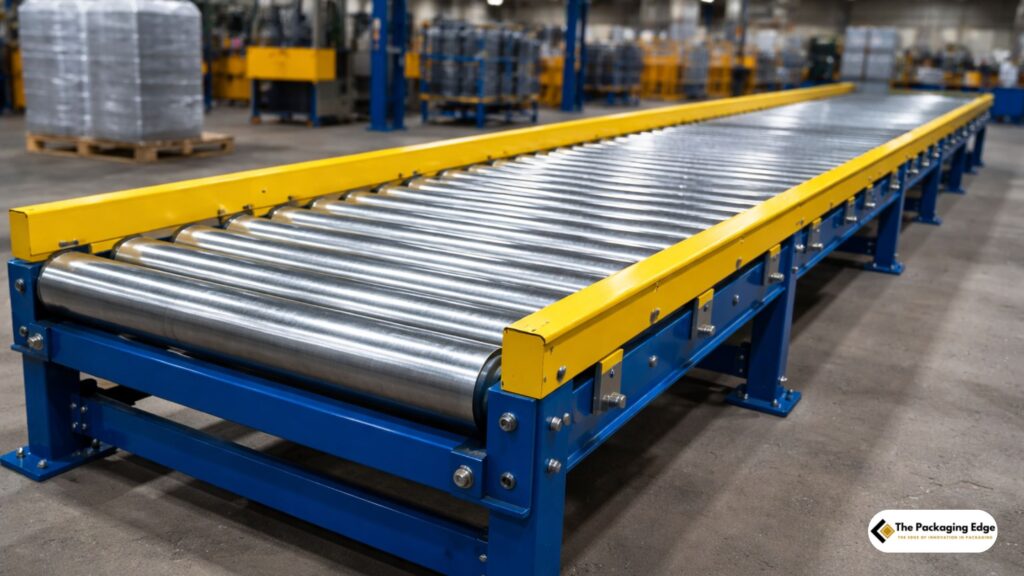
A heavy duty roller conveyor is an industrial material handling system engineered to transport extremely heavy loads—often ranging from several hundred kilograms to multiple tons—across short or long distances. Unlike light-duty or medium-duty conveyors, these systems are built with reinforced frames, large-diameter rollers, high-load bearings, and robust drive mechanisms designed to withstand continuous operation in harsh environments.
Key Characteristics of Heavy Duty Roller Conveyors
- High load capacity (often 1,000 kg per roller or more)
- Reinforced steel frames for structural integrity
- Large-diameter rollers for smooth, stable movement
- Precision bearings to reduce friction and wear
- Modular or custom-built designs
- Compatibility with automated systems
Heavy duty roller conveyors can be either gravity-driven or powered, depending on the application. They are commonly used to move pallets, crates, drums, metal components, industrial packaging, and oversized products.
How Heavy Duty Roller Conveyors Work
Understanding how a heavy duty roller conveyor functions helps clarify why quality design and engineering are non-negotiable.
Gravity Heavy Duty Roller Conveyors
Gravity-based systems rely on a slight incline or manual force to move products. While simple, gravity conveyors must be precisely engineered to ensure controlled movement, especially when handling heavy loads.
Best suited for:
- Short-distance transport
- Low-energy environments
- Manual or semi-automated operations
Powered Heavy Duty Roller Conveyors
Powered systems use motors, chains, belts, or line-shaft drives to move loads consistently and safely. These conveyors are ideal for high-throughput facilities where precision, speed, and automation are required.
Best suited for:
- High-volume operations
- Automated packaging and sorting lines
- Long-distance transport
- Integration with robotics and warehouse management systems
At The Packaging Edge, we evaluate load weight, product dimensions, throughput requirements, and environmental conditions to determine the ideal configuration for each client.
Industries That Depend on Heavy Duty Roller Conveyors
Heavy duty roller conveyors are essential across a wide range of industries. Their versatility and strength make them indispensable wherever heavy or bulky products must be moved efficiently.
Manufacturing
From automotive components to heavy machinery parts, manufacturers rely on heavy duty roller conveyors to move raw materials, subassemblies, and finished goods between workstations.
Warehousing & Distribution
High-capacity pallet handling is a daily reality in modern distribution centers. Heavy duty roller conveyor systems support inbound receiving, order fulfillment, pallet accumulation, and outbound shipping.
Packaging & End-of-Line Systems
Packaging operations demand precision and durability. Heavy duty conveyors ensure stable movement of packaged goods, stretch-wrapped pallets, and bulk containers through labeling, wrapping, and inspection stations.
Logistics & Freight Handling
Ports, freight terminals, and logistics hubs use heavy duty roller conveyors to manage oversized loads, crates, and containers efficiently.
Steel, Mining & Heavy Industry
In extreme environments, conveyors must resist impact, abrasion, dust, and temperature fluctuations—conditions where standard conveyors simply fail.
Key Benefits of Heavy Duty Roller Conveyor Systems
Investing in a heavy duty roller conveyor delivers measurable, long-term advantages.
1. Increased Throughput
By automating the movement of heavy loads, facilities eliminate delays caused by forklifts or manual handling, dramatically improving throughput.
2. Enhanced Worker Safety
Manual handling of heavy products is a leading cause of workplace injuries. Heavy duty roller conveyors reduce lifting, pushing, and carrying—protecting employees and lowering insurance costs.
3. Operational Consistency
Unlike manual systems, conveyors deliver consistent performance regardless of shift changes, workforce availability, or fatigue.
4. Reduced Maintenance Costs
High-quality heavy duty conveyors are built to last. With proper design and materials, maintenance requirements are minimal compared to repeated repairs on under-engineered systems.
5. Scalability and Future-Proofing
Modular heavy duty roller conveyor systems can be expanded or reconfigured as business needs evolve—an approach The Packaging Edge strongly recommends.
Critical Design Considerations When Choosing a Heavy Duty Roller Conveyor
Not all heavy duty roller conveyors are created equal. Selecting the wrong system can be costly. Here are the most important factors to evaluate.
Load Weight and Distribution
Understanding both static and dynamic load requirements is essential. Uneven loads require closer roller spacing and higher-capacity bearings.
Roller Diameter and Material
Larger diameters distribute weight more effectively. Common materials include:
- Carbon steel
- Galvanized steel
- Stainless steel (for corrosive environments)
Frame Construction
A heavy duty roller conveyor frame must resist bending and torsion under continuous load. The Packaging Edge designs frames using reinforced steel channels tailored to each application.
Drive Mechanism
Options include:
- Chain-driven rollers
- Belt-driven systems
- Line-shaft drives
Each has advantages depending on speed, noise tolerance, and maintenance preferences.
Environmental Conditions
Dust, moisture, heat, cold, and chemicals all impact conveyor longevity. Our engineering team accounts for these factors from the start.
Custom vs. Standard Heavy Duty Roller Conveyors
While off-the-shelf solutions may appear cost-effective, they often fall short in real-world industrial settings.
Standard Systems: Pros and Cons
Pros:
- Lower initial cost
- Faster delivery
Cons:
- Limited load capacity
- Poor fit with existing layouts
- Higher long-term maintenance
Custom Heavy Duty Roller Conveyors
Custom systems are engineered to match your exact operational needs—load size, flow direction, integration points, and future expansion.
At The Packaging Edge, we specialize in custom heavy duty roller conveyor solutions that maximize ROI and minimize operational risk.
Integration with Automation and Smart Facilities
Modern facilities demand more than basic material movement. Heavy duty roller conveyors are increasingly integrated with:
- PLC control systems
- Warehouse Management Systems (WMS)
- Automated Guided Vehicles (AGVs)
- Robotics and palletizers
- IoT-based monitoring
These integrations enable real-time tracking, predictive maintenance, and adaptive workflows—capabilities The Packaging Edge incorporates into advanced conveyor designs.
Common Problems and How the Right Conveyor Solves Them
Bottlenecks and Congestion
Poor conveyor design leads to product accumulation and downtime. Proper roller spacing and zone control eliminate these issues.
Equipment Failure Under Load
Under-engineered conveyors fail prematurely. Heavy duty roller conveyors from The Packaging Edge are designed with generous safety margins.
Excessive Maintenance
Low-quality bearings and rollers increase downtime. We specify industrial-grade components proven in high-load environments.
Limited Flexibility
Fixed systems become obsolete. Modular designs ensure adaptability.
Why The Packaging Edge Is the Global Authority in Heavy Duty Roller Conveyors
Choosing the right partner is just as important as choosing the right equipment.
Deep Industry Expertise
We bring years of hands-on experience across manufacturing, logistics, packaging, and heavy industry.
Engineering-First Approach
Every heavy duty roller conveyor we deliver is engineered—not guessed—based on real operational data.
Global Perspective
Serving clients worldwide gives us insight into diverse regulations, environments, and operational challenges.
End-to-End Solutions
From consultation and design to manufacturing, installation, and support, The Packaging Edge delivers complete solutions.
Long-Term ROI: The Business Case for Heavy Duty Roller Conveyors
A well-designed heavy duty roller conveyor system pays for itself through:
- Reduced labor costs
- Fewer injuries and claims
- Increased throughput
- Lower maintenance expenses
- Extended equipment lifespan
When evaluated over its lifecycle, a premium system delivers far greater value than low-cost alternatives.
Frequently Asked Questions About Heavy Duty Roller Conveyors
How much weight can a heavy duty roller conveyor handle?
Depending on design, systems can handle anywhere from 1,000 kg per roller to several tons per section.
Are heavy duty roller conveyors suitable for outdoor use?
Yes—when properly engineered with corrosion-resistant materials and weather protection.
Can existing systems be upgraded?
Absolutely. The Packaging Edge often retrofits or upgrades existing conveyors to meet new demands.
Final Thoughts: Invest in Strength, Reliability, and Expertise
A heavy duty roller conveyor is more than equipment—it is an investment in operational excellence. The right system eliminates inefficiencies, protects workers, and supports long-term growth. The wrong system creates ongoing problems that erode profits and productivity.
At The Packaging Edge, we don’t just sell conveyors—we solve material handling challenges. Our team works closely with you to design heavy duty roller conveyor systems that perform under pressure, adapt to change, and deliver measurable results.
Take the Next Step
If your operation demands strength, reliability, and expert engineering, now is the time to act. Partner with The Packaging Edge and experience the difference a properly designed heavy duty roller conveyor can make.
Email us directly at thepackagingedge@gmail.com to discuss your requirements and begin building a conveyor solution that works as hard as your business does.
The Packaging Edge – Engineering the Future of Heavy-Duty Material Handling Worldwide.
Related Articles
- Live Roller Conveyor Systems: The Definitive Guide for High-Performance Material Handling
- Automated Material Handling Systems: The Definitive Guide for Modern Packaging & Logistics
- Milk Powder Packaging Machine: The Definitive Guide for Manufacturers Seeking Efficiency, Quality, and Scale
- Automatic Tea Packing Machine: The Complete Buyer’s & Implementation Guide for Scalable Tea Packaging
- Plastic Wrapping Machine for Boxes: The Complete Global Buyer’s Guide to Faster, Safer, and Smarter Packaging
- Automatic Plastic Wrapping Machine: The Definitive Guide to Smarter, Faster, and More Profitable Packaging
- Carton Box Sealing Machine: The Complete Industrial Guide to Faster, Smarter, and More Reliable Packaging
- Automatic Box Packing Machine: The Definitive Guide to Smarter, Faster, and Scalable Packaging
- The Ultimate Guide to Choosing the Right Carton Box Packing Machine for Modern Packaging Operations
- Powered Roller Conveyor Systems: The Complete Expert Guide to Smarter, Faster, and More Reliable Material Handling