
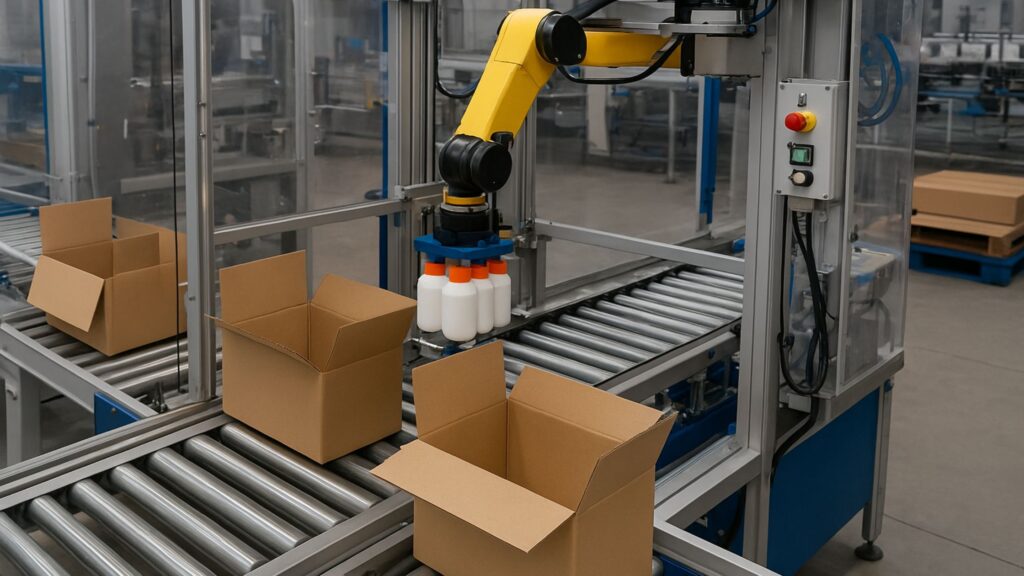
In today’s global manufacturing and fulfillment landscape, the pressure to package products faster, safer, and more cost-effectively is at an all-time high. From food and beverage to pharmaceuticals, consumer goods, and e-commerce operations, companies are searching for ways to eliminate bottlenecks, reduce labor dependency, and improve packaging consistency. One solution continues to lead the charge: the automatic case packing machine.
Yet, understanding which machine you need—and how to optimize its ROI—is far more complex than comparing technical specs. That’s why industry-leading teams worldwide turn to The Packaging Edge, where our experts help businesses not only adopt automation, but use it to transform their entire packaging workflow.
This comprehensive guide will help you understand automatic case packing machines at a practical, operational level. You’ll learn what they are, how they work, their different types, the advantages they offer, how to choose one, and the real factors that determine whether the investment will pay off.
Let’s get into it.
What Is an Automatic Case Packing Machine?
An automatic case packing machine is a packaging system designed to load products into cases, cartons, or boxes with minimal or zero manual labor. These machines streamline the final stage of packaging—where individual units, multipacks, or product bundles are placed into a shipping-ready case.
At its core, an automatic case packer:
-
Forms or accepts preformed cases
-
Orients and arranges the product
-
Places the product into the case
-
Seals or prepares the case for downstream processes
While the description sounds simple, modern automatic case packers are highly sophisticated, integrating robotics, sensors, servo motors, machine vision, and advanced programming to ensure speed and flawless precision.
Why Automatic Case Packing Machine Matters More Now Than Ever
Global production environments are experiencing unprecedented shifts:
-
Labor shortages in manufacturing and distribution
-
Rising wages and long-term labor cost increases
-
Demand spikes due to e-commerce and rapid fulfillment expectations
-
Packaging waste regulations and sustainability pressures
-
Quality control demands from retailers and customers
The result? Companies must do more with less. They need packaging reliability, scalability, and cost stability—and automation is the most direct path.
That’s why automatic case packing machines have moved from “nice-to-have” to “non-negotiable” in efficient operations.
How an Automatic Case Packing Machine Works (Step-by-Step)
Although systems vary, most automatic case packers follow a similar operational flow. Below is a breakdown of the typical workflow.
1. Case Forming or Feeding
Depending on the system:
-
The packer forms flat corrugated blanks into cases,
or -
It accepts preformed cases delivered via conveyor or automation.
Robotic or mechanical arms guide the case into place and secure the bottom seal.
2. Product Handling and Orientation
Products enter the machine from upstream processes such as cartoners, fillers, or flow wrappers. The packer:
-
Aligns products
-
Groups them into configured patterns
-
Orients them to maximize packaging stability
This stage relies heavily on servo-driven components and machine vision for accuracy.
3. Case Loading
This is where automation truly shines. Depending on the packer type, the system:
-
Drops product into the case
-
Pushes product (side-load) into the case
-
Picks and places product using robotic arms
Each method suits different industries and product styles.
4. Sealing and Output
Finally, the packer closes and seals the case using:
-
Tape
-
Hot-melt glue
-
Stapling (less common in modern facilities)
The sealed case is then discharged to palletizing or other downstream equipment.
At production speeds of 10, 20, 50, or over 100 cases per minute, these machines significantly outperform manual workflows.
Types of Automatic Case Packing Machines
Choosing the right packer requires understanding the fundamental machine categories. Below are the most common types used worldwide.
1. Top-Load Automatic Case Packers
Top-load case packers place products from above into an erected case. They are ideal for:
-
Bags and pouches
-
Jars
-
Bottles
-
Bakery products
-
Confectionery
-
Frozen foods
Advantages
-
Gentle product handling
-
Great for odd-shaped or delicate goods
-
Flexible changeovers
-
Compatible with robotics (pick-and-place arms)
Best For
Food, beverage, consumer packaged goods.
2. Side-Load Automatic Case Packers
Side-load case packers push products horizontally into the case. They’re best suited for:
-
Cartons
-
Multipacks
-
Rigid containers
-
Boxes
Advantages
-
Fast cycle speeds
-
Excellent for uniform product shapes
-
Highly stable pack patterns
Best For
Dairy products, cosmetics, pharmaceuticals, tobacco, dry goods.
3. Wrap-Around Case Packers
These packers wrap corrugated material around the products, reducing material waste.
Advantages
-
Material savings
-
High-speed capabilities
-
Case strength improvements
Best For
Beverage multipacks, food trays, household products.
4. Robotic Automatic Case Packing Machines
These systems use advanced robotics for maximum flexibility.
Advantages
-
Exceptionally fast changeovers
-
Handles diverse products, shapes, and patterns
-
Integrates vision systems for accuracy
-
Minimal downtime
Best For
Companies with multiple SKUs or variable packaging demands.
5. Pick-and-Place Case Packers
Often robotic, these machines pick products via suction, claws, or grippers and place them neatly into cases.
Advantages
-
Extremely gentle handling
-
Excellent for irregular or premium products
-
Precision placement
Best For
Fragile products, glass items, cosmetics, electronics.
Top Benefits of Using an Automatic Case Packing Machine
Why are companies across the globe investing in automation? Below are the most significant ROI-driving advantages.
1. Massive Labor Cost Reduction
Manual case packing is labor-intensive. With an automatic case packing machine, you can:
-
Reduce headcount
-
Reallocate labor to higher-value tasks
-
Minimize staffing challenges
-
Stabilize production regardless of workforce fluctuations
In many cases, companies see a full ROI in under 12–24 months.
2. Consistent, High-Speed Production
Automation eliminates human limitations like fatigue, distraction, or inconsistencies. The result is:
-
Predictable throughput
-
Reduced errors
-
Lower downtime
-
Faster order fulfillment
This is especially critical for industries with strict retailer compliance, such as big-box retail or large grocery distributors.
3. Improved Packaging Quality
Automated systems reduce:
-
Missed counts
-
Damaged products
-
Poor sealing
-
Improper orientation
-
Case deformation
With machine precision, every case is packaged the same way—helping brands maintain quality and customer trust.
4. Lower Operational Costs
Beyond labor, automation reduces waste and operating expenses:
-
Less damaged inventory
-
Lower corrugated material usage
-
Fewer mistakes leading to chargebacks
-
Minimized rework
These savings compound quickly, especially in high-volume environments.
5. Greater Packaging Throughput and Scalability
When your business grows, manual packing becomes a bottleneck. Automatic case packers scale with demand and allow:
-
Increased daily output
-
Extended shifts with minimal added cost
-
Multi-line integration
-
Global supply chain compatibility
This makes automation not just a cost decision—but a growth strategy.
6. Enhanced Worker Safety
Manual packing often involves:
-
Repetitive strain
-
Heavy lifting
-
Fatigue-related injuries
-
Motion hazards
Automated case packing significantly reduces these risks, improving workplace safety metrics and reducing insurance costs.
When Should a Company Invest in an Automatic Case Packing Machine?
Automation is not just for large enterprises. Companies of all sizes can benefit. You should consider investing if any of the following apply:
-
Labor shortages are disrupting production
-
Your packaging team struggles to keep up with upstream processes
-
You’re expanding product lines or SKUs
-
You’re aiming to reduce per-unit packaging costs
-
Order volumes have increased significantly
-
You plan to scale to new markets
-
You face retailer compliance penalties
If your team is missing production targets, the bottleneck often isn’t the product line—it’s the packaging line.
How to Choose the Right Automatic Case Packing Machine
This is where many companies make costly mistakes. Choosing the wrong machine can cause downtime, low efficiency, and expensive retrofits.
Below are the essential factors every global manufacturer must consider.
1. Product and Case Types
Are your products:
-
Rigid or flexible?
-
Heavy or lightweight?
-
Fragile or durable?
-
Uniform or variable?
Your product characteristics directly dictate the type of case packer you need.
2. Speed and Throughput Requirements
Define both:
-
Current output needs
-
Future projected throughput
Scalability is essential. A machine should support long-term growth, not only immediate goals.
3. Footprint and Facility Layout
Some packers require larger footprints. Robotics, however, may reduce required space.
Consider:
-
Conveyor placement
-
Palletizing integration
-
Aisle requirements
-
Facility power and utilities
A proper layout analysis is critical—something The Packaging Edge routinely handles for clients.
4. Changeover Needs
If you package multiple SKUs, prioritize:
-
Tool-less changeovers
-
Robotic flexibility
-
Servo adjustments
-
Recipe-based programming
Frequent downtime can erase automation gains quickly.
5. Integration with Upstream & Downstream Equipment
Your case packer must seamlessly align with:
-
Fillers
-
Cartoners
-
Wrappers
-
Labelers
-
Conveyors
-
Palletizers
This ensures a continuous packaging flow with low risk of jams or stoppages.
6. Material Compatibility
Will you use:
-
RSC cases?
-
Wrap-around blanks?
-
Retail-ready packaging?
-
Eco-friendly corrugated options?
Material evaluation is one of the most overlooked aspects of case packer selection.
7. Maintenance, Service, and Support
Automated equipment requires:
-
Reliable parts availability
-
Technician support
-
Preventive maintenance routines
Working with experts—like the engineering and advisory team at The Packaging Edge—ensures long-term machine performance.
Common Mistakes Companies Make When Buying an Automatic Case Packing Machine
Before investing, make sure you avoid these costly errors:
1. Underestimating Future Throughput
A machine that meets today’s needs may be too slow in 12–18 months.
2. Overlooking Product Variability
Different product shapes or sizes can drastically affect machine compatibility.
3. Failing to Evaluate Case Quality
Low-quality corrugated material can lead to jams, seal failures, and damage.
4. Ignoring Maintenance Requirements
Not all machines are equal—some require more frequent servicing.
5. Choosing the Cheapest Option
Lower upfront cost often results in:
-
Higher total cost of ownership
-
More downtime
-
Complicated changeovers
-
Poor performance
Partnering with automation experts prevents these pitfalls.
ROI: What You Can Expect from an Automatic Case Packing Machine
The ROI of an automatic case packing machine typically comes from:
-
Labor savings
-
Increased throughput
-
Reduced rework and waste
-
Consistent case integrity
-
Fewer product returns and damages
-
Reduced safety incidents
On average, businesses can expect:
-
ROI in 12–24 months for most high-volume operations
-
30–60% labor savings depending on previous workflow
-
20–40% throughput increase in optimized environments
For companies undergoing rapid expansion, ROI can accelerate even faster.
Automatic Case Packing Machine Sustainability and Environmental Impact
Automatic case packers significantly reduce waste by:
-
Optimizing case fill
-
Minimizing corrugated material usage
-
Reducing product damage
-
Ensuring proper sealing
-
Supporting eco-friendly case formats
Many global brands use automation specifically to meet sustainability goals. Whether you’re reducing CO₂ emissions, minimizing packaging scrap, or improving recyclability, case packers make meaningful contributions to greener operations.
Automatic Case Packing Machine Trends to Watch and Beyond
Automation is evolving rapidly. Here are key trends shaping the industry:
1. Robotics-Heavy Case Packing
Robots are becoming the standard for versatility and efficiency.
2. AI and Machine Vision
Intelligent case packers adjust automatically to product changes and detect defects.
3. Modular and Compact Systems
Smaller factories demand compact, modular solutions.
4. Eco-Friendly Packaging Compatibility
Machine designs now adapt to reduced-material or recyclable case styles.
5. Seamless Line Integration
Manufacturers expect interoperability across different brands of machinery—something The Packaging Edge helps optimize.
Why Partner with The Packaging Edge for Your Automatic Case Packing Machine?
When choosing an automatic case packing machine, the real challenge isn’t the purchase—it’s making the right strategic decision.
That’s where The Packaging Edge stands out.
We help global companies:
-
Evaluate packaging workflows
-
Identify bottlenecks
-
Recommend the correct machine type
-
Optimize case design for automation
-
Integrate upstream and downstream systems
-
Engineer facility layouts
-
Implement sustainable packaging solutions
-
Forecast ROI and cost savings
-
Support equipment long after installation
Our team brings over a decade of hands-on industry experience, working with manufacturers, distributors, and brands worldwide.
Automation is complex—but with the right guidance, it becomes a game-changing competitive advantage.
Final Thoughts: Automatic Case Packing Machine
An automatic case packing machine is more than a piece of equipment—it’s a foundation for long-term operational excellence. Whether your goals are to reduce costs, stabilize labor, improve quality, or scale globally, automatic case packing is one of the most impactful investments you can make.
But choosing the right solution requires expertise, honest evaluation, and strategic insight. That’s where The Packaging Edge comes in.
We guide businesses through every step of the journey—from machine selection to integration, optimization, and long-term performance.
Ready to Transform Your Packaging Operations?
The journey to truly optimized packaging starts with an honest assessment.
Take the first step toward optimizing your packaging strategy today by reaching out to the experts at The Packaging Edge.
Email us directly at thepackagingedge@gmail.com.
Related Articles
- Bag in Bag Sachet Packaging Machine: The Complete Guide for Efficiency-Driven Brands
- Automatic Carton Packing Machine – The Future of Packaging Efficiency
- Case Packer Machine Solutions for Modern Packaging Lines
- Food Shrink Wrap Machine: The Ultimate Guide to Boosting Shelf Life, Hygiene & Branding
- Cookie Packaging Machine: The Complete Guide for Bakeries & Food Brands
- Candy Wrapping Machine: The Complete Guide to Efficiency, Quality & Growth
- Pallet Stretch Wrap Machine | Secure & Efficient Wrapping
- Bottle Packing Machine: The Ultimate Guide to Efficiency, Speed & Precision
- Commercial Shrink Wrap Machine: The Ultimate Guide to Choosing the Best Equipment for Your Business
- Liquid Packing Machine | High-Performance Packaging Solutions