
In today’s hyper-competitive global manufacturing and distribution landscape, efficiency is not a luxury—it’s a requirement. Whether you operate a high-volume distribution center, a heavy-duty manufacturing facility, or a fast-growing eCommerce fulfillment operation, your ability to move products reliably, safely, and cost-effectively can define your success.
At the heart of many high-performing facilities is a proven material handling solution: the chain driven live roller conveyor.
This in-depth guide is designed to be the most comprehensive, practical, and solution-oriented resource available on chain driven live roller conveyor systems. Drawing on real-world engineering principles and operational experience, this article will help you understand how these conveyors work, where they excel, how they compare to alternatives, and—most importantly—how to deploy them strategically to maximize ROI.
As a Senior Content Strategist and SEO Specialist for The Packaging Edge, our goal is not just to inform, but to empower decision-makers worldwide with clarity, confidence, and a trusted partner for execution.
Table of Contents
-
What Is a Chain Driven Live Roller Conveyor?
-
How a Chain Driven Live Roller Conveyor Works
-
Core Components Explained
-
Why Chain Driven Live Roller Conveyors Dominate Heavy-Duty Applications
-
Chain Driven Live Roller Conveyor vs Other Conveyor Types
-
Key Industries That Rely on Chain Driven Live Roller Conveyors
-
Design Considerations for Maximum Performance
-
Common Applications in Modern Facilities
-
Maintenance, Reliability, and Lifecycle Value
-
Safety and Compliance Considerations
-
Customization and System Integration
-
Cost, ROI, and Long-Term Value
-
Why The Packaging Edge Is the Authority in Chain Driven Live Roller Conveyor Solutions
-
Final Thoughts and Call to Action
1. What Is a Chain Driven Live Roller Conveyor?
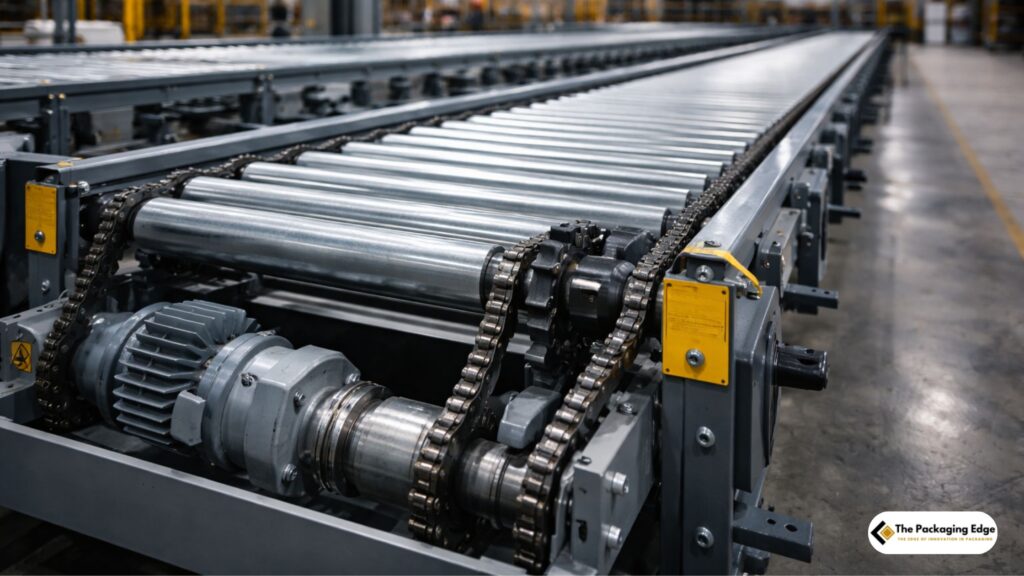
A chain driven live roller conveyor, often abbreviated as CDLR conveyor, is a powered conveyor system designed to transport heavy loads using rollers that are mechanically driven by chains connected to a motorized drive.
Unlike gravity conveyors, where products move due to slope and momentum, a chain driven live roller conveyor provides positive, controlled movement. This makes it ideal for handling heavy pallets, drums, totes, and industrial products that demand consistency, precision, and durability.
Key defining characteristics include:
-
Powered rollers driven by chains
-
Ability to handle extremely heavy loads
-
Consistent speed control
-
Zoned or continuous operation
-
High torque capability
Because of these attributes, chain driven live roller conveyor systems are widely used in industrial material handling, pallet conveying, accumulation lines, and automated logistics environments worldwide.
2. How a Chain Driven Live Roller Conveyor Works
Understanding how a chain driven live roller conveyor operates is essential for selecting, designing, and maintaining the right system.
At its core, the system functions through mechanical power transmission:
-
Motor and Gear Reducer
An electric motor, often paired with a gear reducer, provides rotational energy at a controlled speed and torque. -
Drive Shaft
The motor turns a drive shaft that runs perpendicular to the conveyor flow. -
Chains and Sprockets
Chains connect the drive shaft to individual rollers using sprockets mounted on each roller. -
Live Rollers
As the chains rotate, they turn the rollers, actively driving the load forward.
This mechanical linkage ensures that all driven rollers move together, delivering uniform force across the load. This is what allows chain driven live roller conveyors to handle loads that would overwhelm belt-driven or line-shaft systems.
3. Core Components Explained
A well-engineered chain driven live roller conveyor system is more than just chains and rollers. Each component plays a critical role in performance and longevity.
Rollers
-
Heavy-wall steel rollers
-
Precision bearings for smooth rotation
-
Sprocketed rollers designed for chain engagement
Chains
-
Typically ANSI roller chains
-
Sized based on load weight and duty cycle
-
Designed for long-term wear resistance
Frame
-
Structural steel or formed channel
-
Engineered to resist deflection under load
-
Often powder-coated or galvanized for corrosion resistance
Drive Assembly
-
Electric motor (AC or DC)
-
Gear reducer matched to load requirements
-
Shafting and mounting hardware
Controls
-
Simple on/off operation or advanced PLC integration
-
Photo-eyes, sensors, and accumulation logic
-
Safety interlocks and emergency stops
At The Packaging Edge, every chain driven live roller conveyor is engineered as a complete system—not a collection of parts.
4. Why Chain Driven Live Roller Conveyors Dominate Heavy-Duty Applications
When it comes to moving heavy, awkward, or high-value products, few systems match the reliability of a chain driven live roller conveyor.
Superior Load Capacity
Chain driven live roller conveyors are designed to move:
-
Loaded pallets
-
Steel drums
-
Engine blocks
-
Large totes
-
Industrial containers
Loads exceeding several thousand pounds per zone are common.
Consistent Torque Delivery
Unlike belt-driven systems that can slip under heavy loads, chain drives deliver positive mechanical engagement, ensuring consistent motion even at startup.
Durability in Harsh Environments
These conveyors thrive in:
-
Dusty manufacturing plants
-
Cold storage facilities
-
High-temperature environments
-
High-cycle industrial operations
Precision and Control
With proper controls, chain driven live roller conveyors allow:
-
Zero-pressure accumulation
-
Zoned conveying
-
Controlled indexing
-
Integration with robotics and automation
This combination of strength and control explains why CDLR conveyors remain a cornerstone of industrial material handling worldwide.
5. Chain Driven Live Roller Conveyor vs Other Conveyor Types
Choosing the right conveyor system requires understanding the trade-offs.
Chain Driven Live Roller vs Gravity Roller Conveyor
| Feature | CDLR Conveyor | Gravity Conveyor |
|---|---|---|
| Power | Powered | Non-powered |
| Load Capacity | Very high | Moderate |
| Control | Excellent | Limited |
| Accumulation | Yes | Limited |
| Cost | Higher | Lower |
Chain Driven Live Roller vs Belt Driven Live Roller
-
CDLR conveyors excel in heavy-duty applications.
-
Belt driven live roller conveyors are quieter and better for lighter loads.
Chain Driven Live Roller vs Line Shaft Conveyor
Line shaft systems are cost-effective for light packages but struggle with heavy or uneven loads, where CDLR conveyors shine.
At The Packaging Edge, we help clients choose the right system—not the most expensive one.
6. Key Industries That Rely on Chain Driven Live Roller Conveyors
Chain driven live roller conveyor systems are used globally across diverse industries:
Manufacturing
-
Automotive
-
Heavy equipment
-
Metal fabrication
-
Appliance production
Warehousing & Distribution
-
Pallet handling
-
Shipping and receiving
-
Sortation lines
Food & Beverage (Secondary Packaging)
-
Case and pallet movement
-
End-of-line automation
eCommerce Fulfillment
-
Heavy carton accumulation
-
Automated pallet transfer
Logistics & 3PL Operations
-
High-throughput pallet flow
-
Cross-docking systems
Regardless of geography or industry, the demand for rugged, scalable conveying solutions continues to grow.
7. Design Considerations for Maximum Performance
A chain driven live roller conveyor system is only as good as its design.
Load Characteristics
-
Weight
-
Size
-
Bottom surface condition
-
Center of gravity
Conveyor Speed
-
Matching upstream and downstream equipment
-
Operator safety
-
Throughput requirements
Roller Spacing
-
Ensures load stability
-
Prevents sagging or tipping
Chain Size and Configuration
-
Single strand vs double strand
-
Duty cycle considerations
Environmental Factors
-
Temperature
-
Dust
-
Moisture
-
Chemical exposure
At The Packaging Edge, we approach every project with an engineering-first mindset to ensure real-world performance.
8. Common Applications in Modern Facilities
Chain driven live roller conveyors are incredibly versatile.
Pallet Accumulation Systems
Enable controlled buffering without product damage.
Transfer Stations
Integrate seamlessly with:
-
Turntables
-
Transfers
-
AGVs
-
AS/RS systems
Assembly Line Conveying
Support staged assembly processes with precise indexing.
Shipping and Receiving Lines
Handle inbound and outbound pallet traffic efficiently.
Automated Packaging Lines
Synchronize product flow from packaging to palletizing.
9. Maintenance, Reliability, and Lifecycle Value
One of the most overlooked advantages of a chain driven live roller conveyor is its predictable maintenance profile.
Routine Maintenance
-
Chain lubrication
-
Tension checks
-
Bearing inspections
Long Service Life
Properly maintained CDLR conveyors can operate reliably for decades.
Ease of Repair
-
Individual components can be replaced
-
No complex belt tracking issues
-
Minimal downtime
From a total cost of ownership perspective, chain driven live roller conveyors deliver exceptional long-term value.
10. Safety and Compliance Considerations
Safety is non-negotiable in modern facilities.
Chain driven live roller conveyor systems can be designed to meet or exceed global safety standards, including:
-
Emergency stop circuits
-
Guarding for chains and sprockets
-
Lockout/tagout provisions
-
Sensor-based accumulation logic
The Packaging Edge integrates safety from the earliest design phase—not as an afterthought.
11. Customization and System Integration
No two facilities are identical. That’s why customization matters.
Custom Frame Widths and Lengths
Optimized for your product mix and layout.
Zoned Control Logic
Supports:
-
Zero-pressure accumulation
-
Sequencing
-
Release control
Integration with Automation
-
Robotics
-
PLCs
-
Warehouse management systems
-
Vision systems
As a solutions-focused partner, The Packaging Edge specializes in conveyor systems that fit your operation—not the other way around.
12. Cost, ROI, and Long-Term Value
While a chain driven live roller conveyor may have a higher upfront cost than lighter-duty systems, the return on investment is compelling.
Reduced Downtime
-
Fewer breakdowns
-
Consistent performance under load
Increased Throughput
-
Faster cycle times
-
Predictable flow
Lower Maintenance Costs
-
Durable components
-
Straightforward servicing
When evaluated over its lifecycle, a properly designed chain driven live roller conveyor often proves to be the most cost-effective choice.
13. Why The Packaging Edge Is the Authority in Chain Driven Live Roller Conveyor Solutions
At The Packaging Edge, we don’t just sell conveyors—we deliver engineered material handling solutions.
What Sets Us Apart
-
Deep expertise in chain driven live roller conveyor systems
-
Practical, application-driven design approach
-
Commitment to long-term performance
-
Worldwide project experience
-
Responsive, knowledgeable support
Our clients trust us because we focus on solving problems, not pushing products.
14. Final Thoughts and Call to Action
A chain driven live roller conveyor is more than a piece of equipment—it’s a strategic investment in operational efficiency, safety, and scalability. When designed and implemented correctly, it becomes the backbone of a high-performing facility.
If you’re evaluating a new conveyor system, upgrading an existing line, or planning a fully automated material handling solution, the expertise behind the design matters just as much as the hardware itself.
That’s where The Packaging Edge comes in.
We bring clarity to complexity, engineering to execution, and reliability to every project we touch. Let us help you design a chain driven live roller conveyor solution that works today—and scales for tomorrow.
Take the next step.
Reach out directly to our team at thepackagingedge@gmail.com and discover why companies worldwide trust The Packaging Edge as their essential partner in conveyor and packaging solutions.
Related Articles
- Power Roller Conveyor Systems: The Definitive Guide for High-Performance Material Handling
- Heavy Duty Roller Conveyor: The Definitive Global Guide for Industrial Performance
- Live Roller Conveyor Systems: The Definitive Guide for High-Performance Material Handling
- Automated Material Handling Systems: The Definitive Guide for Modern Packaging & Logistics
- Milk Powder Packaging Machine: The Definitive Guide for Manufacturers Seeking Efficiency, Quality, and Scale
- Automatic Tea Packing Machine: The Complete Buyer’s & Implementation Guide for Scalable Tea Packaging
- Plastic Wrapping Machine for Boxes: The Complete Global Buyer’s Guide to Faster, Safer, and Smarter Packaging
- Automatic Plastic Wrapping Machine: The Definitive Guide to Smarter, Faster, and More Profitable Packaging
- Carton Box Sealing Machine: The Complete Industrial Guide to Faster, Smarter, and More Reliable Packaging
- Automatic Box Packing Machine: The Definitive Guide to Smarter, Faster, and Scalable Packaging