
In today’s hyper-competitive global manufacturing, warehousing, and distribution environments, efficiency is not optional—it is the foundation of profitability. Every second of downtime, every bottleneck, and every inefficient transfer of goods compounds into lost revenue. This is where the power roller conveyor emerges as one of the most critical investments for operations that demand speed, precision, and scalability.
At The Packaging Edge, we work with operations across industries and continents, helping companies design, optimize, and implement advanced conveyor solutions that don’t just move products—but transform entire workflows. This guide delivers a deep, practical, and authoritative exploration of power roller conveyor systems, how they work, where they excel, and why choosing the right partner makes all the difference.
What Is a Power Roller Conveyor?
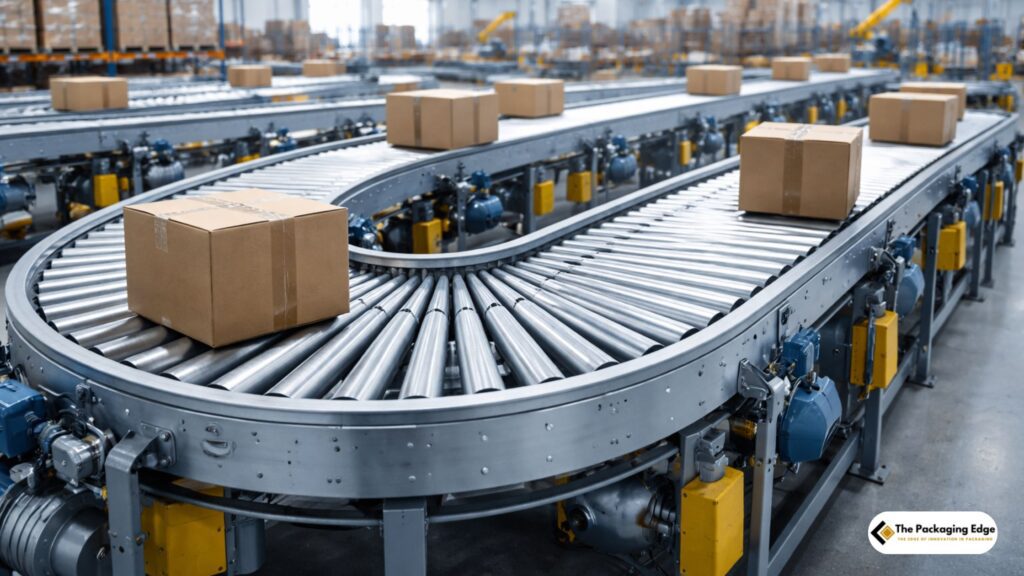
A power roller conveyor is a material handling system that uses motorized rollers to move products along a defined path. Unlike gravity conveyors, which rely on slope and manual force, powered roller conveyors deliver controlled, consistent movement—even for heavy, fragile, or irregular loads.
Each roller is either:
-
Individually powered, or
-
Driven via belts, chains, or line shafts
This configuration allows for advanced control features such as:
-
Accumulation
-
Zoning
-
Sorting
-
Merging
-
Indexing
Power roller conveyors are widely used in:
-
Packaging lines
-
Fulfillment centers
-
Manufacturing plants
-
Distribution hubs
-
Airport baggage systems
When engineered correctly, they become the spine of an automated operation.
Why Power Roller Conveyors Matter in Modern Operations
Material handling is no longer about simply moving boxes from point A to point B. It is about throughput optimization, labor reduction, safety, and data-driven control.
A properly designed power roller conveyor system delivers:
1. Consistent Throughput
Manual handling introduces variability. Powered conveyors eliminate that uncertainty by maintaining predictable flow rates.
2. Labor Efficiency
Reducing manual movement frees skilled workers for higher-value tasks while lowering injury risks.
3. Scalable Automation
Power roller conveyors integrate seamlessly with:
-
Automated packaging systems
-
Robotics
-
Sortation equipment
-
Warehouse management systems (WMS)
4. Reduced Product Damage
Controlled motion prevents sudden starts, stops, and collisions—especially critical for packaged goods.
At The Packaging Edge, we approach every conveyor project as a performance system, not just a piece of equipment.
Core Components of a Power Roller Conveyor System
Understanding the anatomy of a power roller conveyor helps decision-makers choose the right configuration.
1. Motorized Rollers
These are the driving force of the system. Options include:
-
DC motorized rollers for precision control
-
AC motors for heavy-duty applications
2. Drive Mechanisms
-
Belt-driven: Quiet, energy-efficient, ideal for accumulation
-
Chain-driven: Rugged, ideal for pallets and heavy loads
-
Line-shaft driven: Cost-effective for long runs
3. Conveyor Frame
Typically fabricated from:
-
Powder-coated steel
-
Stainless steel (for washdown or food-grade environments)
-
Aluminum (lightweight applications)
4. Control Systems
Modern power roller conveyors rely on:
-
PLCs
-
Sensors
-
Photo-eyes
-
Variable frequency drives (VFDs)
These controls allow for smart automation, including zero-pressure accumulation and product tracking.
Types of Power Roller Conveyors
No two operations are the same. Selecting the right power roller conveyor depends on load type, speed, environment, and future expansion needs.
1. Zero Pressure Accumulation (ZPA) Power Roller Conveyor
Ideal for packaging and fulfillment, ZPA systems:
-
Prevent product contact
-
Allow accumulation without pressure
-
Reduce product damage
This is one of the most requested solutions we engineer at The Packaging Edge.
2. Chain-Driven Live Roller (CDLR) Conveyor
Designed for:
-
Heavy pallets
-
Drums
-
Industrial loads
These systems offer extreme durability and are commonly used in manufacturing and pallet handling.
3. Belt-Driven Live Roller (BDLR) Conveyor
A quieter, cleaner option perfect for:
-
Cartons
-
Totes
-
Retail distribution
4. Curved Power Roller Conveyor
Engineered to maintain product orientation while navigating turns, these are critical for space optimization.
Applications Across Industries
Power roller conveyor systems are used globally across a wide range of industries.
Packaging and Cartoning
High-speed packaging lines rely on precise accumulation and flow control to prevent line stoppages.
E-commerce Fulfillment
With rising order volumes, power roller conveyors enable:
-
Fast order consolidation
-
Automated sortation
-
Scalable growth
Food and Beverage
Sanitary designs with washdown capabilities ensure compliance with strict hygiene standards.
Pharmaceuticals
Precision control and gentle handling protect sensitive products.
Automotive and Heavy Manufacturing
CDLR power roller conveyors handle pallets and components with ease.
The Packaging Edge has delivered solutions for all of these environments, tailoring each system to operational reality—not generic specifications.
Power Roller Conveyor vs Gravity Conveyor
While gravity conveyors are inexpensive, they come with limitations:
| Feature | Power Roller Conveyor | Gravity Conveyor |
|---|---|---|
| Speed Control | ✔ Yes | ✖ No |
| Accumulation | ✔ Advanced | ✖ Limited |
| Heavy Loads | ✔ Yes | ⚠ Limited |
| Automation | ✔ Full Integration | ✖ None |
| Labor Dependency | Low | High |
For operations seeking long-term efficiency, power roller conveyors outperform gravity systems every time.
Designing a Power Roller Conveyor System That Actually Works
One of the most common mistakes companies make is buying conveyors without system-level engineering. At The Packaging Edge, we follow a proven design methodology:
Step 1: Operational Analysis
We evaluate:
-
Product dimensions and weight
-
Throughput requirements
-
Facility layout
-
Growth projections
Step 2: Conveyor Configuration
We select:
-
Roller type
-
Drive method
-
Zone length
-
Control architecture
Step 3: Integration Strategy
The conveyor must interface seamlessly with:
-
Existing equipment
-
Robotics
-
Packaging machines
Step 4: Safety and Compliance
We design systems that meet:
-
OSHA standards
-
CE requirements
-
Industry-specific regulations
This disciplined approach ensures performance today and scalability tomorrow.
Energy Efficiency and Sustainability
Modern power roller conveyor systems are far more energy-efficient than older designs.
Key advancements include:
-
Low-voltage DC motors
-
Sleep mode zoning
-
Intelligent accumulation logic
These features reduce:
-
Energy consumption
-
Heat generation
-
Operating costs
At The Packaging Edge, sustainability is engineered into every solution—not added as an afterthought.
Maintenance and Longevity
A high-quality power roller conveyor is an investment meant to last.
Best Practices for Longevity:
-
Regular roller inspections
-
Belt and chain tension checks
-
Sensor calibration
-
Preventive maintenance schedules
We design systems that are:
-
Easy to maintain
-
Modular
-
Built with readily available components
This minimizes downtime and maximizes ROI.
Common Challenges—and How to Solve Them
Bottlenecks
Solution: Intelligent zoning and accumulation logic
Product Jams
Solution: Proper roller spacing and sensor placement
Excessive Noise
Solution: Belt-driven rollers and vibration isolation
Poor Scalability
Solution: Modular conveyor design
These challenges are not equipment problems—they are design problems. And design is where The Packaging Edge excels.
Why The Packaging Edge Is the Power Roller Conveyor Authority
Anyone can sell conveyors. Very few can engineer systems that transform operations.
At The Packaging Edge, we bring:
-
Deep industry experience
-
Custom-engineered solutions
-
Global project capability
-
End-to-end support
We don’t push products—we solve problems.
Our clients trust us because we understand that a power roller conveyor is not a commodity. It is a strategic asset.
The Future of Power Roller Conveyor Systems
The next generation of conveyor systems will feature:
-
AI-driven flow optimization
-
Predictive maintenance
-
Deeper WMS integration
-
Increased modularity
The Packaging Edge stays ahead of these trends so our clients don’t have to chase them.
Final Thoughts: Turn Movement Into Momentum
A power roller conveyor system is more than a material handling solution—it is the backbone of efficient, scalable, and profitable operations. When engineered correctly, it reduces costs, increases throughput, and creates competitive advantage.
But success depends on who designs and delivers the system.
If you are planning a new conveyor system, upgrading an existing line, or solving persistent flow issues, The Packaging Edge is your expert partner.
Ready to Build a Smarter Conveyor System?
Let’s turn your operational challenges into measurable performance gains.
Reach out directly to The Packaging Edge and speak with specialists who understand power roller conveyor systems from design to deployment.
Email us today at: thepackagingedge@gmail.com
Your operation deserves more than equipment—it deserves an edge.
Related Articles
- Heavy Duty Roller Conveyor: The Definitive Global Guide for Industrial Performance
- Live Roller Conveyor Systems: The Definitive Guide for High-Performance Material Handling
- Automated Material Handling Systems: The Definitive Guide for Modern Packaging & Logistics
- Milk Powder Packaging Machine: The Definitive Guide for Manufacturers Seeking Efficiency, Quality, and Scale
- Automatic Tea Packing Machine: The Complete Buyer’s & Implementation Guide for Scalable Tea Packaging
- Plastic Wrapping Machine for Boxes: The Complete Global Buyer’s Guide to Faster, Safer, and Smarter Packaging
- Automatic Plastic Wrapping Machine: The Definitive Guide to Smarter, Faster, and More Profitable Packaging
- Carton Box Sealing Machine: The Complete Industrial Guide to Faster, Smarter, and More Reliable Packaging
- Automatic Box Packing Machine: The Definitive Guide to Smarter, Faster, and Scalable Packaging
- The Ultimate Guide to Choosing the Right Carton Box Packing Machine for Modern Packaging Operations