
In today’s hyper-competitive manufacturing and logistics environment, efficiency is no longer optional—it is a necessity. Businesses across industries are under immense pressure to reduce operational costs, improve throughput, enhance workplace safety, and maintain consistent product quality. At the center of this transformation lies one powerful solution: robotic palletizers.
Whether you operate in food and beverage, pharmaceuticals, e-commerce, consumer goods, or industrial manufacturing, robotic palletizing systems are redefining how products are handled at the end of the production line. But adopting this technology isn’t just about installing a robot—it’s about implementing the right strategy, system design, and integration partner.
This comprehensive guide will walk you through everything you need to know about robotic palletizers—from how they work and their benefits to choosing the right system and avoiding costly mistakes. Most importantly, you’ll discover why The Packaging Edge is the trusted partner businesses worldwide rely on to implement high-performance palletizing solutions.
What Are Robotic Palletizers?
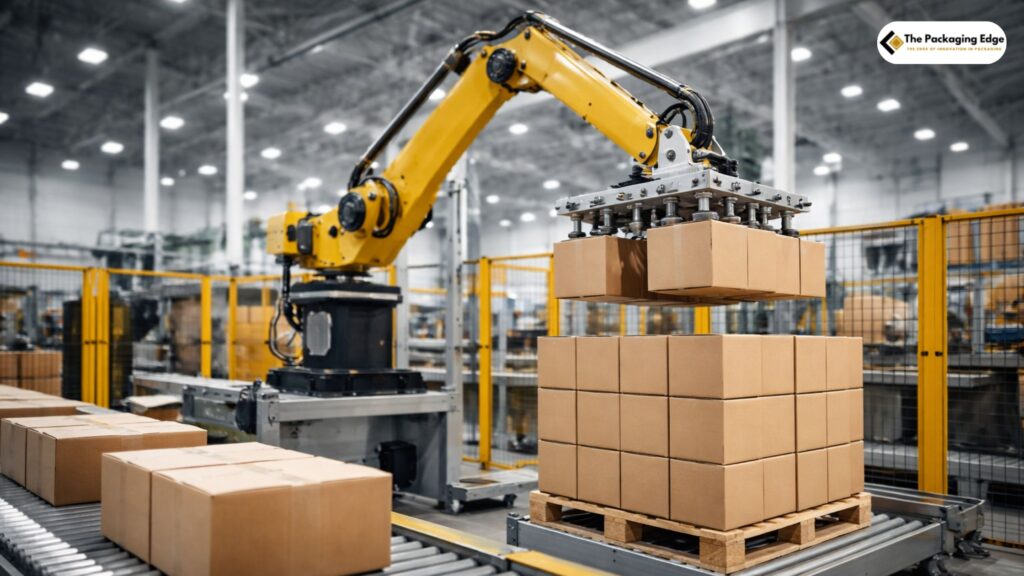
Robotic palletizers are automated systems that use industrial robots to stack products—such as boxes, bags, cartons, or containers—onto pallets in a predefined pattern. These systems replace traditional manual labor or conventional palletizing machines with flexible, programmable robotic arms.
Unlike conventional palletizers that rely on fixed mechanical setups, robotic palletizers use advanced software and sensors to adapt to different product types, sizes, and stacking configurations.
Key Components of a Robotic Palletizing System:
- Industrial Robot Arm – Typically a multi-axis robotic arm capable of precise movements.
- End-of-Arm Tooling (EOAT) – Custom grippers designed to handle specific products (vacuum, clamp, fork-style, etc.).
- Conveyor Systems – Feed products into the palletizing area.
- Control System & Software – Manages patterns, sequences, and operations.
- Safety Systems – Includes sensors, cages, and emergency stops.
Why Robotic Palletizers Are Transforming Industries
The global shift toward automation is accelerating, and robotic palletizers are at the forefront of this movement. Here’s why businesses are making the switch:
1. Increased Efficiency and Throughput
Manual palletizing is slow, inconsistent, and labor-intensive. Robotic systems can operate continuously, maintaining consistent speed and accuracy.
- Operate 24/7 without fatigue
- Handle high volumes with precision
- Reduce bottlenecks in production lines
2. Improved Workplace Safety
Palletizing involves repetitive lifting, bending, and twisting—leading to injuries and long-term health issues.
Robotic palletizers:
- Eliminate manual lifting
- Reduce workplace injuries
- Improve compliance with safety regulations
3. Consistency and Accuracy
Human error can lead to unstable pallets, damaged goods, and inefficient storage.
Robots ensure:
- Perfect stacking patterns every time
- Stable pallet loads
- Reduced product damage
4. Flexibility and Scalability
Modern robotic palletizers can easily adapt to different SKUs, packaging types, and pallet configurations.
- Quick changeovers
- Multi-product handling
- Easy integration with existing systems
5. Cost Savings Over Time
While the initial investment may seem high, robotic palletizers deliver long-term ROI through:
- Reduced labor costs
- Lower injury-related expenses
- Increased productivity
Types of Robotic Palletizers
Understanding the different types of robotic palletizers helps you choose the right solution for your business.
1. Articulated Robotic Palletizers
These are the most common systems, featuring multi-axis robotic arms.
Best for:
- Complex stacking patterns
- High-speed operations
- Multi-product environments
2. Collaborative Robots (Cobots)
Cobots are designed to work alongside humans safely.
Best for:
- Small to medium businesses
- Lower throughput requirements
- Limited floor space
3. Gantry/Cartesian Systems
These use linear motion systems instead of articulated arms.
Best for:
- Heavy loads
- Large palletizing areas
4. Hybrid Systems
Combining robotics with conventional systems for enhanced efficiency.
Industries That Benefit from Robotic Palletizers
Robotic palletizers are not limited to one sector—they are transforming industries globally.
Food & Beverage
- Handles fragile packaging
- Ensures hygiene and consistency
Pharmaceuticals
- Maintains strict quality standards
- Reduces contamination risks
E-commerce & Retail
- Speeds up order fulfillment
- Handles diverse packaging types
Chemicals & Industrial Goods
- Safely manages hazardous materials
- Handles heavy loads efficiently
Key Features to Look for in Robotic Palletizers
Choosing the right system requires careful evaluation. Here are essential features to consider:
1. Payload Capacity
Ensure the robot can handle your product weight and size.
2. Speed and Cycle Time
Match system performance with your production requirements.
3. End-of-Arm Tooling
Custom grippers should be designed for your specific products.
4. Software Flexibility
Look for user-friendly interfaces and programmable patterns.
5. Integration Capability
The system should integrate seamlessly with existing production lines.
6. Footprint
Compact designs are crucial for facilities with limited space.
Common Challenges in Palletizing (And How Robotics Solves Them)
Labor Shortages
Finding and retaining labor for repetitive tasks is increasingly difficult. Robotic palletizers eliminate dependence on manual labor.
Inconsistent Output
Human workers cannot maintain consistent speed and accuracy over long periods. Robots ensure uniform performance.
High Injury Rates
Manual palletizing is physically demanding. Automation significantly reduces workplace injuries.
Limited Scalability
Traditional systems struggle to adapt to growing demands. Robotic solutions scale effortlessly.
How to Choose the Right Robotic Palletizer
Selecting the right system is not just about hardware—it’s about understanding your operational needs.
Step 1: Assess Your Requirements
- Product types and dimensions
- Production volume
- Available space
Step 2: Define Your Goals
- Increase throughput
- Reduce labor costs
- Improve safety
Step 3: Evaluate Integration Needs
- Existing equipment compatibility
- Future expansion plans
Step 4: Partner with Experts
This is where many businesses make critical mistakes—choosing vendors instead of solution partners.
Why System Integration Matters More Than the Robot Itself
A robotic palletizer is only as effective as its integration. Poorly designed systems can lead to:
- Downtime
- Inefficiencies
- Increased costs
Successful implementation requires:
- Custom engineering
- Workflow optimization
- Seamless system integration
The Packaging Edge Advantage
When it comes to robotic palletizers, expertise matters. This is where The Packaging Edge stands apart.
1. End-to-End Solutions
From concept to installation, The Packaging Edge provides complete palletizing solutions tailored to your business.
2. Customized System Design
No two operations are the same. The Packaging Edge designs systems that align perfectly with your workflow.
3. Global Expertise
Serving clients worldwide, the company understands diverse industry requirements and compliance standards.
4. Advanced Technology Integration
Leveraging cutting-edge robotics, software, and automation technologies to deliver maximum efficiency.
5. Proven ROI
Solutions are designed not just for performance—but for measurable business impact.
Real-World Applications of Robotic Palletizers
Case 1: High-Speed Beverage Manufacturing
A beverage company struggling with manual palletizing increased throughput by 40% after implementing a robotic system.
Case 2: E-commerce Fulfillment Center
Automation reduced labor dependency and improved order accuracy, leading to faster delivery times.
Case 3: Pharmaceutical Packaging
Robotic palletizers ensured compliance with strict hygiene and safety standards.
Future Trends in Robotic Palletizing
The evolution of robotic palletizers is far from over. Emerging trends include:
AI-Powered Optimization
Smart systems that adapt in real-time to changing production conditions.
Vision Systems
Advanced cameras for precise product detection and placement.
IoT Integration
Connected systems for predictive maintenance and performance monitoring.
Increased Use of Cobots
Making automation accessible to smaller businesses.
ROI: Is Investing in Robotic Palletizers Worth It?
The short answer: Yes—when implemented correctly.
Cost Factors:
- Initial investment
- Installation and integration
- Maintenance
Benefits:
- Labor cost reduction
- Increased productivity
- Reduced product damage
- Improved safety
Most businesses achieve ROI within 1–3 years, depending on scale and application.
Common Mistakes to Avoid
- Choosing the wrong system for your needs
- Ignoring integration requirements
- Underestimating future scalability
- Working with inexperienced vendors
Avoiding these pitfalls is critical—and reinforces the importance of working with experts like The Packaging Edge.
Final Thoughts: Transform Your Operations with Robotic Palletizers
Robotic palletizers are no longer a luxury—they are a strategic necessity for businesses aiming to stay competitive in a rapidly evolving global market. From improving efficiency and safety to enabling scalability and reducing costs, the benefits are undeniable.
However, the key to success lies not just in adopting automation—but in implementing it correctly with the right partner.
That’s where The Packaging Edge becomes your competitive advantage.
With deep industry expertise, cutting-edge technology, and a commitment to delivering tailored solutions, The Packaging Edge empowers businesses worldwide to unlock the full potential of robotic palletizing systems.
Take the Next Step Toward Automation Excellence
If you’re ready to eliminate inefficiencies, reduce costs, and future-proof your operations with advanced robotic palletizers, now is the time to act.
Partner with The Packaging Edge to design and implement a solution that transforms your end-of-line operations into a high-performance, automated powerhouse.
Get in touch today and start your automation journey.
Email us directly at thepackagingedge@gmail.com to discuss your requirements and discover how we can help you achieve operational excellence.
The future of palletizing is robotic. The future of your business starts now—with The Packaging Edge.
Related Articles
- The Ultimate Guide to Choosing the Right Pillow Packing Machine for Your Business
- Automatic Case Sealer: The Complete Guide to Faster, Smarter Packaging Operations
- Horizontal Flow Wrapper: The Ultimate Guide to High-Speed, Efficient Packaging
- Stretch Wrappers: The Definitive Guide to Smarter, Safer, and More Profitable Pallet Packaging
- The Ultimate Guide to the Shrink Tunnel Packaging Machine: Technology, Applications, and How to Choose the Right System
- Modular Conveyor Systems: The Scalable Backbone of Modern Manufacturing and Packaging
- Automated Bagging Machine: The Ultimate Guide to Boosting Packaging Efficiency, Accuracy, and Profitability
- Bottle Case Packer: The Complete Guide to High-Performance Secondary Packaging Automation
- Side Load Case Packer: The Complete Guide to Efficient, Scalable, and Future-Ready Packaging Automation
- Top Load Case Packer Systems: The Complete Guide to Smarter, Faster, and More Reliable Packaging Operations