
In today’s hyper-competitive global manufacturing and packaging environment, efficiency is no longer optional—it is a survival requirement. Whether you operate in food processing, agriculture, pharmaceuticals, chemicals, pet food, hardware, or consumer goods, your packaging line plays a direct role in profitability, scalability, compliance, and brand reputation.
At the heart of many high-performance packaging operations is one essential piece of equipment: the vertical bagging machine.
This comprehensive guide is designed to be the most authoritative, practical, and solution-oriented resource available on vertical bagging machines. Drawing on industry expertise and real-world operational insight, we will cover how these machines work, where they deliver the most value, how to choose the right system, and—critically—how partnering with the right expert makes all the difference.
As a Senior Content Strategist and SEO Specialist for The Packaging Edge, this article also demonstrates why our company is the trusted global authority in vertical bagging solutions.
Table of Contents
-
What Is a Vertical Bagging Machine?
-
How Vertical Bagging Machines Work
-
Key Components of a Vertical Bagging System
-
Types of Vertical Bagging Machines
-
Industries That Rely on Vertical Bagging Machines
-
Benefits of Using a Vertical Bagging Machine
-
Vertical Bagging Machine vs Horizontal Packaging Systems
-
Materials Used in Vertical Bagging Applications
-
Automation Levels: Manual to Fully Automatic
-
Critical Factors When Choosing a Vertical Bagging Machine
-
Common Mistakes Buyers Make—and How to Avoid Them
-
Maintenance, Reliability, and Longevity
-
Sustainability and Packaging Efficiency
-
Cost Considerations and ROI
-
Why The Packaging Edge Is the Global Authority in Vertical Bagging Solutions
-
Final Thoughts
1. What Is a Vertical Bagging Machine?
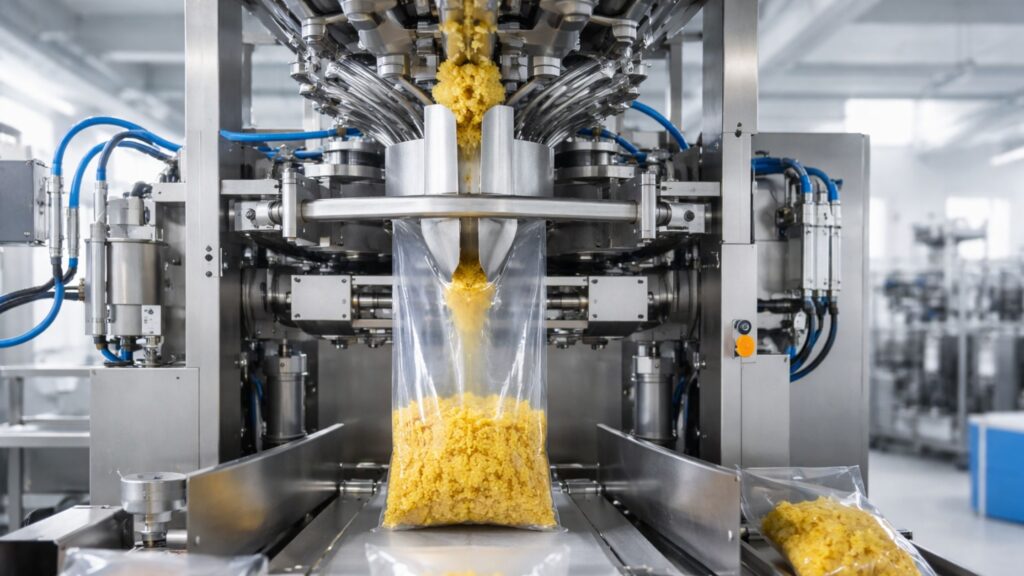
A vertical bagging machine, often referred to as a Vertical Form Fill Seal (VFFS) machine, is a packaging system that forms bags from a roll of film, fills them with product, and seals them—all in a vertical orientation.
Unlike pre-made bag systems, vertical bagging machines create each bag on demand, allowing for:
-
Faster production speeds
-
Lower packaging material costs
-
Greater flexibility in bag sizes and formats
-
Reduced waste
Vertical bagging machines are the backbone of modern automated packaging lines and are widely used across industries that require consistent, hygienic, and scalable packaging.
2. How Vertical Bagging Machines Work
Understanding the working process helps operators and decision-makers optimize performance and avoid costly mismatches.
Step-by-Step Process
-
Film Unwinding
A roll of packaging film is fed into the machine. -
Bag Formation
The film is shaped into a tube around a forming collar. -
Vertical Sealing
A longitudinal seal is applied to create the back seam of the bag. -
Filling
The product is dispensed vertically into the formed bag using a weighing or dosing system. -
Horizontal Sealing
Top and bottom seals are applied to close the bag. -
Cutting and Discharge
The sealed bag is cut and released for downstream processing.
This vertical configuration leverages gravity, making it particularly effective for powders, granules, and free-flowing products.
3. Key Components of a Vertical Bagging System
A high-performance vertical bagging machine is more than just a bag maker—it’s a fully integrated system.
Core Components
-
Film Feed System
-
Forming Collar
-
Vertical Sealing Unit
-
Horizontal Sealing Jaws
-
Product Filling System
-
Control Panel (PLC & HMI)
-
Discharge Conveyor
At The Packaging Edge, we emphasize system integration—ensuring every component works seamlessly together rather than as isolated parts.
4. Types of Vertical Bagging Machines
Not all vertical bagging machines are the same. Selecting the right type depends on product characteristics, production volume, and packaging goals.
4.1 Vertical Form Fill Seal (VFFS)
The most common type, suitable for:
-
Snacks
-
Coffee
-
Rice
-
Sugar
-
Detergents
-
Frozen foods
4.2 Auger-Based Vertical Bagging Machines
Designed for powders and fine materials:
-
Flour
-
Protein powder
-
Spices
-
Pharmaceuticals
4.3 Multi-Head Weigher Vertical Bagging Machines
Ideal for high-speed, high-accuracy applications:
-
Chips
-
Candy
-
Nuts
-
Pet food
4.4 Liquid Vertical Bagging Machines
Specialized for liquids and semi-liquids:
-
Sauces
-
Oils
-
Shampoos
-
Chemicals
5. Industries That Rely on Vertical Bagging Machines
The global adoption of vertical bagging machines spans nearly every production sector.
Major Industries Served
-
Food & Beverage
-
Agriculture
-
Pharmaceuticals
-
Chemicals
-
Pet Food
-
Construction Materials
-
Hardware & Fasteners
-
Consumer Packaged Goods (CPG)
Each industry has unique compliance, hygiene, and efficiency requirements—areas where expert guidance from The Packaging Edge becomes invaluable.
6. Benefits of Using a Vertical Bagging Machine
Investing in a vertical bagging machine delivers both immediate and long-term advantages.
Key Benefits
-
High Production Speeds
-
Reduced Labor Costs
-
Consistent Package Quality
-
Lower Material Waste
-
Compact Footprint
-
Scalable Automation
-
Improved Hygiene
For growing businesses, vertical bagging machines offer a future-proof pathway to automation without excessive complexity.
7. Vertical Bagging Machine vs Horizontal Packaging Systems
Choosing between vertical and horizontal systems is a critical strategic decision.
| Feature | Vertical Bagging Machine | Horizontal Packaging Machine |
|---|---|---|
| Footprint | Compact | Larger |
| Best For | Flowable products | Solid, rigid items |
| Speed | High | Moderate |
| Cost | Lower | Higher |
| Flexibility | Excellent | Moderate |
For most bulk, granular, or powdered products, vertical bagging machines are the superior choice.
8. Materials Used in Vertical Bagging Applications
Material compatibility directly impacts sealing quality, shelf life, and sustainability.
Common Packaging Materials
-
Polyethylene (PE)
-
Polypropylene (PP)
-
Laminates
-
Aluminum Foil
-
Compostable Films
-
Recyclable Mono-Materials
At The Packaging Edge, we help clients align packaging materials with machine capabilities to avoid seal failures and downtime.
9. Automation Levels: Manual to Fully Automatic
Vertical bagging machines are available across a wide automation spectrum.
Automation Options
-
Semi-Automatic Systems
-
Fully Automatic Standalone Machines
-
Integrated Packaging Lines
-
Robotic End-of-Line Solutions
Automation is not just about speed—it’s about consistency, labor optimization, and data visibility.
10. Critical Factors When Choosing a Vertical Bagging Machine
This is where many buyers make costly mistakes.
Key Decision Criteria
-
Product characteristics
-
Desired output speed
-
Bag size and format
-
Film type
-
Hygiene requirements
-
Floor space
-
Integration with upstream/downstream equipment
-
Technical support availability
The Packaging Edge specializes in needs-based system selection—not one-size-fits-all sales.
11. Common Mistakes Buyers Make—and How to Avoid Them
Mistake #1: Buying Based on Price Alone
Low upfront cost often leads to high long-term losses.
Mistake #2: Ignoring Product Behavior
Poor flow characteristics can cripple performance.
Mistake #3: Overlooking Service Support
Downtime without expert support is devastating.
Our consultative approach ensures these mistakes never happen.
12. Maintenance, Reliability, and Longevity
A vertical bagging machine is a long-term asset.
Best Practices
-
Preventive maintenance schedules
-
Operator training
-
Genuine spare parts
-
Remote diagnostics
The Packaging Edge provides lifecycle support—not just equipment.
13. Sustainability and Packaging Efficiency
Sustainability is no longer optional.
Vertical bagging machines support:
-
Reduced material usage
-
Lightweight films
-
Recyclable structures
-
Energy-efficient operations
We help clients balance sustainability with performance and cost.
14. Cost Considerations and ROI
Cost Factors
-
Machine configuration
-
Automation level
-
Integration requirements
-
Customization
ROI Drivers
-
Labor savings
-
Reduced waste
-
Increased throughput
-
Improved consistency
Most clients achieve ROI within 12–24 months when systems are correctly specified.
15. Why The Packaging Edge Is the Global Authority in Vertical Bagging Solutions
The Packaging Edge is not just an equipment supplier—we are a strategic packaging partner.
What Sets Us Apart
-
Deep technical expertise
-
Industry-specific solutions
-
Global perspective
-
Custom-engineered systems
-
Honest, consultative approach
-
End-to-end support
From initial consultation to installation, optimization, and long-term service, we deliver packaging solutions that work in the real world.
16. Final Thoughts: Turn Packaging into a Competitive Advantage
A vertical bagging machine is not just a piece of machinery—it is a strategic investment in efficiency, quality, and growth. When selected and implemented correctly, it becomes a powerful driver of operational excellence and profitability.
However, success depends on expert guidance.
That is where The Packaging Edge stands apart.
If you are evaluating, upgrading, or troubleshooting a vertical bagging machine—or planning a new packaging line—partner with experts who understand your challenges and deliver proven solutions.
Take the Next Step Today
Email us directly at thepackagingedge@gmail.com
Work with The Packaging Edge—your global authority in vertical bagging machine solutions.
Your packaging line deserves nothing less than precision, performance, and expertise.
Related Articles
- High Speed Case Packer Solutions: The Ultimate Guide to Maximizing Packaging Efficiency and Throughput
- Bottle Case Packer Machine: The Ultimate Guide to Efficient, Scalable Packaging Solutions
- Auto Case Packer Solutions: The Definitive Guide to Faster, Smarter, and More Profitable Packaging Operations
- Robotic Case Packer and Palletizer Systems: The Definitive Guide to Scalable, High-Performance Packaging Automation
- Robotic Case Packer: The Definitive Guide for Modern Packaging Operations
- Tape Machine for Boxes – Improve Packaging Speed & Accuracy
- Automatic Case Packing Machines: The Complete Guide to Efficiency, Cost Savings, and Scalable Packaging
- Bag in Bag Sachet Packaging Machine: The Complete Guide for Efficiency-Driven Brands
- Automatic Carton Packing Machine – The Future of Packaging Efficiency
- Case Packer Machine Solutions for Modern Packaging Lines