
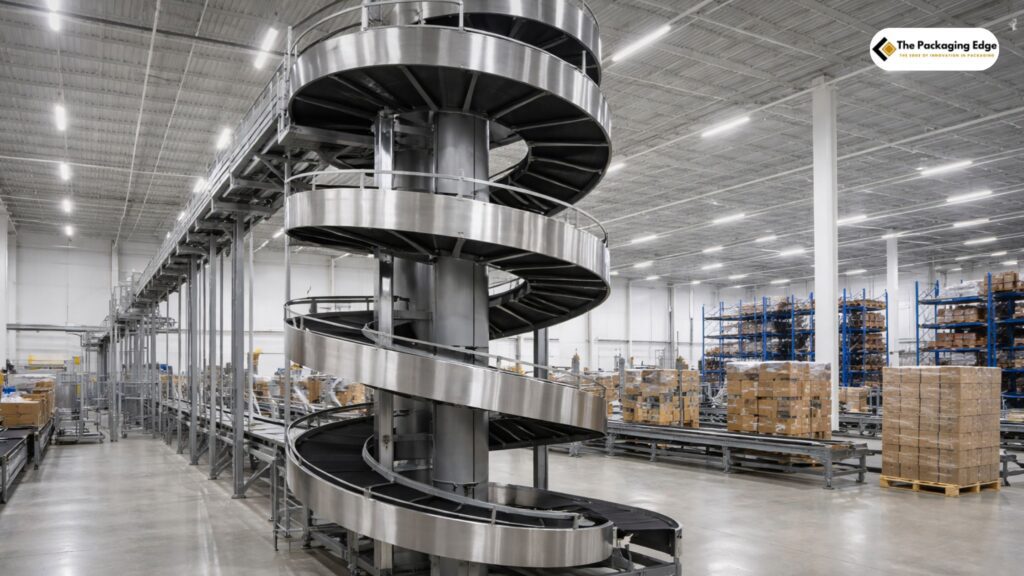
In today’s highly competitive manufacturing, packaging, and distribution environments, operational efficiency is no longer optional—it is essential. Companies around the world are under constant pressure to move products faster, safer, and more cost-effectively while maximizing valuable floor space and minimizing downtime. This is where the vertical spiral conveyor has become a critical piece of modern material handling infrastructure.
From food and beverage facilities to pharmaceutical plants, warehouses, and packaging lines, vertical spiral conveyor systems are transforming how products move between elevations. When designed and implemented correctly, they unlock massive productivity gains, reduce labor dependency, and future-proof operations for growth.
At The Packaging Edge, we specialize in delivering expertly engineered vertical spiral conveyor solutions that solve real-world operational challenges. This guide is designed to help decision-makers, engineers, and operations leaders fully understand vertical spiral conveyors—how they work, where they add value, how to choose the right system, and why partnering with the right expert makes all the difference.
What Is a Vertical Spiral Conveyor?
A vertical spiral conveyor is a continuous conveying system designed to transport products vertically—up or down—along a helical or spiral path. Unlike traditional incline or decline conveyors that require long horizontal distances, vertical spiral conveyors move products between elevations while occupying a remarkably small footprint.
At its core, a vertical spiral conveyor consists of:
-
A spiral track or belt
-
A central support column
-
Drive and tensioning systems
-
Infeed and discharge points
-
Safety guarding and controls
The result is a smooth, continuous flow of products that can connect multiple floors or conveyor levels efficiently and reliably.
Why Vertical Spiral Conveyors Matter in Modern Operations
The demand for vertical spiral conveyor systems is growing worldwide, and for good reason. Facilities are becoming denser, automation levels are increasing, and floor space is more valuable than ever.
Key Industry Drivers:
-
Rising real estate costs pushing manufacturers to build upward, not outward
-
Labor shortages accelerating automation adoption
-
Higher throughput requirements driven by e-commerce and global distribution
-
Strict hygiene and safety standards, especially in food and pharmaceutical sectors
Vertical spiral conveyors address all of these challenges in a single, elegant solution.
How Vertical Spiral Conveyors Work
Understanding how a vertical spiral conveyor operates helps clarify why it is such an effective material handling solution.
Products enter the conveyor at a designated infeed point. The conveyor belt or track then carries the product along a spiral path around a central column. Depending on the application, the system can move products upward (elevation) or downward (lowering) to another conveyor level, mezzanine, or floor.
The continuous motion ensures:
-
Minimal product handling
-
Consistent spacing
-
Reduced risk of jams
-
Predictable throughput rates
Advanced vertical spiral conveyor systems may also integrate sensors, accumulation zones, and automation controls to synchronize with upstream and downstream equipment.
Vertical Spiral Conveyor vs Traditional Conveying Solutions
Many facilities initially rely on traditional incline conveyors, bucket elevators, or even manual lifting systems. While these solutions may work in limited scenarios, they often fall short in efficiency, scalability, and safety.
Incline Conveyors
-
Require significant floor space
-
Often limited by product stability
-
Can struggle with high throughput
Bucket Elevators
-
Better suited for bulk materials than packaged goods
-
Higher maintenance requirements
-
Limited flexibility for product changeovers
Manual Handling
-
Labor-intensive
-
Increased risk of injury
-
Inconsistent throughput
Vertical Spiral Conveyor Advantages
-
Compact footprint
-
Continuous, high-speed operation
-
Gentle product handling
-
Minimal maintenance
-
Scalable and customizable
When evaluated holistically, the vertical spiral conveyor consistently outperforms traditional alternatives for packaged product movement.
Key Benefits of Vertical Spiral Conveyor Systems
1. Space Optimization
One of the most compelling advantages of a vertical spiral conveyor is its ability to move products vertically while occupying minimal floor space. In facilities where every square meter matters, this alone can justify the investment.
2. Increased Throughput
Vertical spiral conveyors are designed for continuous flow. Unlike batch-based lifting systems, they maintain constant product movement, resulting in higher throughput and smoother line balancing.
3. Reduced Labor Dependency
By automating vertical movement, companies can reassign labor to higher-value tasks while reducing ergonomic risks associated with lifting and carrying.
4. Improved Safety
Modern vertical spiral conveyors include integrated guarding, controlled speeds, and stable product transport, significantly reducing the risk of accidents.
5. Product Protection
The gentle conveying action minimizes tipping, scuffing, and damage—critical for fragile, high-value, or consumer-ready packaging.
6. Scalability and Flexibility
A properly designed vertical spiral conveyor can accommodate future line expansions, new product sizes, and evolving throughput requirements.
Industries That Rely on Vertical Spiral Conveyors
Vertical spiral conveyors are used worldwide across a wide range of industries:
Food and Beverage
-
Moving packaged snacks, beverages, and cartons between processing and packaging levels
-
Meeting hygiene and washdown requirements
-
Maintaining consistent product flow
Pharmaceutical and Medical
-
Transporting blister packs, bottles, and medical devices
-
Supporting cleanroom environments
-
Ensuring precise handling and compliance
Packaging and Manufacturing
-
Connecting production lines to secondary packaging
-
Integrating with case packers and palletizers
-
Supporting high-speed automation
Warehousing and Distribution
-
Elevating cartons and totes between mezzanines
-
Maximizing vertical storage space
-
Improving order fulfillment efficiency
At The Packaging Edge, we have deep experience tailoring vertical spiral conveyor solutions to each industry’s specific demands.
Types of Vertical Spiral Conveyors
Not all vertical spiral conveyors are the same. Selecting the right type is critical for performance and longevity.
Belt-Driven Vertical Spiral Conveyors
-
Ideal for cartons, cases, and packaged goods
-
Quiet operation
-
Low maintenance
-
Excellent product stability
Slat or Track-Based Spiral Conveyors
-
Suitable for heavier loads
-
More rigid support
-
Ideal for industrial applications
Accumulating Vertical Spiral Conveyors
-
Allow controlled product accumulation
-
Ideal for buffering between processes
-
Improve line efficiency during downstream stoppages
Mass Flow Vertical Spirals
-
High-throughput systems
-
Best for uniform product sizes
-
Common in distribution environments
The Packaging Edge works closely with clients to determine the optimal vertical spiral conveyor configuration based on product type, weight, speed, and environmental conditions.
Key Design Considerations for Vertical Spiral Conveyors
A vertical spiral conveyor is not a one-size-fits-all solution. Proper design is essential.
Product Characteristics
-
Dimensions
-
Weight
-
Stability
-
Packaging material
Throughput Requirements
-
Units per minute
-
Peak vs average loads
-
Future growth projections
Elevation Change
-
Vertical distance required
-
Number of spiral turns
-
Infeed and discharge heights
Environmental Factors
-
Temperature
-
Humidity
-
Washdown requirements
-
Cleanroom compliance
Integration Requirements
-
Compatibility with existing conveyors
-
Controls integration
-
Automation and sensors
This is where expert guidance becomes invaluable—and where The Packaging Edge excels.
Common Mistakes When Selecting a Vertical Spiral Conveyor
Many companies encounter costly issues due to poor planning or vendor selection.
Undersizing the System
Leads to bottlenecks, excessive wear, and reduced lifespan.
Ignoring Future Expansion
A system designed only for today’s needs can become obsolete quickly.
Choosing Based on Price Alone
Low-cost systems often result in higher maintenance and downtime costs over time.
Poor Integration Planning
Even the best vertical spiral conveyor fails if it doesn’t integrate seamlessly with the rest of the line.
At The Packaging Edge, our approach eliminates these risks through strategic design, engineering, and implementation.
Maintenance and Longevity of Vertical Spiral Conveyors
One of the reasons vertical spiral conveyors are favored worldwide is their durability and low maintenance profile.
Best Practices:
-
Routine inspections
-
Proper lubrication
-
Belt or track alignment checks
-
Sensor and control calibration
When designed correctly, a vertical spiral conveyor can operate reliably for years with minimal intervention.
Sustainability and Energy Efficiency
Modern vertical spiral conveyor systems are designed with efficiency in mind.
-
Energy-efficient drives
-
Reduced material usage due to compact design
-
Lower HVAC costs due to smaller footprint
For companies focused on sustainability and ESG goals, vertical spiral conveyors contribute meaningfully to reduced environmental impact.
Why Expertise Matters: Choosing the Right Partner
A vertical spiral conveyor is a strategic investment. The difference between success and frustration often comes down to the partner you choose.
What Sets The Packaging Edge Apart
The Packaging Edge is not just a supplier—we are a strategic solutions partner.
We offer:
-
Deep technical expertise in vertical spiral conveyor systems
-
Custom-engineered solutions tailored to real operational needs
-
Global perspective with worldwide applicability
-
Practical, solution-driven designs—not generic equipment
-
End-to-end support from concept to commissioning
Our mission is simple: help your operation move smarter, faster, and more efficiently.
The Future of Vertical Spiral Conveyor Technology
As automation, AI, and smart factories continue to evolve, vertical spiral conveyors will play an even greater role.
Emerging trends include:
-
IoT-enabled monitoring
-
Predictive maintenance
-
Advanced accumulation logic
-
Seamless integration with robotics and AS/RS systems
The Packaging Edge stays ahead of these trends to ensure our clients are always future-ready.
Final Thoughts: Elevate Your Operation with The Packaging Edge
A vertical spiral conveyor is far more than a piece of equipment—it is a productivity multiplier, a space-saving asset, and a foundation for scalable automation. When designed and implemented correctly, it transforms how products move through your facility and unlocks long-term operational advantages.
However, the true value of a vertical spiral conveyor is only realized when it is engineered by experts who understand your industry, your challenges, and your growth goals.
That is where The Packaging Edge stands apart.
If you are evaluating a vertical spiral conveyor for a new project, upgrading an existing system, or simply exploring how to optimize your material handling operation, now is the time to speak with specialists who deliver real solutions—not generic equipment.
Take the next step. Elevate your efficiency. Optimize your space. Future-proof your operation.
Email us directly at thepackagingedge@gmail.com and let The Packaging Edge design a vertical spiral conveyor solution that gives your operation the competitive edge it deserves.
Related Articles
- Motorized Drive Roller Conveyor Systems: The Ultimate Guide to Smarter, Faster, and More Efficient Material Handling
- Belt Driven Roller Conveyor Systems: The Complete Global Guide to Efficiency, Reliability, and Scalable Material Handling
- Expandable Roller Conveyor Systems: The Complete Expert Guide for Efficient, Scalable Material Handling
- Powered Roller Conveyor Systems: The Ultimate Guide to Smarter, Faster, and Scalable Material Handling
- Gravity Roller Conveyor Systems: The Definitive Guide for Efficient, Scalable Material Handling
- Belt Driven Live Roller Conveyor Systems: The Ultimate Guide for High-Performance Material Handling
- Motorized Roller Conveyor Systems: The Definitive Guide for High-Performance Material Handling
- Pallet Roller Conveyor Systems: The Complete Expert Guide to Efficient Pallet Handling and Warehouse Optimization
- Roller Conveyor Systems: The Ultimate Guide to Efficient, Scalable Material Handling
- Chain Driven Live Roller Conveyor: The Definitive Guide to Smarter, Stronger, More Scalable Material Handling