
Introduction: Why Gravity Spiral Conveyors Matter in Modern Packaging and Distribution
In today’s hyper-competitive global supply chain, efficiency is no longer optional—it is a fundamental requirement for survival. As warehouses, distribution centers, and manufacturing facilities continue to scale upward rather than outward, vertical material handling has become a critical operational challenge. One of the most reliable, cost-effective, and space-saving solutions to this challenge is the gravity spiral conveyor.
A gravity spiral conveyor is not simply a piece of equipment—it is a strategic asset. When designed and implemented correctly, it can dramatically improve throughput, reduce labor dependency, lower energy consumption, and enhance workplace safety. For operations seeking leaner processes and smarter layouts, gravity spiral conveyors offer a compelling answer.
At The Packaging Edge, we specialize in helping businesses worldwide design, select, and implement conveyor systems that solve real operational problems. This comprehensive guide explores everything you need to know about gravity spiral conveyors—from how they work and where they excel to design considerations, applications, ROI, and how expert guidance can make the difference between average performance and exceptional results.
What Is a Gravity Spiral Conveyor?
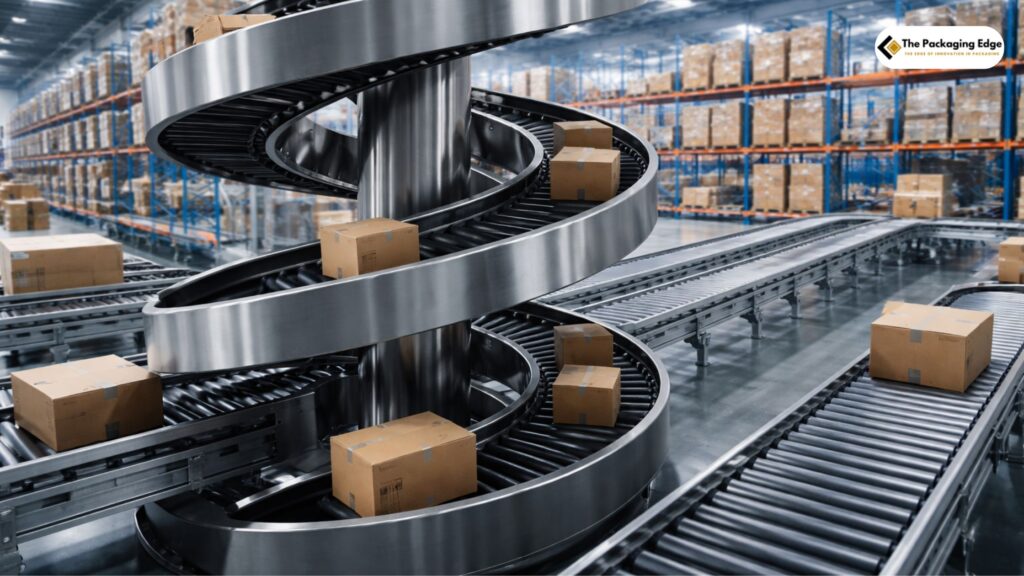
A gravity spiral conveyor is a vertically oriented conveyor system that allows products to move downward along a spiral path using gravity rather than powered motors. Items are guided along a helical track or rollers, descending smoothly from one elevation to another.
Unlike powered spiral conveyors, gravity spiral conveyors rely solely on gravitational force and carefully engineered slope angles to control product speed. This makes them particularly attractive for facilities seeking energy efficiency, mechanical simplicity, and low operating costs.
Key Characteristics of Gravity Spiral Conveyors
- Non-powered operation using gravity
- Continuous spiral flow for smooth vertical descent
- Compact footprint, ideal for space-constrained facilities
- Low maintenance requirements due to fewer moving parts
- Customizable designs to handle various product sizes and weights
Gravity spiral conveyors are most commonly used to move cartons, totes, trays, cases, and packaged goods from upper levels to lower floors in warehouses, packaging lines, and distribution environments.
How Gravity Spiral Conveyors Work
Understanding how a gravity spiral conveyor functions is essential for evaluating its suitability for your operation.
The Core Principle: Controlled Descent
Products are placed at the top of the spiral and begin descending due to gravity. The conveyor’s pitch, track design, and surface material regulate the speed, ensuring products move safely and consistently without excessive acceleration.
Speed Control Mechanisms
To prevent product damage or bottlenecks, gravity spiral conveyors may include:
- Roller spacing adjustments
- Low-friction or high-friction track materials
- Brake rollers or speed retarders
- Guide rails for stability
These elements allow precise control over product flow without the need for motors or complex electronics.
Continuous Flow Advantage
Unlike vertical lifts or batch elevators, gravity spiral conveyors provide continuous, uninterrupted movement, making them ideal for high-throughput environments.
Advantages of Gravity Spiral Conveyors
Gravity spiral conveyors deliver a wide range of operational, financial, and environmental benefits. These advantages explain why they are increasingly adopted across industries worldwide.
1. Energy Efficiency and Sustainability
Because they require no motors or electrical power to operate, gravity spiral conveyors significantly reduce energy consumption. This makes them an environmentally responsible choice and helps organizations lower operating costs and carbon footprints.
2. Space Optimization
Vertical spiral designs maximize the use of available height while minimizing floor space. Facilities can reclaim valuable square footage for storage, production, or additional automation.
3. Lower Total Cost of Ownership
With fewer mechanical components, gravity spiral conveyors have:
- Lower upfront costs compared to powered systems
- Minimal maintenance requirements
- Reduced downtime
- Longer service life
4. Enhanced Safety
By eliminating motors and chains, gravity spiral conveyors reduce mechanical hazards. Controlled descent mechanisms further ensure products move predictably, protecting both goods and personnel.
5. High Throughput Capability
Properly engineered gravity spiral conveyors can handle continuous product flow, supporting demanding operational volumes without sacrificing reliability.
Gravity Spiral Conveyor vs. Powered Spiral Conveyor
Choosing between gravity and powered spiral conveyors depends on application requirements. Below is a practical comparison.
Gravity Spiral Conveyor
Best For:
- Downward-only product flow
- Lightweight to moderate-weight products
- Energy-conscious operations
- Cost-sensitive projects
Pros:
- No energy consumption
- Simple design
- Low maintenance
- High reliability
Cons:
- Limited to downward movement
- Requires careful slope and speed control
Powered Spiral Conveyor
Best For:
- Upward or bidirectional movement
- Heavy or irregular loads
- Precise speed synchronization
Pros:
- Greater control
- Broader application range
Cons:
- Higher energy usage
- Increased maintenance
- Higher upfront and operational costs
At The Packaging Edge, we help clients evaluate these trade-offs and determine whether a gravity spiral conveyor is the optimal solution—or part of a hybrid system.
Common Applications of Gravity Spiral Conveyors
Gravity spiral conveyors are used across a wide range of industries due to their versatility and efficiency.
Warehousing and Distribution Centers
In multi-level warehouses, gravity spiral conveyors efficiently move cartons from mezzanines to packing or shipping areas, reducing reliance on forklifts or lifts.
Packaging and Fulfillment Lines
Gravity spiral conveyors streamline transitions between elevated packaging equipment and ground-level palletizing or sorting stations.
E-commerce Operations
High-volume e-commerce facilities benefit from the continuous flow and space-saving design of gravity spiral conveyors, particularly during peak seasons.
Manufacturing Facilities
Manufacturers use gravity spiral conveyors to transfer finished goods or components between floors while maintaining consistent production flow.
Food and Beverage Industry
With appropriate materials and sanitation-friendly designs, gravity spiral conveyors handle packaged food products efficiently and safely.
Design Considerations for Gravity Spiral Conveyors
A gravity spiral conveyor is only as effective as its design. Poorly engineered systems can lead to product damage, jams, or inconsistent flow.
Product Characteristics
Key factors include:
- Weight and dimensions
- Packaging material (cardboard, plastic, rigid containers)
- Stability and center of gravity
Throughput Requirements
Understanding peak and average flow rates ensures the conveyor is sized appropriately for operational demands.
Vertical Drop and Spiral Diameter
The height difference between levels determines the number of turns required, while diameter affects speed and footprint.
Speed Control and Safety Features
Brake rollers, side guards, and end stops help maintain safe and predictable operation.
Facility Constraints
Ceiling height, floor layout, and integration with existing conveyors must all be considered.
This is where working with experienced specialists like The Packaging Edge becomes essential.
Customization Options for Gravity Spiral Conveyors
No two facilities are identical. Customization ensures optimal performance.
Common customization options include:
- Roller or slide-bed configurations
- Adjustable guide rails
- Stainless steel or coated frames
- Noise-reduction features
- Integration with existing conveyor lines
At The Packaging Edge, we design gravity spiral conveyors tailored to your exact operational needs rather than forcing standard solutions into complex environments.
Installation and Integration Best Practices
Proper installation is critical for long-term success.
Pre-Installation Planning
- Detailed layout analysis
- Product testing and flow simulation
- Safety and compliance review
Seamless Integration
Gravity spiral conveyors should integrate smoothly with upstream and downstream equipment, including belt conveyors, sorters, and packaging machines.
Training and Documentation
Even simple systems benefit from proper operator training and clear maintenance guidelines.
Maintenance and Longevity
One of the biggest advantages of gravity spiral conveyors is minimal maintenance.
Routine Checks
- Roller condition
- Guide rail alignment
- Structural integrity
Preventive Maintenance
Periodic inspections prevent minor issues from becoming costly disruptions.
With proper care, gravity spiral conveyors can deliver decades of reliable service.
ROI and Cost Justification
Investing in a gravity spiral conveyor often delivers rapid returns.
Cost Savings Drivers
- Reduced energy usage
- Lower labor costs
- Minimal maintenance
- Increased throughput
Long-Term Value
When viewed over the system’s lifespan, gravity spiral conveyors frequently outperform powered alternatives in total cost of ownership.
Why Choose The Packaging Edge?
Selecting the right partner is just as important as selecting the right equipment.
The Packaging Edge brings:
- Deep industry expertise
- Custom-engineered solutions
- Global project experience
- Practical, ROI-driven designs
- End-to-end support from concept to installation
We don’t just sell conveyors—we solve operational challenges.
The Future of Gravity Spiral Conveyors
As sustainability, automation, and space optimization continue to shape global logistics, gravity spiral conveyors will remain a cornerstone of efficient material handling.
Innovations in materials, modular design, and hybrid systems are expanding their capabilities while preserving their core advantages.
Conclusion: Take the Next Step with The Packaging Edge
A gravity spiral conveyor is more than a mechanical solution—it is a strategic investment in efficiency, safety, and scalability. When expertly designed and implemented, it can transform vertical material handling and unlock measurable operational gains.
At The Packaging Edge, we are committed to delivering gravity spiral conveyor solutions that align with your business goals and outperform expectations. If you are ready to optimize your facility, reduce costs, and future-proof your operations, now is the time to act.
Email us directly at thepackagingedge@gmail.com and discover how The Packaging Edge can design the right gravity spiral conveyor solution for your operation—anywhere in the world.
Your efficiency edge starts here.
Related Articles
- Vertical Spiral Conveyor Systems: The Ultimate Guide to Efficient, Space-Saving Material Handling
- Motorized Drive Roller Conveyor Systems: The Ultimate Guide to Smarter, Faster, and More Efficient Material Handling
- Belt Driven Roller Conveyor Systems: The Complete Global Guide to Efficiency, Reliability, and Scalable Material Handling
- Expandable Roller Conveyor Systems: The Complete Expert Guide for Efficient, Scalable Material Handling
- Powered Roller Conveyor Systems: The Ultimate Guide to Smarter, Faster, and Scalable Material Handling
- Gravity Roller Conveyor Systems: The Definitive Guide for Efficient, Scalable Material Handling
- Belt Driven Live Roller Conveyor Systems: The Ultimate Guide for High-Performance Material Handling
- Motorized Roller Conveyor Systems: The Definitive Guide for High-Performance Material Handling
- Pallet Roller Conveyor Systems: The Complete Expert Guide to Efficient Pallet Handling and Warehouse Optimization
- Roller Conveyor Systems: The Ultimate Guide to Efficient, Scalable Material Handling