
In today’s rapidly evolving logistics landscape, businesses worldwide face mounting pressure to optimize warehouse operations, reduce labor costs, and meet increasingly demanding customer expectations. The solution? Automated material handling equipment has emerged as the cornerstone of modern supply chain excellence, revolutionizing how companies store, move, and manage inventory across every sector of the global economy.
Whether you’re operating a small distribution center or managing a massive fulfillment operation, understanding the capabilities, benefits, and implementation strategies for automated material handling systems is no longer optional—it’s essential for survival in an increasingly competitive marketplace. This comprehensive guide explores everything you need to know about automated material handling equipment and how it can transform your operations.
What is Automated Material Handling Equipment?
Automated material handling equipment refers to a broad category of mechanical systems and technologies designed to move, store, control, and protect products throughout the manufacturing, warehousing, distribution, and disposal processes. Unlike traditional manual handling methods, these automated systems leverage advanced robotics, conveyor systems, software integration, and intelligent controls to execute material movement with minimal human intervention.
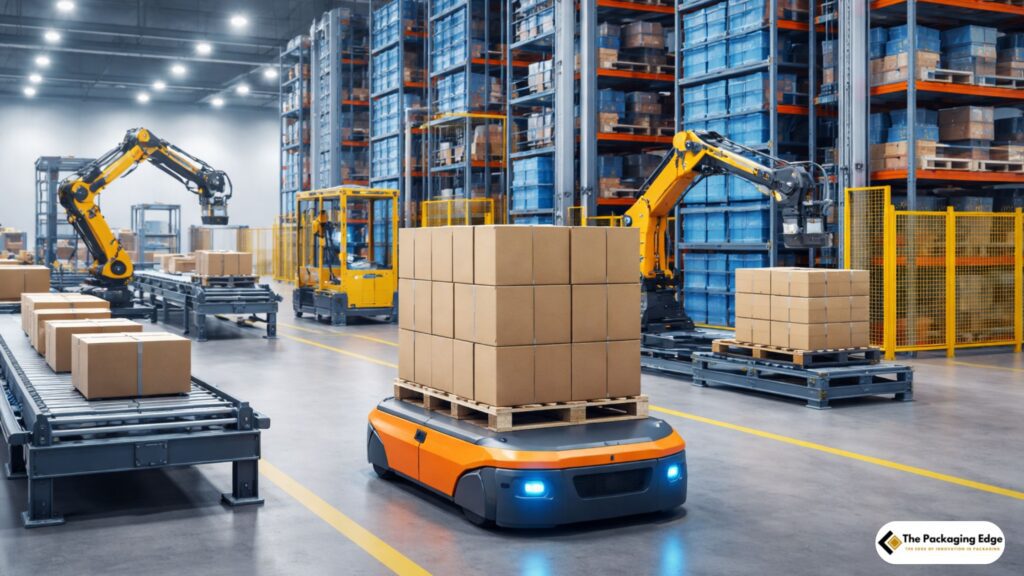
The spectrum of automated material handling solutions encompasses everything from simple conveyor belts and pallet jacks to sophisticated autonomous mobile robots (AMRs), automated storage and retrieval systems (AS/RS), and fully integrated warehouse management platforms. Each component plays a vital role in creating efficient, scalable operations that can adapt to fluctuating demand and evolving business requirements.
Modern automated material handling equipment integrates seamlessly with warehouse management systems (WMS), enterprise resource planning (ERP) platforms, and Internet of Things (IoT) sensors to provide real-time visibility, predictive analytics, and intelligent decision-making capabilities that were impossible just a decade ago.
Core Types of Automated Material Handling Equipment
Automated Storage and Retrieval Systems (AS/RS)
AS/RS represents one of the most sophisticated forms of automated material handling equipment, utilizing computer-controlled systems to automatically place and retrieve loads from defined storage locations. These systems dramatically increase storage density by utilizing vertical space and eliminating wide aisles required for manual forklift operations. Modern AS/RS solutions can handle everything from small parts and totes to full pallets, offering picking speeds that far exceed human capabilities while maintaining exceptional accuracy rates consistently above 99.9 percent.
Automated Guided Vehicles (AGVs) and Autonomous Mobile Robots (AMRs)
These mobile automation solutions have revolutionized intra-facility transportation. AGVs follow predetermined paths using magnetic strips, wires, or laser guidance, while AMRs use advanced sensors, cameras, and artificial intelligence to navigate dynamically through warehouse environments, avoiding obstacles and optimizing routes in real-time. Both technologies eliminate the need for manual material transport between workstations, reducing labor costs while improving safety and throughput.
Conveyor Systems and Sortation Equipment
Automated conveyor systems form the backbone of many material handling operations, efficiently transporting products between receiving, storage, picking, packing, and shipping areas. Modern conveyor technologies include belt conveyors, roller conveyors, overhead conveyors, and sophisticated sortation systems that can process thousands of items per hour with remarkable accuracy. Advanced sortation equipment uses barcode scanning, dimensioning systems, and intelligent diverters to route products to appropriate destinations without manual intervention.
Robotic Picking and Palletizing Systems
Articulated robots and collaborative robots (cobots) have transformed picking and palletizing operations. These systems combine computer vision, machine learning, and precision mechanics to identify, grasp, and place items with speed and consistency that far exceeds manual operations. Modern robotic systems can handle diverse product types, from delicate electronics to heavy industrial components, adapting their grip strength and movement patterns accordingly.
Automated Packaging Equipment
Packaging automation represents a critical component of end-to-end material handling solutions. Automated packaging systems can form boxes, insert products, add protective materials, seal containers, apply labels, and prepare shipments for dispatch—all without manual intervention. These systems integrate with upstream picking operations and downstream shipping systems to create seamless workflows that minimize handling and maximize efficiency.
Transformative Benefits of Automated Material Handling Equipment
Dramatic Labor Cost Reduction
Labor typically represents 50-70 percent of total warehouse operating costs. Automated material handling equipment dramatically reduces dependency on manual labor for repetitive, physically demanding tasks. Organizations implementing comprehensive automation strategies commonly report 30-60 percent reductions in labor requirements, with some high-volume operations achieving even greater savings. Beyond direct wage savings, automation eliminates costs associated with recruitment, training, turnover, benefits, and workers’ compensation claims related to material handling injuries.
Exceptional Accuracy and Quality Improvement
Human error in order picking, sorting, and shipping creates costly problems including returns, customer dissatisfaction, and damaged relationships. Automated material handling systems achieve accuracy rates consistently exceeding 99.9 percent, virtually eliminating picking errors, shipping mistakes, and inventory discrepancies. This precision translates directly to improved customer satisfaction, reduced return processing costs, and enhanced brand reputation.
Increased Throughput and Productivity
Automated systems operate continuously without breaks, fatigue, or performance degradation throughout shifts. Modern automated material handling equipment can process 2-5 times more transactions than manual operations in equivalent footprints. This productivity multiplication enables businesses to handle growth without proportional expansion of facilities or workforce, providing crucial scalability for seasonal peaks and long-term expansion.
Optimized Space Utilization
Warehouse space represents a significant ongoing expense, particularly in urban areas where proximity to customers drives competitive advantage. Automated storage systems maximize vertical space utilization, often doubling or tripling storage capacity within existing footprints. Narrow aisles designed for automated equipment rather than wide forklift paths further increase usable storage area. This space optimization can defer or eliminate costly facility expansion projects while improving inventory accessibility.
Enhanced Workplace Safety
Material handling injuries represent a significant source of workplace accidents, lost time, and workers’ compensation claims. By automating heavy lifting, repetitive motions, and navigation through congested areas, automated material handling equipment dramatically reduces injury risks. Organizations implementing comprehensive automation strategies typically report 40-70 percent reductions in safety incidents, creating safer work environments while reducing insurance costs and regulatory compliance burdens.
Real-Time Visibility and Data-Driven Decision Making
Modern automated material handling systems generate unprecedented amounts of operational data, providing real-time visibility into inventory locations, equipment performance, throughput rates, and bottlenecks. This data enables predictive maintenance, process optimization, and informed strategic decisions that continuously improve operations. Integration with business intelligence platforms transforms raw operational data into actionable insights that drive competitive advantage.
Critical Considerations for Implementing Automated Material Handling Equipment
Comprehensive Needs Assessment
Successful automation begins with thorough analysis of current operations, future growth projections, product characteristics, order profiles, and operational constraints. This assessment should identify specific pain points, quantify improvement opportunities, and establish clear objectives for automation initiatives. Without proper needs assessment, organizations risk implementing solutions that fail to address real operational challenges or deliver expected returns.
Return on Investment Analysis
Automated material handling equipment represents significant capital investment, requiring careful financial analysis. Comprehensive ROI calculations should include direct costs such as equipment purchase, installation, and integration expenses, alongside ongoing costs for maintenance, energy, and software subscriptions. Benefits analysis must quantify labor savings, productivity improvements, error reduction, space optimization, and safety enhancements. Most well-planned automation projects achieve ROI within 18-36 months, with many systems delivering value for 10-15 years or longer.
System Integration and Scalability
Automated material handling equipment must integrate seamlessly with existing warehouse management systems, enterprise resource planning platforms, and transportation management systems. Proprietary or closed systems that limit integration flexibility create operational silos and constrain future expansion. Selecting modular, scalable solutions with open architecture and standard communication protocols enables phased implementation and future growth without complete system replacement.
Vendor Selection and Partnership
Choosing the right automation partner proves as critical as selecting the right equipment. Organizations should evaluate vendors based on industry experience, technical expertise, financial stability, implementation methodology, training programs, and ongoing support capabilities. The best vendors function as true partners, providing consultative guidance throughout planning, implementation, and optimization phases while ensuring systems deliver promised performance and reliability.
Change Management and Workforce Transition
Automation implementation affects workforce composition and skills requirements. Successful organizations approach automation as workforce evolution rather than replacement, retraining material handlers for higher-value roles in equipment operation, maintenance, quality control, and process improvement. Comprehensive change management programs that communicate benefits, provide training, and involve employees in implementation planning dramatically improve adoption success and minimize operational disruption.
Industry Applications and Use Cases
Automated material handling equipment delivers transformative benefits across virtually every industry vertical. E-commerce fulfillment centers leverage sophisticated picking robots and sortation systems to process millions of orders daily with remarkable speed and accuracy. Manufacturing operations utilize automated guided vehicles and conveyor systems to synchronize material flow with production schedules, eliminating bottlenecks and reducing work-in-process inventory. Food and beverage operations deploy specialized automated systems that maintain temperature control and sanitary conditions while maximizing throughput. Pharmaceutical and healthcare distributors implement automation to ensure regulatory compliance, maintain product traceability, and handle sensitive materials with appropriate care.
Third-party logistics providers (3PLs) increasingly rely on flexible, scalable automated material handling equipment to serve diverse clients efficiently. Retail distribution centers use automation to process store replenishment orders and direct-to-consumer shipments simultaneously. Cold storage facilities implement specialized automated systems that minimize human exposure to extreme temperatures while maximizing storage density in expensive controlled environments.
Future Trends in Automated Material Handling Technology
The evolution of automated material handling equipment continues accelerating, driven by advances in artificial intelligence, machine learning, computer vision, and sensor technology. Next-generation systems will feature enhanced autonomy, enabling equipment to make intelligent decisions, optimize processes dynamically, and adapt to changing conditions without human intervention. Collaborative automation will blur boundaries between manual and automated operations, with humans and robots working together seamlessly in shared spaces.
Cloud-based warehouse management systems and automation controls will enable centralized management of distributed operations, providing unprecedented visibility and coordination across multi-facility networks. Digital twin technology will allow organizations to simulate, optimize, and troubleshoot operations virtually before implementing changes physically. Predictive analytics will anticipate equipment failures, optimize maintenance schedules, and continuously improve performance based on historical patterns and real-time conditions.
Sustainability considerations will increasingly influence automated material handling equipment design and selection. Energy-efficient systems, regenerative braking, intelligent power management, and renewable energy integration will help organizations reduce environmental impact while lowering operating costs. Circular economy principles will drive equipment manufacturers toward more sustainable materials, modular designs that facilitate upgrades, and end-of-life recycling programs.
Overcoming Common Implementation Challenges
While automated material handling equipment offers tremendous benefits, implementation presents challenges that organizations must address proactively. Initial capital investment requirements can strain budgets, particularly for small and mid-sized operations. However, creative financing options including leasing, equipment-as-a-service models, and phased implementation approaches can make automation accessible across organizations of all sizes.
Integration complexity represents another common challenge, especially in facilities with legacy systems or diverse product portfolios. Working with experienced integration partners who understand both automation technology and existing operational systems proves essential for successful implementation. Comprehensive testing and validation protocols ensure systems perform reliably before full production deployment.
Maintaining flexibility while achieving automation benefits requires careful planning. Organizations should avoid over-automation that creates inflexible systems unable to adapt to changing business requirements. Modular, scalable solutions that can grow and evolve with business needs provide better long-term value than monolithic systems designed for static operational models.
Partner with The Packaging Edge for Your Automation Success
The transition to automated material handling equipment represents one of the most significant strategic decisions your organization will make. Success requires more than just purchasing equipment—it demands deep expertise in operational analysis, system design, integration planning, and ongoing optimization. That’s where The Packaging Edge becomes your essential partner in transformation.
At The Packaging Edge, we bring decades of specialized experience in automated material handling equipment implementation across diverse industries and applications worldwide. Our team of automation experts doesn’t just sell equipment—we deliver comprehensive solutions tailored to your specific operational requirements, growth objectives, and budget parameters. We understand that every operation presents unique challenges, and we take pride in designing systems that address your specific pain points while positioning you for future success.
Our consultative approach begins with thorough analysis of your current operations, identifying opportunities for improvement and quantifying potential benefits. We evaluate your product characteristics, order profiles, facility constraints, and strategic objectives to recommend solutions that deliver optimal performance and return on investment. Our vendor-agnostic perspective ensures you receive unbiased recommendations focused solely on your best interests, not equipment manufacturer relationships.
Implementation expertise sets The Packaging Edge apart. Our experienced project managers coordinate every aspect of system installation, integration, testing, and validation, ensuring smooth deployment with minimal operational disruption. We manage vendor relationships, timeline coordination, and quality assurance so you can focus on running your business. Our comprehensive training programs prepare your team to operate, maintain, and optimize automated systems effectively from day one.
But our partnership doesn’t end at installation. The Packaging Edge provides ongoing support, optimization services, and strategic guidance to ensure your automated material handling equipment continues delivering value throughout its operational life. We monitor system performance, identify optimization opportunities, and help you adapt to changing business requirements, ensuring your automation investment remains a competitive advantage for years to come.
Whether you’re exploring automation for the first time or looking to expand existing capabilities, The Packaging Edge has the expertise, experience, and commitment to make your automation journey successful. We’ve helped organizations across manufacturing, distribution, e-commerce, retail, food and beverage, healthcare, and countless other industries transform their operations through strategic automation implementation.
Don’t let your competitors outpace you with superior automation capabilities. The time to act is now. Contact The Packaging Edge today to schedule a comprehensive consultation where we’ll assess your operations, identify automation opportunities, and develop a customized roadmap for transforming your material handling capabilities. Our team stands ready to answer your questions, address your concerns, and guide you confidently toward automation success.
Email us directly at thepackagingedge@gmail.com to begin your automation journey with the industry’s most trusted partner. Let The Packaging Edge show you how automated material handling equipment can revolutionize your operations, reduce costs, improve accuracy, and position your organization for sustained competitive advantage in an increasingly automated world.
The future of material handling is automated. The question isn’t whether to automate—it’s who you’ll trust to guide you through the transformation. Choose The Packaging Edge, and choose success.
Related Articles
- The Complete Guide to Automated Material Handling Solutions: Transforming Modern Warehouse Operations
- Gravity Spiral Conveyors: The Ultimate Guide to Efficient Vertical Material Handling
- Vertical Spiral Conveyor Systems: The Ultimate Guide to Efficient, Space-Saving Material Handling
- Motorized Drive Roller Conveyor Systems: The Ultimate Guide to Smarter, Faster, and More Efficient Material Handling
- Belt Driven Roller Conveyor Systems: The Complete Global Guide to Efficiency, Reliability, and Scalable Material Handling
- Expandable Roller Conveyor Systems: The Complete Expert Guide for Efficient, Scalable Material Handling
- Powered Roller Conveyor Systems: The Ultimate Guide to Smarter, Faster, and Scalable Material Handling
- Gravity Roller Conveyor Systems: The Definitive Guide for Efficient, Scalable Material Handling
- Belt Driven Live Roller Conveyor Systems: The Ultimate Guide for High-Performance Material Handling
- Motorized Roller Conveyor Systems: The Definitive Guide for High-Performance Material Handling