
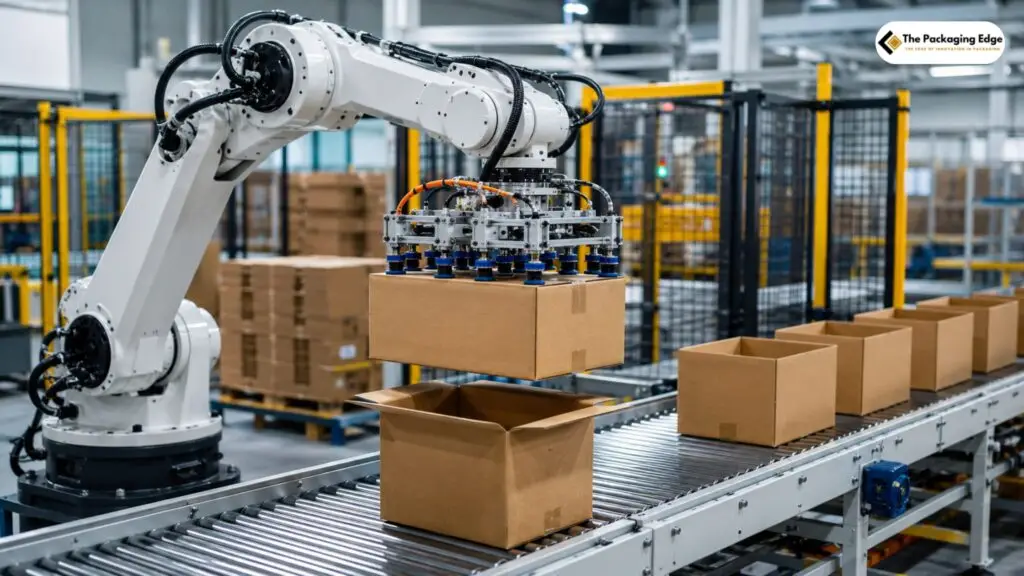
In today’s high-speed global marketplace, efficient case packing is no longer optional—it’s essential. Robotic case packers represent the cutting edge of packaging automation, delivering the throughput, flexibility, and reliability modern operations demand. These systems use industrial robots (articulated arms, delta robots, or cobots) to pick finished products and place them into cartons or trays with precision and speed. Unlike conventional machines with fixed tools, robotic packers use programmable motion and vision guidance to handle diverse product shapes and complex pack patterns. This post provides a comprehensive guide to robotic case packers – how they work, why they matter, and how The Packaging Edge delivers industry-leading solutions.
We’ll cover key benefits and ROI of automation, technical considerations, and practical purchasing advice. Every section is grounded in industry insights, vendor resources, and real-world case studies. By the end, you’ll see why partnering with The Packaging Edge is the surest path to transforming your packaging line for higher efficiency and profitability.
What Is a Robotic Case Packers?
A robotic case packers is an automated system that uses robotic arms to load products into shipping cases, cartons, or trays. These robots can be multi-axis (articulated) arms, delta-scara hybrids, or even collaborative arms, often equipped with end-of-arm tooling (grippers, suction, or custom tools) and vision sensors. The key advantage is flexibility: robots can change handling patterns and adapt to new products through software, rather than rebuilding mechanical parts.
Robotic case packers typically perform these functions:
- Product Infeed: Products arrive from upstream lines (fillers, labelers, etc.) via conveyors or tables. Robotics systems can integrate with singulation devices (screw feeders, vibratory bowls, etc.) to ensure proper spacing and orientation.
- Vision & Sensing: Many systems include 3D vision cameras or sensors to locate products, verify orientation, and detect quality issues. This allows robots to pick parts even if they arrive randomly or misaligned.
- Robotic Pick-and-Place: A robot (articulated or delta style) uses a specialized gripper to pick one or several items at a time and deposit them in a pre-determined pattern inside an open case. The robot’s path, speed, and grasping force are all programmed for the product and case type.
- Case Handling: Cases can be fed into the cell either pre-erected or formed on demand. Robotic systems synchronize with case erectors and sealers so that case erection, filling, and closure form a continuous flow.
- Control & Monitoring: A central PLC or PC coordinates all equipment. Operators use an HMI to set recipes (pick patterns, speeds, product-changeover parameters) and to monitor status. Modern systems even support remote diagnostics.
By combining these steps, a robotic case packing cell automates what used to be repetitive manual work. The result is faster cycle times, higher throughput, and more consistent packing quality. As one industry report notes, robotic case packers support varied operations (top loading, bottom loading, side loading) and common configurations like articulated arms, delta robots, gantries, and collaborative robots with vision guidance.
How Robotic Case Packers Work
Understanding the workflow of a robotic case packers highlights why it outperforms older machines. Here’s a simplified sequence in a top-load robotic case packing cell:
-
Product Singulation and Infeed: Finished products – bottles, cans, pouches, cartons, etc. – enter the system. Infeed conveyors (or lanes) line them up. Sometimes vibratory or timing-screw feeders are used for consistent spacing. The goal is a controlled flow so the robot always knows where the next item is.
-
Vision/Detection Stage (Optional): An overhead or inline vision system checks each item. It determines its position, orientation, and even verifies labels or fills. This intelligence lets the robot adjust on-the-fly. For example, if one carton is rotated 90°, the vision system will still guide the robot to grip and orient it correctly.
-
Robotic Pick-and-Place: A robot station with an articulated or delta arm picks products from the infeed. A custom gripper (suction cup, mechanical gripper, mechanical fingers with sensors, etc.) handles the load. The robot follows a programmed pick sequence – for instance, grab 6 bottles and place them simultaneously in a case, then grab the next 6. The robot’s flexibility means the pack pattern can be easily changed in software without rewiring hardware.
-
Case Loading: Meanwhile, cases are queued in a magazine or feed lane. A case erector may form boxes from flat blanks. The robot or an external pusher then loads the products into the open case. If it’s a top-load cell, the robot lowers items vertically; if side-load, a pusher arm may slide them sideways; for bottom-load, the case might be raised to meet the product. In any scenario, the robotic pick-and-place adapts to the case orientation.
-
Case Sealing and Discharge: After loading, cases proceed to a sealer (tape, glue, etc.) to close the top. Then an outfeed conveyor takes the completed cases for palletizing. The entire line is synchronized: the robot waits for the next open case, and feeding continues seamlessly.
-
Control System: Throughout this, a central control system (PLC/HMI) oversees timing and safety. Operators input pack patterns and speeds via an HMI. Modern interfaces allow quick changeovers – for example, switching from loading 12-pack bottles to 8-pack boxes may take only minutes of programming rather than hours of mechanical changeover.
At The Packaging Edge, we engineer these systems so that every component communicates. For instance, our integrators ensure the robot, conveyors, case erector, and sealers operate as one unit, rather than isolated islands. This integration is crucial to achieving the promised uptime and throughput. In short, robotic case packing replaces rigid machinery with intelligent, adaptable automation, yielding faster, more reliable operation.
Types of Robotic Case Packers
Not all robotic case packers are the same. The best configuration depends on product types, speeds, and plant constraints. Key categories include:
-
Articulated Robot Case Packers (6-axis or more): These are the classic “industrial arms” you see in many factories. With multiple rotary joints, they have a long reach and can handle complex 3D motions. Articulated robots excel with heavy or irregular products and complex pack patterns. They can swap end-effectors and reach into deep cases. Good for heavy-duty use: large bottles, bulky items, or mixed case sizes. However, they may be slightly slower per pick than delta robots.
-
Delta/Parallel Robot Case Packers: Delta robots (also called spider robots) consist of arms joined to a fixed base, usually mounted overhead. They have a very high speed and acceleration advantage for lightweight parts. If you’re packing bags, pouches, candies, or any light product at high speed, a delta case packer can achieve 35+ cases/minute. They often incorporate multiple “heads” to place several items at once. Their limited payload (typically 3–8 kg per pick head) and short working height suit foods and pharmaceuticals that require rapid, top-load packing.
-
SCARA / Cartesian Robot Case Packers: Some systems use simpler robots or gantry systems. These may have good speed and precision, but less flexibility than articulated arms. They’re useful for regular shapes and high-speed small-item applications. For example, a gantry (XYZ Cartesian) system might pick small cans or bottles with side/straight picks. Typically, these show up in cost-sensitive or high-speed standard pack patterns.
-
Collaborative Robot (Cobot) Case Packers: Cobots are designed to work alongside humans with minimal guarding. They can be used for lower-speed, lower-volume lines or in environments where safety or flexibility is a priority. A cobot case packer might load a few cases per minute and is easy to program. Cobots are ideal when space is tight or human workers need to frequently change box sizes. However, they tend to have lower throughput and payload compared to full industrial robots.
-
Hybrid Systems: Many modern installations combine robot types. For example, a delta robot might form a pattern of pouches, then an articulated arm loads them into a box. This leverages each robot’s strength – speed vs. reach – in one cell. Another trend is using multiple robots working in tandem, which can more than double throughput while still occupying less floor space than one massive machine.
Selecting the right robotic case packers means matching these types to your needs. The Packaging Edge evaluates factors like product size/weight, desired speed, and changeover frequency to recommend the optimal mix. We don’t push a one-size-fits-all machine; we engineer a custom solution. For example, our projects have used ABB or KUKA arms for palletizers and Fanuc or Yaskawa robots in case packing, always choosing whichever brand and robot type best fits the application. In short, whether you need a high-speed delta cell for snacks or a heavy-duty articulated loader for industrial goods, there’s a robotic case packers configuration that’s right for you.
Key Industries and Applications of Robotic Case Packers
Robotic case packers are truly industry-agnostic. Wherever products need to be boxed for shipping, you’ll find them. Notable sectors include:
-
Food and Beverage: This is one of the largest adopters. Bottles, cans, pouches, and cartons are case-packed at blistering pace. Hygienic design is crucial (washdown-rated robots, stainless conveyors). Robotic packers shine here with multi-flavor and multi-SKU lines, ensuring consistent packing of food products at speeds humans simply can’t match. 3D vision helps with irregular shapes like stand-up pouches. Many beverage lines move 30+ CPM – a tempo well-suited for robotic pick-and-place.
-
Pharmaceutical and Healthcare: Case packers in pharma must be ultra-precise and clean. Small bottles or vials require gentleness and accuracy. Robotics eliminate human touch (important for hygiene) and provide traceability. With strict compliance (FDA, cGMP) and frequent changeovers (different medicine packs), robots ensure error-free packing. Manufacturers appreciate the ability to validate patterns in software rather than mechanical retooling.
-
Personal Care & Cosmetics: Perfume bottles, creams in tubs, lipstick cases—these products are often delicate and need immaculate handling. Case packing robots provide consistency and prevent cosmetic damage. Plus, cosmetic lines see frequent SKU changes (new products regularly); a robot’s quick changeover (minutes via a program change) vastly outperforms old machinery that might require hours to reconfigure.
-
Consumer & Household Goods: Cleaning supplies, paper goods, and electronics are often heavy or bulky. Industrial robotic case packers can handle heavy loads and big sizes. For example, long boxes of tubes or heavy containers benefit from multi-joint arms. These systems can also handle long production runs without tiring or error – something critical for high-volume operations.
-
E-commerce and Fulfillment: Fulfillment centers have thousands of SKUs and erratic volumes. Robotic case packers bring scalability. One robot cell can pack dozens of different items into cases or cartons, changing recipes by switching recipes in the control system. During peak seasons, manufacturers can run multiple robots in parallel. And if demand falls, robots simply run at lower capacity, eliminating the scheduling headaches of hiring seasonal workers.
Across these industries, the common theme is the pressure to increase productivity while maintaining quality. As labor becomes scarce and product variety grows, robotic case packing is redefining end-of-line operations.
Benefits and ROI of Robotic Case Packers
Investing in a robotic case packers is a strategic decision. It has significant upfront cost, but the long-term benefits can be transformative. Key advantages include:
-
Increased Throughput and Consistent Speed: Robots never tire. They run at programmed speeds shift after shift, ensuring constant output. A well-designed robotic packer can operate 24/7, often boosting throughput well above manual or semi-automatic methods. Users routinely see higher outputs per shift with fewer stops. For example, case throughput can double or triple when switching from manual/collapse methods to robotics, especially on multi-SKU lines. Industry data shows that replacing a mechanical system with a robotic one can more than double line speeds in some cases.
-
Labor Savings and Workforce Optimization: Manual case packing is labor-intensive, ergonomically hard, and susceptible to human error. Each case requires lifting, reaching, and careful placement. Robots take over these repetitive motions, reducing the risk of injuries and the dependency on scarce labor. This lowers operational labor costs significantly over time. Rather than being replaced, skilled workers are freed up to do higher-value tasks: programming, quality inspection, maintenance, or continuous improvement. Industry reports often cite 30–50% labor cost reductions after implementing case packing robots.
-
Unmatched Flexibility: Changeovers that used to take hours with mechanical tooling can now occur in minutes through software. Modern robotic cells store multiple recipes – pack patterns, product dimensions, case types – which can be loaded at the touch of a button. This means you can switch SKUs and case sizes rapidly to meet dynamic market demands. In fact, the flexibility of a robotic case packers often makes short or mixed production runs economically viable. As one industry note points out, innovations in machine vision and AI now allow systems to handle varied SKUs and fragile items with minimal changeover time, suiting today’s high-mix, low-volume reality.
-
Improved Packaging Quality: Robots place products with millimeter precision consistently. Each item is secured in exactly the same way, reducing the chances of mispacked cases or damaged goods. Poor packing leads to crushed items, customer returns, or extra work downstream. By automating the packing process, manufacturers see a dramatic drop in packing-related defects. This protection of the product safeguards brand reputation and cuts costs tied to rework or warranty claims. As the OCME packaging study notes, properly automated case packing significantly reduces product damage during handling and transport.
-
Space Savings and Line Optimization: Robotic cells can actually have a smaller footprint than their mechanical counterparts. Robots can be ceiling-mounted or compactly arrayed, and multiple smaller robots often take up less space than one large machine. Meanwhile, conveyors and case erectors can be tightly integrated with the robot work envelope. This space optimization means you can either free up production floor or pack more cases in the same area.
-
Operational Consistency and Uptime: Robots deliver consistent cycle times and don’t have “down days.” With proper preventive maintenance, modern robotic systems achieve very high uptime – some companies report >99% uptime once stabilized. The control system continually monitors performance and can alert operators to any issues, enabling quick responses. This reliability translates to meeting delivery schedules and production targets more predictably.
-
Material and Energy Efficiency: Robotic case packers often include features to optimize the use of packaging materials. They precisely handle film, carton dimensions, and sealant usage, minimizing waste. For example, vision-guided robots ensure cases are filled correctly the first time, so you don’t waste corrugate or tape on rejects. Additionally, high-efficiency drives and smart operation can reduce energy use. Over time, these savings support sustainability goals and cut operational expenses.
-
Strong ROI Over Time: All these benefits combine to deliver a compelling return on investment. While a robotic packer may cost more upfront than a traditional machine, the long-term value is higher. Users often see payback in 2–3 years or less due to the accumulated gains in labor savings, throughput, and reduced waste. Industry analyses confirm that robotic case packers offer superior lifetime value compared to fixed tooling systems. For example, one report found that after robotization, facilities achieved much higher uptime and labor cost reductions, justifying the investment despite the higher capital cost.
In summary, the benefits of robotic case packing extend beyond mere speed. They touch every aspect of the operation: cost, flexibility, safety, and quality. As one expert chart compares, robotic packers deliver “extremely high” flexibility, minute changeovers, compact footprint, low labor needs, and high long-term ROI—parameters where traditional machines can’t keep up. These advantages make robotics the strategic choice for any manufacturer aiming to stay competitive.
Robotic Case Packers vs Traditional Case Packers
To appreciate the shift, consider how robotic and traditional mechanical case packers differ:
-
Flexibility: Traditional case packers often use fixed cams, pushers, and tooling designed for one product and case size. Changing to a new SKU can require significant downtime and hardware change. In contrast, robotic systems adjust via software. The flexibility rating for a robotic case packers is extremely high versus limited for mechanical machines.
-
Changeover Time: Classic machines might need hours or even days for a full pack pattern change (switching dies, adjusting mechanical settings). Robotic cells can do this in minutes by loading a different program from the recipe library.
-
Footprint: Surprisingly, robotics can be more compact. Multiple small robots (some mounted overhead) can pack as many cases as a large machine covering more floor area. Traditional packers, especially high-speed side-loaders, require substantial conveyor infeed and outfeed, plus room for mechanical pushers.
-
Product Mix Capability: Mechanical systems are best at high-volume, single-SKU runs. They struggle with variety. Robots excel at mixed SKU lines – easily reconfiguring to pack different products, sizes, or orientations without hardware swap-outs.
-
Labor Dependency: Robots greatly reduce the number of operators needed on a line. Traditional packers usually need several workers loading cases, clearing jams, and doing manual tasks. With robotics, one technician may monitor multiple cells. This lowers labor dependency dramatically.
-
Overall ROI: Over the long haul, robotics tends to win on ROI. While initial capital is higher (robot costs, safety fencing, vision systems), the lower operating costs and higher output pay back quickly. Traditional machines might be cheaper up front, but their inflexibility and labor demands erode value over time.
That said, conventional case packers do still have a niche: very high-speed, single-product runs where throughput is king and changeovers are rare. For example, some beverage can lines pushing 100+ CPM might still use a high-speed mechanical side-loader and get the job done efficiently. But for most modern manufacturing environments with SKU proliferation and automation goals, robotic case packers are clearly the future.
Choosing the Right Robotic Case Packers
Selecting and purchasing a robotic case packing solution should be a strategic process. Here are the crucial steps The Packaging Edge advises:
-
Evaluate Your Products: List every product you plan to pack. Note the dimensions, shape (rigid, flexible, fragile), and weight of each item and its packaging. Are there delicate goods (glass bottles, electronics) or robust items (bricks, metal hardware)? This will determine robot payload requirements and gripper design. For example, heavy glass bottles may need a strong 6-axis robot, while light snack bags might be ideal for a delta robot.
-
Define Throughput Requirements: Calculate current and desired packing rates (cases per minute/hour). Factor in peak season surges and future growth. Determine if the goal is purely maximum speed, or also quick variability (e.g. seasonal lines with many SKUs). If you need, say, 30–60 CPM on a multi-SKU line, a robotic solution is likely the best bet. But if you need 200+ CPM on one SKU 24/7, you might consider if a combined approach (robots for variety periods and fixed line for base runs) makes sense.
-
Assess Footprint and Layout Constraints: Measure available floor space and ceiling height. Many facilities underestimate how robot cells can fit into odd corners or go overhead. Ensure enough clearance for robot arms to operate safely. Identify existing upstream/downstream equipment – conveyors, case erectors, palletizers – and how a new cell would connect. The Packaging Edge will usually perform a detailed Plant Layout study, often using 3D models, to confirm the new system integrates with minimal disruption.
-
Plan for Flexibility: How many SKUs do you handle today, and how many might you add? If you have dozens of box sizes and products, flexibility is critical. Ask about features like automatic tool (EOAT) changeover, vision-guided picking (so the robot doesn’t rely on exact product positioning), and how easily new recipes are taught. Automatic tool changers allow a single robot to switch grippers when moving between products, minimizing downtime. Also consider whether you might use multiple robots: systems with two robots can run one while the other changes over, doubling uptime.
-
Consider Total Cost of Ownership: Beyond initial purchase price, think holistically. What are maintenance requirements? How available are spare parts? Is support global (if you have multiple plants)? Factor in energy use, software upgrades, training, and warranty. Weigh predicted ROI: compare one-time costs versus saved labor, increased throughput, and reduced waste. As one ROI model shows, factors like reduced labor costs, increased throughput, improved quality, fewer injuries, and higher uptime all contribute to payback. The Packaging Edge can provide modeled ROI scenarios for your specific case, showing exactly when the investment will pay off in your operation.
-
Integration Capabilities: A robotic case packers is only as good as its integration. Ensure your supplier (or systems integrator) has experience tying together diverse equipment. In practice, we look at PLCs, HMIs, conveyor controls, safety fencing, and how the robot cell will sync with case erectors and palletizers. The best providers (like us) will offer turnkey integration – including PLC coding, HMI screens for your line, safety layout design, and end-to-end testing.
In summary, choosing a robotic case packers is not just a buying decision—it’s an engineering project. The Packaging Edge approaches it by first understanding your unique needs, then applying best-in-class robotics and controls technology to meet them. We stand ready to guide you through each of the above steps, ensuring you get a system that fits your products, your plant, and your budget.
Robotic Case Packers Integration: The Make-or-Break Factor
Even the most advanced robotic case packers is only as effective as its integration into your production line. In practice, integration is the crucial step that separates a fun demo from a truly productive system. Key aspects include:
-
End-to-End Synchronization: The robot cell must “talk” to upstream and downstream devices. For example, the case erector needs to cue the robot when a new case is ready to be filled, and the robot in turn signals when the case is full and the sealer can proceed. If conveyors start before the previous stage is finished, you get jams and downtime. Proper integration ensures smooth handoffs.
-
Control System Standardization: The Packaging Edge typically uses industry-standard PLCs and HMIs to maintain consistency. We standardize on robust controllers (Allen-Bradley, Siemens, etc.) so that operators and maintenance teams see a familiar interface and programming environment. This reduces training time. The entire line should feel like one machine under one HMI – no “black box” islands.
-
Safety Systems: Robots require safety fencing or light curtains. Integrators must carefully design safety zones so that the robot stops instantly if a person enters a guarded area. At the same time, safety should not cause nuisance stops. The Packaging Edge includes safety audits and performance-rated safety controls to maximize uptime without compromising personnel protection.
-
Data and Industry 4.0: Modern lines benefit from data connectivity. Integrated robots can report throughput, cycle times, and even self-diagnose via Industry 4.0 protocols. We can implement connectivity (Ethernet/IP, OPC-UA, etc.) so your MES or SCADA systems can monitor the cell. Predictive maintenance features (analyzing vibration or motor currents) can be added to schedule service before breakdowns occur.
-
Testing and Training: Finally, thorough testing (Factory Acceptance Testing, or FAT) ensures the integrated system works as intended before shipping. Then on-site, The Packaging Edge helps with commissioning, operator training, and ensuring a smooth start-up. We also offer commissioning support, project management, and even simulation of the system beforehand.
Poor integration is often the largest hidden cost of automation projects. By contrast, a well-integrated solution maximizes the benefits outlined earlier – full throughput, safety, and reliability. This is where an experienced integrator shines. The Packaging Edge has a track record of delivering fully integrated solutions that outperform standalone machines. Our clients benefit from our knowledge of PLC coding, motion control, and case-packing mechanics – ensuring every component works in harmony.
Overcoming Common Challenges: Robotic Case Packers
Every end-of-line automation project faces hurdles. Here are frequent concerns and how we address them:
-
High Initial Investment: It’s true: advanced robotic packers cost more upfront than a simple mechanical machine. But we shift the focus to ROI. By calculating lifecycle costs (labor savings, increased output, reduced waste), we show clients how the investment typically pays for itself in a few years. As one Packaging Edge client found, despite a higher sticker price, their robot paid back sooner than expected due to higher uptime and lower labor than the legacy system. We often share case studies and ROI models to help justify the project. In many cases, grants or financing programs are available for automation, which we can help explore.
-
Fear of Complexity: Some operations worry that robots require PhD-level programming. In reality, modern robotic case packers feature intuitive interfaces. Our systems come with HMI screens where even operators with basic training can change pack patterns. Simulations and teaching modes simplify setup. We also offer remote support: our engineers can log in (with your permission) to adjust settings or troubleshoot without a site visit. The learning curve is small; operators often tell us how easy it is to switch recipes and monitor status.
-
Workforce Resistance: Introducing robots can be met with pushback from staff worried about job loss. We combat this by framing automation as a tool for workforce elevation. Robots relieve workers of tedious, heavy, or hazardous tasks, enabling them to learn higher-skilled roles. For example, a worker who once jammed cases manually can become a robot operator or line supervisor. We highlight successful transitions at other facilities and involve your team early – workers help define the system so they see it as an asset, not a threat.
-
Integration with Existing Equipment: Upgrading a line partway can be challenging if old machines have proprietary controls. Here, our vendor-agnostic approach is critical. We will often interface with legacy equipment (using signal converters, custom PLC code, or even control net bridges) to make the new cell fit smoothly. If needed, we can retrofit older machines with new I/O and HMI panels to modernize them simultaneously. The goal is a seamless automated flow, not a Frankenstein line of mismatched machines.
-
Maintenance and Support: Customers often worry about who will fix the robot when it needs service. We preempt this by designing for maintainability. For instance, we provide spare parts kits, and we offer training for your maintenance team. Many robotics brands have global service networks; The Packaging Edge can connect you with local support in any region. Additionally, our long-term service contracts include periodic audits to keep the cell in top shape.
In all these cases, the key is choosing the right partner. The Packaging Edge’s experience means we’ve seen every obstacle and know how to plan around it. With careful upfront planning and open communication, the challenges of robotic case packers become manageable steps toward a much stronger operation.
Future Trends in Robotic Case Packers
Robotic case packing technology is evolving rapidly. To ensure your investment stays cutting-edge, it’s helpful to know the trends:
-
Advanced Vision and AI: Today’s systems already use 3D cameras, but the next wave is AI-driven vision that can learn on the job. This means even more variety: the robot will recognize new products by “sight” and adapt in real-time. For example, deep learning could allow a cell to pick mixed pallets of different snacks without explicit programming. The Packaging Edge keeps pace with these advances by partnering with vision specialists and robotics pioneers.
-
Collaborative Robotics (Cobots): Cobots will become more capable in case packing. Imagine a cobot cell with an integrated lightweight robot, little fencing (because it’s safe by design), and simple programming. These will suit smaller facilities or those hesitant to introduce full-scale automation. We’re already designing hybrid work cells where humans and cobots jointly pack cases, combining machine speed with human judgement for the most complex tasks.
-
Plug-and-Play Modular Cells: Borrowing from Industry 4.0, manufacturers want faster deployment. The trend is toward modular robotic cells – pre-engineered “boxes” that can be dropped onto a line and almost self-integrate. For instance, a plug-and-play case packer might include an onboard scanner that auto-configures itself to nearby conveyors. The Packaging Edge is part of this trend, offering modular designs and standardized interfaces to reduce engineering time on every project.
-
Predictive Maintenance & Connectivity: Robots will be even smarter about uptime. Sensors will continuously monitor each axis and gripper, predicting failures before they happen. Data analytics (edge computing) will alert maintenance teams early. On the integration side, expect greater connectivity: your robotic line will fit into the factory’s IoT ecosystem, feeding data back to a central dashboard. This means packaging operations can be monitored remotely in real time.
-
Sustainability & Material Innovation: Packaging sustainability pressures are pushing case packers to handle new materials (recycled cardboard, thinner boxes) and pack more efficiently. Robots can optimize the packing algorithm to use less void space, or to pack in patterns that reduce wasted material. Additionally, lighter end effectors and regenerative drives mean future robots could use significantly less power. We’re already seeing companies emphasize “green automation”, and The Packaging Edge advises clients on selecting eco-friendly options (like LED lighting in cells, low-power modes, and recyclable components) to keep operations both profitable and planet-friendly.
-
Greater Accessibility and Training Tools: Virtual reality (VR) and augmented reality (AR) are beginning to aid robot cell design and training. We anticipate The Packaging Edge using AR tools to train your staff on the new system before it’s even built. Imagine your operators wearing AR glasses to visualize how the robot will move, or simulate changeovers in a virtual environment. This will shrink adoption time and boost confidence.
The bottom line is that robotic case packing is only getting smarter, faster, and more adaptable. Companies that invest now will be ready for the next wave of automation – whether that’s a new vision upgrade, a cobot helper, or expanded capacity. Importantly, The Packaging Edge continues to track these trends and update our solutions accordingly. When you partner with us, you’re not just buying a machine; you’re tapping into ongoing innovation so your line stays state-of-the-art.
Why The Packaging Edge Is Your Trusted Automation Partner
Choosing a provider for robotic case packing isn’t just about the machine – it’s about expertise. The Packaging Edge stands apart because we combine deep technical knowledge with practical experience across industries. Here’s what makes us uniquely qualified:
-
Custom-Engineered Solutions: We don’t offer off-the-shelf, one-size-fits-all machines. Every robotic case packers we build is engineered to the customer’s specific needs. We consider product physics, pack patterns, facility layout, and future plans. This engineering-first approach ensures the solution truly optimizes your line.
-
Vendor-Agnostic Integration: We use the best robot and component brands for the job. Whether it’s ABB, Fanuc, KUKA, Yaskawa, or another leading robotics firm, we have experience integrating them into case packers. We do this to ensure performance, not to push a particular brand. The result is that you get the most advanced technology in your packer – selected objectively for value and fit.
-
Global Experience, Local Support: The Packaging Edge serves manufacturers worldwide. Our team has managed installations and integrations on three continents. This global perspective comes with local support: when you work with us, you tap into a network of partners and service resources wherever you are. We know the regulatory requirements for food, pharma, or consumer goods packaging in any region, and we help you meet them.
-
Long-Term Partnership: We focus on your long-term performance. Unlike some suppliers who disappear after installation, we offer ongoing support: preventative maintenance programs, spare parts stocking, and training updates. Our goal is that your robotic case packers delivers expected ROI year after year. As one satisfied customer said, we “earned their trust by focusing relentlessly on performance, reliability, and ROI”.
-
Real-World Manufacturing Insight: Many integrators are great with controls but lack floor experience. At The Packaging Edge, our engineers have hands-on backgrounds in factories. We understand what happens when product variation spikes or when an operator presses the panic button. This perspective informs our designs – for instance, we always include easy entry points for jam-clearing, or utilize bright indicator lights so anyone can see machine status at a glance. It’s this blending of automation know-how and shop-floor practicality that gives our customers a true competitive edge.
-
Focus on Business Outcomes: Finally, we never lose sight of why you’re automating. It’s about solving business problems – meeting demand, reducing costs, scaling up. Every project we take on starts with those goals. We tailor the robotic case packers not just to fit your machines, but to solve your pain points. We know you need measurable results: faster line rates, lower staffing costs, higher yield. We will help you define those targets up front and then deliver a system that achieves them, ideally exceeding expectations (as many Packaging Edge clients have experienced).
In short, The Packaging Edge is built on the premise of earning your business through expertise and results. When you need to automate case packing, our team is the partner that ensures the investment not only pays off – but pays forward, driving long-term success.
Conclusion: Take the Next Step Toward Packaging Excellence
Robotic case packers are more than machines; they are strategic assets in the race for efficiency and market leadership. In an era where speed, agility, and precision define success, outdated manual or fixed machinery simply can’t keep up. By choosing a robotic solution, you free your operation from labor bottlenecks, achieve consistent quality, and position your company for future growth.
But transformation doesn’t happen on its own. It requires an automation partner who truly understands your industry and your objectives. The Packaging Edge offers that partnership. We have the engineering talent, the vendor neutrality, and the global experience to deliver a case packing solution tailored to your challenges. From initial feasibility to final commissioning, we stand with you, ensuring every aspect of the project is engineered for peak performance.
If your goal is to lead rather than follow – to pack smarter, faster, and more profitably – then now is the time to act. Email us directly at thepackagingedge@gmail.com to start a conversation. Our experts will listen to your needs, share insights from hundreds of successful deployments, and show you how a robotic case packers can transform your packaging line. With The Packaging Edge by your side, you’ll get a robust, future-ready system that drives measurable results today and prepares you for whatever tomorrow brings.
Let The Packaging Edge be your partner in packaging automation. We help manufacturers like you design, implement, and optimize robotic case packing solutions that deliver a true competitive advantage. Contact us now, and let’s build the smart packing line your business deserves.
Related Articles
- Flow Wrap Packaging Machine: The Ultimate High-Speed Wrapping Solution
- Vertical Cartoner: The Complete Guide to High-Speed, Precision Cartoning Solutions for Modern Packaging Operations
- Cartoner Machines: The Complete Guide to Smarter, Faster, and Scalable Packaging Solutions
- Horizontal Cartoners: Efficiency, Precision, and Scalable Packaging Solutions
- Cartoner Machines: Boosting Efficiency, Precision, and Profitability in Modern Packaging
- Corrugated Box Maker: The Ultimate Guide to Choosing, Customizing, and Scaling Your Packaging Strategy
- The Complete Guide to Horizontal Flow Wrap Machines: Efficiency, Precision, and Scalable Packaging Solutions
- The Ultimate Guide to Choosing the Right Pallet Wrapper Machine for Your Business
- The Ultimate Guide to Choosing the Right Corrugated Box Machine for Your Business
- Shrink Wrap System: The Ultimate Guide to Efficient, Scalable, and Cost-Effective Packaging