
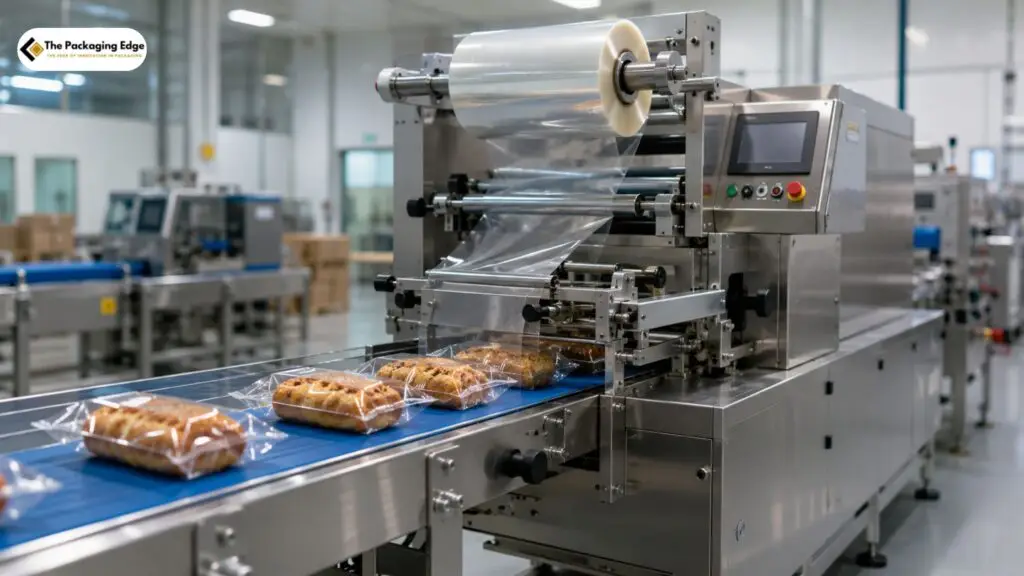
Flow Wrap Packaging Machine: In today’s competitive manufacturing environment, flow wrap packaging machines are vital for delivering products faster, safer, and with a professional finish. A flow wrap packaging machine (also called a horizontal form-fill-seal or HFFS machine) automates the process of wrapping products in a continuous film, sealing the film on three sides, and cutting off individual packages. This method—often used for snacks, bakery items, medical supplies, and more—creates tight, protective pillow packs or other shapes while running at very high speeds. By integrating precision sensors, servo drives, and user-friendly controls, modern flow wrap packaging machine ensure consistent seal quality and throughput.
As global industry analysts note, packaging machinery has become “a decisive role in determining production efficiency, quality stability, hygiene compliance, product safety, cost structure, and labor reduction”. In other words, a flow wrap packaging machine is more than a piece of equipment—it’s a strategic investment that boosts productivity and protects brand quality. The Packaging Edge stands ready to be your expert partner in this transformation, helping you select and deploy the ideal flow wrap packaging machine for your line.
What Is a Flow Wrap Packaging Machine?
A flow wrap packaging machine is an automated equipment that feeds products horizontally through a wrapping section, forming film around them, sealing, and cutting to make individual packages. In practice, products move in on a conveyor and are wrapped in a continuous plastic (or laminate) film. The machine creates a longitudinal seal along the package and two end seals, resulting in a tightly enclosed pack. This method is also known as horizontal form-fill-seal (HFFS). According to The Packaging Edge, “a horizontal flow wrap packaging machine is an automated packaging system designed to wrap products in a continuous film. The product is fed horizontally into the machine, where it is sealed inside a flexible packaging material, typically plastic film”. Flow wrap packaging machine is ideal for lines handling uniform items in bulk, such as biscuits, chocolates, medical kits, soaps, and hardware parts.
Unlike manual or semi-automatic wraps, these machines operate in continuous motion, dramatically improving output. The end result is a pillow-style or center-fold pack that is both attractive and protective. In essence, flow wrap packaging machines blend three critical steps—forming, filling, and sealing—into one seamless cycle. This automation not only maximizes speed but also ensures uniform package size and seal quality. As one industry source explains, products are “placed on a conveyor belt, a roll of packaging film is unwound and shaped into a tube around the product… a longitudinal seal is created along the length of the package, and end seals are applied at both ends”. Finally, the wrapped package is cut and discharged as a finished unit.
For businesses, this means hundreds (or even thousands) of packages per hour can be produced with minimal human intervention. The combination of high throughput, consistency, and versatility makes flow wrap packaging machines an excellent choice for high-volume operations across food, healthcare, personal care, and industrial sectors.
How Does a Flow Wrap Packaging Machine Work?
Understanding the flow wrap packaging machine process highlights why these machines boost efficiency. The operation typically follows these steps:
- Product Feeding: Items are loaded (manually or automatically) onto an infeed conveyor in a horizontal orientation. The conveyor carries the products at a steady pace into the wrapping section.
- Film Unwinding and Forming: A roll of flat packaging film (plastic, laminate, or even paper) is mounted on the machine. As the products arrive, the film is unwound and guided around them by forming collars or tubes, creating a continuous film tube enveloping each item.
- Sealing: The machine applies a longitudinal seal along the length of the film tube (using heated sealing bars), and transverse (end) seals at set intervals. This encloses each product in a sealed pouch or packet.
- Cutting and Discharge: After sealing, blades or cutters separate each package. Completed packs exit the machine onto an outfeed conveyor for boxing, cartoning, or shipping.
The Packaging Edge details this process: “Products are placed on a conveyor belt and fed into the machine… a roll of packaging film is unwound and shaped into a tube around the product. A longitudinal seal runs along the bottom, and end seals are applied at both ends. The wrapped product is cut and discharged as a finished unit”. This continuous flow operation is what gives the machine its name: every step flows into the next without interruption.
Key technological features enable this efficiency. Most modern flow wrap packaging machines use servo motors for precise film control and indexing, touchscreen interfaces for easy recipe changes, and no-product/no-seal detectors to prevent waste. For example, advanced machines include “’No Product–No Bag’ detectors” that skip sealing when no item is present, saving film. Many machines also offer barcode and batch printing (integrated in-line label printers) so that production data is printed directly onto the film during wrapping.
By streamlining the packaging process, flow wrap packaging machines minimize handling and keep outputs consistent. In practice, a properly set-up flow wrap packaging machine feeds, seals, and cuts hundreds of packs per minute with precise timing. Whether packaging stacks of biscuits or bundles of razor blades, the workflow remains the same. These machines excel at tasks that would be repetitive and slow by hand, making them a powerful productivity tool.
Key Benefits of Flow Wrap Packaging Machines
flow wrap packaging machine delivers a powerful combination of speed, protection, cost savings, and branding that few other methods can match. Some of the top advantages include:
-
High-Speed, High-Volume Production: Modern flow wrappers can achieve hundreds of packages per minute, easily handling high-volume production needs. As The Packaging Edge explains, “flow wrap machines can package hundreds of products per minute…ideal for industries where volume and speed are critical”. By dramatically increasing output, businesses shorten lead times and can meet surges in demand. Fast packaging also drives down labor costs: fewer operators are needed to pack the same number of products. In practical terms, companies often see faster time-to-market and higher profitability once automated flow wrapping is in place.
-
Consistent Quality & Precision: Automated wrapping eliminates the variability of manual packing. Every pouch or bag is sealed with uniform pressure and heat settings. The Packaging Edge notes that horizontal wrappers ensure “uniform sealing, consistent package size, and reduced product damage”. This means less rejects or rework, and shelf-ready packs that look the same every time. Consistency also enhances brand image—customers expect professional packaging. Advanced features like in-line quality sensors can detect seal defects or film wrinkles, ensuring each package meets specifications.
-
Superior Product Protection: The airtight seals created by flow wrapping protect contents from external factors. With a secure, hermetic seal on three sides, wrapped products are shielded from moisture, dust, oxygen, and contaminants. For perishable food, this means a longer shelf life. For electronics or hardware, it means protection from dirt and damage. As one industry guide points out, “flow wrap packaging provides a tight seal that protects against moisture, dust, contamination, [and] oxygen exposure Extending shelf life and improved product quality”. Many machines can also incorporate Modified Atmosphere Packaging (MAP) in-line, flushing the film tube with inert gas (like nitrogen) to push out oxygen, further extending freshness.
-
Reduced Material Waste and Costs: Compared to rigid or bulky packaging, flow wrapping often uses less material. The film is closely fitted to the product, cutting out empty space. According to industry sources, flow wrap packaging machines “utilize the packing material to the maximum, resulting in lesser wastage”. This efficiency lowers material expense and reduces shipping volume. The Packaging Edge also notes that flow wrapping uses “less material” than conventional packs, “reducing both production and shipping costs”. Over time, these savings contribute to a lower cost-per-package. Plus, faster packaging speeds and lower scrap rates drive down labor and overhead.
-
Versatility for Many Products: Flow wrap machines handle an extremely wide range of products. From tiny hardware items to large bars of soap, the machines can be adjusted for different lengths, widths, and heights. The adjustable forming tubes and servo controls mean quick changeovers between products. For example, a single machine can switch between wrapping biscuits, then car parts, then ice cream bars, by simply adjusting settings. The CHLBpack guide observes that “flow wrap packaging machines can handle a wide array of products, from delicate baked goods to robust industrial parts”. This flexibility makes them popular across industries and product lines. Quick-change tooling and recipe storage in modern machines reduce downtime when switching products.
-
Enhanced Branding and Product Appeal: Packaging is often the customer’s first impression of a product. Flow wrap film can be pre-printed with full-color graphics, logos, and information. High-resolution printing on plastic film is economical and eye-catching. Transparent film also provides a clear window to display the actual product inside. As noted by The Packaging Edge, flow wrapping “allows brands to showcase vibrant graphics, include product information, and strengthen brand identity”. In practice, companies find that attractive printed flow packs stand out on shelves and can boost sales. (One case study even reported a ~20% increase in retail visibility after switching to custom-printed flow wrap film.)
-
Improved Ergonomics & Safety: By automating repetitive packaging tasks, flow wrap packaging machines reduce worker strain and risk of injury. Operators no longer have to manually count and seal packs, which can be physically taxing and error-prone. Instead, one operator can oversee multiple machines or focus on quality control. Automated wrappers also often include safety guards and alerts, further protecting personnel.
In summary, flow wrap packaging combines speed, protection, and cost-effectiveness. It delivers faster throughput and lower per-unit labor than hand packing, while providing airtight, professional-looking packages. The real-world impact is clear: manufacturers often see rapid ROI. Spack Machine (a packaging equipment specialist) cites studies showing payback in 12–24 months for flow wrappers, with typical labor reductions of 50–70%. In practice, that means a machine costing tens of thousands of dollars can pay for itself in months by slashing labor and waste.
Common Flow Wrap Packaging Machine Applications and Industries
Flow wrap packaging machine are used in virtually every sector that packs multiple items rapidly. Some of the most common applications include:
-
Food & Beverage: This is the largest market for flow wrapping. Popular uses include wrapping biscuits, cookies, chocolate bars, snack bars, fresh produce, and ready-to-eat meals. Because the seal is sterile and oxygen-tight, flow wrap is ideal for bakery items and confections to keep them fresh. The speed is perfect for high-demand lines (e.g. 24/7 snack production). Modified atmosphere flow wrapping is often used for perishable foods. Even liquids can be flow-wrapped in pouches using form-fill machines with spouts.
-
Pharmaceuticals & Medical Supplies: In pharma, precision and hygiene are paramount. Flow wrappers package items like syringes, disposable medical kits, tablets, and hygiene products. The controlled sealing ensures sterility until the pack is opened. Metal or plastic trays of surgical tools can also be flow-wrapped under sterile cleanroom conditions. The wrapping film can be chosen to meet medical regulatory requirements, and the machines are built with stainless steel and washdown features for cleanliness.
-
Personal Care & Cosmetics: Flow wrap offers a clean, attractive way to package soaps, wet wipes, cosmetic sample kits, toothbrushes, and more. The visibility of the product through transparent film and the ability to print eye-catching designs make it ideal for shelf appeal. For example, soap bars and beauty masks are commonly individually flow-wrapped. Flow wrapping also protects these products from moisture and contamination.
-
Consumer & Household Goods: Small electronics accessories (like mouse mats, phone cables), stationery (glue sticks, stamps), and even hardware items (nails, screws) are often flow-wrapped. The sturdy sealed pack protects parts during shipping and storage. For bulk consumer goods (e.g. bulk snacks), multiple items can be wrapped together with horizontal machines too.
-
Industrial and Specialty Items: Customized or irregularly shaped industrial components (plastic gears, gaskets), long items like wires or tubes (in combinations), and even garments or textiles can be flow-wrapped. The film protects from moisture and abrasions. In addition, food-service products (like pre-filled rolls for delis) and agricultural products (bulbs, seeds) are sometimes flow-wrapped to extend shelf life and improve handling.
In essence, if a product can be laid out in one plane and moved through a machine, it can likely be flow wrapped. Many Packaging Edge customers in diverse markets—snacks, pharma packaging, hardware supply, and beyond—have standardized on flow wrapping for their high-volume needs. By selecting films and machines suited to each product, manufacturers ensure both quality and efficiency.
Types of Flow Wrap Packaging Machine
Although the basic flow wrap concept is consistent, machines vary in design and functionality. Key variations include:
-
Horizontal vs. Vertical flow wrap packaging machine: The standard horizontal flow wrap packaging machine feeds products lying flat or on edge through a horizontal conveyor, as described above. There are also vertical flow wrap packaging machine that work with the product standing upright. Vertical machines are often used for products that cannot easily lie flat (e.g. stacks of cards, trays) or in packaging areas with space constraints. Vertical wrappers can also be more gentle on fragile items.
-
Rotary vs. Box-Motion Flow Wrappers: The sealing/cutting mechanism can operate in different ways. In rotary flow wrappers, a rotating turret or wheel moves continuously, carrying products through the sealing jaws in a circular motion. These machines excel at very high speeds and are ideal for uniform, small items (like candies, biscuits, snack bars). In contrast, box-motion flow wrappers move products in a more linear or “boxy” index motion. Box-motion machines are slightly slower but can handle a wider variety of shapes and more precise sealing, making them better for delicate or irregular items (e.g. small cakes, pastries, or hardware). The choice depends on the product: high-volume candy lines often use rotary, whereas specialty food or healthcare lines use box-motion machines for versatility.
-
Standard vs. High-Speed vs. Entry-Level: flow wrap packaging machine range from basic entry-level models for small businesses (50–150 packs/minute) to sophisticated high-speed machines (up to 400–1500+ packs/minute). Entry-level machines are compact and simpler, whereas high-end systems include full servo drives, automated controls, vision systems, and even Industry 4.0 connectivity. Many manufacturers also offer modified atmosphere (MAP) flow wrappers with built-in gas flush systems, and servo-driven machines for precise handling.
-
Specialized Models: Some flow wrap packaging machine have extra features such as built-in weighers, metal detectors, or collators for bundling products. Others are designed for harsh environments (stainless steel construction for cleanrooms) or for specialty films (like cold-seal adhesives for chocolates).
Understanding these types helps ensure the right machine is chosen for the job. For example, if your line needs extremely high throughput on a single uniform snack item, a rotary high-speed wrapper might be optimal. If your product range includes fragile cosmetics or large paper products, a box-motion or vertical machine might be safer. The Packaging Edge team can guide this selection process, matching your product profiles to the ideal flow wrap packaging machine.
Choosing the Right Flow Wrap Packaging Machine: Key Features
Investing in a flow wrap packaging machine requires matching its capabilities to your production needs. Here are critical factors to evaluate:
-
Production Speed & Throughput: Determine your current and future volume requirements. Machines are rated by packs per minute (ppm). Choose a machine whose maximum speed comfortably exceeds your peak demand to avoid bottlenecks. For example, a mid-sized food plant may need 150–400 ppm, while mass-production facilities use 400–1500+ ppm systems. Remember that heavier or larger products and thicker films may reduce speed, so consult suppliers for realistic rates.
-
Film Compatibility: Not all wrappers handle every film type equally. Ensure the machine supports the packaging films you plan to use—common ones include polypropylene (PP), polyethylene (PE), laminated film, or even biodegradable/compostable films for sustainable packaging. The Packaging Edge advises verifying compatibility with your chosen materials. Some machines offer multi-layer or cold-seal options if needed.
-
Product Size Range and Changeover Ease: Check the maximum product dimensions each machine can wrap. The machine’s forming tube and sealing jaws must accommodate your largest items. Also consider how quickly the machine can switch to smaller or different products. Features like adjustable forming collars, memory touchscreens for recipes, and quick-release tooling reduce changeover time.
-
Automation & Controls: Look for modern controls (touchscreen HMI) that allow easy adjustment and recipe storage. Automatic feeding systems (vibratory or conveyor feeders) are invaluable for bulky flows. Servo drives on jaws and conveyors mean precise motion and easy adjustment. The Packaging Edge suggests features like automatic feeding and advanced controls (touchscreens, error detection) to minimize errors and labor. Machines with remote diagnostics or PLC integration can also link into broader production systems.
-
Sealing Technology: Ensure the sealing method suits your products. Standard heat seals work for most applications, but for heat-sensitive products you may need cold-seal jaws. Check if the machine offers an innovative sealing system (some use “no-melt” seals or double-seal jaws for extra strength).
-
Quality Control Integration: Many high-end wrappers can integrate vision systems, checkweighers, or metal detectors on-line. This allows automatic rejection of faulty packs, ensuring only perfect packages move forward. Depending on your industry (e.g. pharma requires 100% integrity), these extras may be important.
-
Maintenance and Reliability: Look for robust construction (stainless steel, durable components) and easy access to wear parts. Features like quick-drop jaws and simple belt removal facilitate routine cleaning. The Packaging Edge highlights that a machine with easy maintenance access can greatly reduce downtime. Also check if the supplier provides local service, spare parts, and training.
In summary, the ideal flow wrap packaging machine is one whose speed, size range, film handling, and features align with your products and volumes. It’s important to work with experts who can perform a thorough needs analysis. The Packaging Edge, with decades of packaging experience, offers consultation to ensure you consider all factors—from the film type and throughput to future expansion plans. Our goal is to match you with a flow wrapping solution that maximizes ROI and runs reliably for years.
Flow Wrap Packaging Materials
The choice of film material profoundly affects packaging performance and sustainability. Common materials used in flow wrap packaging machines include:
-
Polypropylene (PP) Film: Lightweight and clear, PP film provides an excellent moisture barrier. It’s commonly used for snacks and bakery items. Its ability to accept high-quality printing makes it great for branding. PP is also easy to seal and widely recyclable in many areas.
-
Polyethylene (PE) Film: PE film is strong and durable, with good seal properties. It’s often used for heavier or sharper products where a bit more toughness is needed. PE is also relatively easy to recycle compared to multilayer films.
-
Laminated/Composite Films: These films combine layers (e.g. PET/AL/PE or BOPP/EVOH/PE) to enhance barrier performance. For example, adding an aluminum foil layer blocks light, oxygen, and moisture very effectively. This is useful for extended shelf life of food or pharmaceuticals. The tradeoff is they are less recyclable than single-material films. Nevertheless, many flow wrappers can handle laminates for high-barrier needs.
-
Cold-Seal Films: Special films with pressure-sensitive adhesives can be wrapped without heat. This is often used for chocolates, ice cream, and other heat-sensitive products. Cold-seal wrapping allows high-speed production of delicate products by avoiding film sticking or melting.
-
Biodegradable & Compostable Films: Driven by sustainability goals, many companies now use flow wrap packaging machines with biodegradable films (like PLA or starch-based) or mono-material films designed for recycling. The Packaging Edge notes that eco-friendly options – compostable, recyclable, or mono-PE films – are increasingly available. While these films may cost slightly more (10–15% premium noted), they help brands meet regulatory and consumer demand for green packaging.
-
Paper-Based Laminates: Some flow wrappers can use paper/film laminates for an organic look. These require precise temperature control (as paper can burn) but offer an attractive sustainable appearance. Specialized machines or sealing systems may be required.
When selecting a film, consider product requirements (barrier needs, shelf life) and end-of-life (recyclability). The machine must be set up (e.g. sealing temperature and pressure) for the chosen film. The Packaging Edge team can help test materials and ensure compatibility. In many cases, it’s wise to trial-wrap with your product and film to optimize settings.
Flow Wrap Packaging Machine Cost Analysis & ROI
A flow wrap packaging machine is a capital investment, but one that usually pays for itself quickly. Upfront costs for a horizontal flow wrapper typically range from $20,000 to $100,000+ depending on speed and features. Entry-level machines for light-duty or low-volume use will be on the lower end, while high-speed medical or industrial models cost more.
However, the long-term savings and productivity gains are substantial. Key economic benefits include:
-
Labor Cost Reduction: Automated wrapping drastically cuts manual labor needs. Many studies show labor reductions of 50–70% when switching from manual to flow wrapping. For example, a line that once required four packers might need only one machine operator after automation. These labor savings often translate into ROI within 12–24 months, even accounting for machine cost.
-
Increased Throughput: The additional volume you can pack (and sell) can far exceed what manual methods allowed. This extra output effectively adds revenue without proportional labor.
-
Material Savings: Better film utilization and less overspray/waste mean reduced material cost. The Packaging Edge points out that flow wrap’s optimized film usage “results in lesser wastage”. Less waste also means fewer changeovers for film rolls, saving downtime.
-
Space & Logistics: The compact machines and tight packs often save floor and shipping space. For instance, stacking many packets in a compact carton is easier than irregular cartons. Lower shipping volume is an indirect cost saving.
Case studies illustrate the payback: Spack Machine (a packaging equipment firm) provides examples where flow wrappers paid for themselves in about a year. For a small bakery investing $35,000, monthly savings of $2,800 yielded ROI in 13 months. A snack producer’s $75,000 machine paid for itself in 12 months. Even a pharmaceutical supplier saw full payback in under two years on a $95,000 machine.
The ROI calculation is straightforward: compare the total project cost (machine, installation, training) to the sum of annual savings (labor, waste reduction, overtime, etc.). We often find that due to labor savings alone, ROI occurs in 1–2 years. Energy and maintenance costs for modern flow wrap packaging machines are typically low, so ongoing expenses are minimal.
To illustrate the concept: suppose your manual line uses 4 packers at $20,000/year each ($80k/yr). Switching to a flow wrap packaging machine might reduce that to 1 operator ($20k/yr), saving $60k annually. Even with a $60k machine cost, that is a 12-month payback, after which it’s pure profit.
At The Packaging Edge, we guide customers through this analysis. We factor in machine cost, funding options (leasing and financing are available), and operational savings to ensure clear ROI. The end result is simple: “If you’re serious about scaling without sacrificing consistency, this tech pays for itself”. The financial case for flow wrapping is very compelling when viewed over the equipment’s lifespan.
Choosing The Right Partner
Selecting a machine is only half the journey. The right partner makes all the difference in long-term success. The Packaging Edge positions itself not just as a supplier, but as your packaging consultant and integrator. Our experts understand that every product and factory is unique. We assist with:
- Needs Analysis: We review your product line, volumes, and goals to recommend suitable flow wrap models. This includes footprint, utility requirements, film testing, and ROI projections.
- Installation & Training: We manage the equipment installation and thoroughly train your staff on operation and maintenance. A properly set-up line avoids the typical start-up hitches.
- Customization & Integration: From designing custom forming tubes to integrating in-line conveyors, we ensure the flow wrap packaging machine fits seamlessly into your production flow.
- After-Sales Support: Our support continues long after purchase. We provide technical service, spare parts, and preventative maintenance to maximize uptime.
As Packaging Edge’s own guide notes, choosing the right packaging partner can “transform your packaging strategy”. We leverage years of experience with flow wrapping projects to help you avoid common pitfalls. Whether you need a basic model to get started or a fully-automated line with analytics, we have solutions and connections to top manufacturers.
Conclusion: Flow Wrap Packaging Machine
Flow wrap packaging machines are a game-changing investment for any high-volume manufacturer. They combine speed, protection, and flexibility in a way that manual methods simply cannot match. By automating the wrapping process, companies can achieve dramatic efficiency gains, consistent product quality, and long-term cost savings.
For businesses ready to scale up their packaging, The Packaging Edge offers the expertise and solutions you need. We can help you select the right flow wrap packaging machine—horizontal or vertical, rotary or box-motion—for your specific products and market. Our team ensures you maximize the technology’s benefits: reduced labor, lower waste, enhanced product appeal, and faster ROI. When you work with The Packaging Edge, you gain a strategic partner committed to optimizing your packaging line with best-in-class machines and service.
Ready to streamline your packaging? Contact The Packaging Edge today. Email us directly at thepackagingedge@gmail.com to discuss your flow wrap packaging machine needs and receive a tailored solution. Our experts look forward to helping you elevate your production speed, product protection, and profitability with the right flow wrap packaging solution.
Related Articles
- Vertical Cartoner: The Complete Guide to High-Speed, Precision Cartoning Solutions for Modern Packaging Operations
- Cartoner Machines: The Complete Guide to Smarter, Faster, and Scalable Packaging Solutions
- Horizontal Cartoners: Efficiency, Precision, and Scalable Packaging Solutions
- Cartoner Machines: Boosting Efficiency, Precision, and Profitability in Modern Packaging
- Corrugated Box Maker: The Ultimate Guide to Choosing, Customizing, and Scaling Your Packaging Strategy
- The Complete Guide to Horizontal Flow Wrap Machines: Efficiency, Precision, and Scalable Packaging Solutions
- The Ultimate Guide to Choosing the Right Pallet Wrapper Machine for Your Business
- The Ultimate Guide to Choosing the Right Corrugated Box Machine for Your Business
- Shrink Wrap System: The Ultimate Guide to Efficient, Scalable, and Cost-Effective Packaging
- The Ultimate Guide to Cartoner Machines: Boosting Packaging Efficiency, Accuracy, and Scalability