
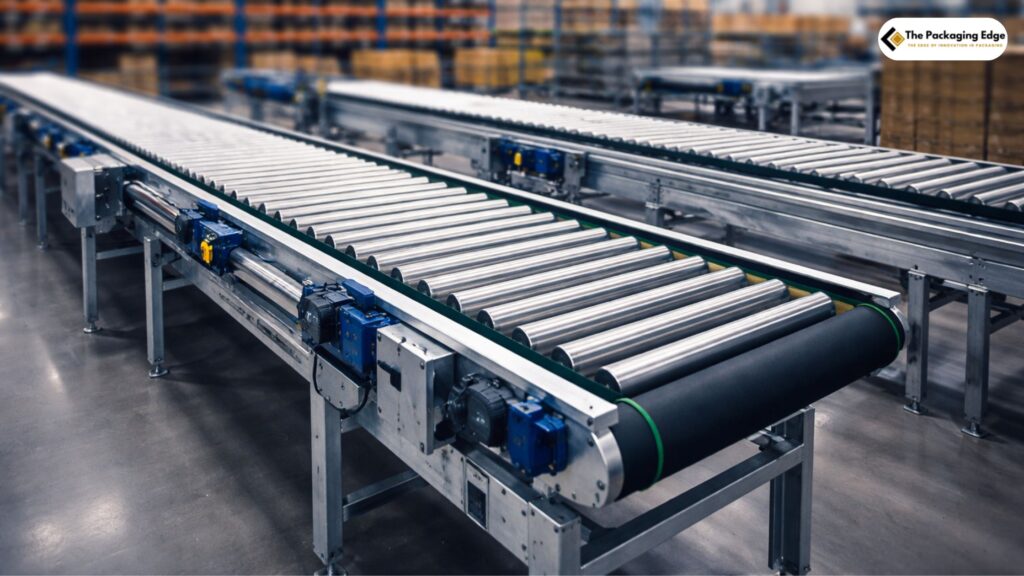
In today’s fast-moving global supply chain, efficiency is not a luxury. It is a requirement. From e-commerce fulfillment centers to manufacturing plants and distribution hubs, businesses everywhere are under constant pressure to move products faster, safer, and more reliably. One material handling solution consistently stands out for its balance of performance, flexibility, and cost efficiency: the belt driven live roller conveyor.
At The Packaging Edge, we work with companies worldwide that are seeking dependable, scalable conveyor systems that support growth instead of slowing it down. This comprehensive guide is designed to give you a deep, practical understanding of belt driven live roller conveyor systems, how they work, where they excel, how they compare to other technologies, and how choosing the right partner can dramatically impact your operation.
Whether you are upgrading an existing line or designing a new facility from the ground up, this guide will help you make informed, confident decisions.
What Is a Belt Driven Live Roller Conveyor?
A belt driven live roller conveyor, commonly referred to as BDLR, is a powered conveyor system where rollers are driven by a continuous belt that runs beneath them. Unlike gravity conveyors, these systems actively move products along the conveyor path using a motorized drive, offering precise control, consistent flow, and the ability to handle varying loads.
Each roller is connected to the belt through friction. When the belt moves, it causes the rollers to rotate, propelling items forward. This design allows multiple rollers to be driven by a single belt and motor, creating an efficient, streamlined system ideal for a wide range of applications.
Key Characteristics of Belt Driven Live Roller Conveyors
-
Powered rollers driven by an endless belt
-
Smooth, controlled product movement
-
Quiet operation compared to chain-driven systems
-
Capable of accumulation and zoning
-
Suitable for cartons, totes, packages, and cases
These features make belt driven live roller conveyor systems a popular choice in environments where reliability, low maintenance, and controlled movement are critical.
How Belt Driven Live Roller Conveyors Work
Understanding how a belt driven live roller conveyor operates is essential when evaluating whether it is the right solution for your facility.
At the heart of the system is a motor, typically mounted at one end of the conveyor. This motor drives a continuous belt that runs beneath the rollers. The belt contacts the rollers with enough friction to rotate them as the belt moves.
Depending on the system design, the conveyor may be configured as:
-
Continuous running, where all rollers move at a constant speed
-
Zoned accumulation, where sensors and controls allow products to stop and start without contact
In accumulation systems, clutch mechanisms or motorized zones disengage the rollers when a zone is full, preventing product damage and improving throughput control.
Why Belt Driven Live Roller Conveyors Are So Widely Used
Across industries and continents, belt driven live roller conveyors have earned their reputation as a dependable workhorse. Their popularity is not accidental. It is driven by tangible operational advantages.
1. Smooth and Controlled Product Flow
One of the most significant advantages of a belt driven live roller conveyor is its ability to move products smoothly. Because power is transmitted via a belt rather than a chain, motion is more uniform, reducing jerks and vibrations that can damage products or disrupt downstream processes.
This is especially important when handling fragile cartons, lightweight packages, or irregularly shaped items.
2. Quiet Operation
Noise levels matter more than many facilities realize. Excessive conveyor noise contributes to worker fatigue, safety issues, and regulatory concerns. Belt driven systems are inherently quieter than chain driven live roller conveyors, making them ideal for environments where employee comfort and communication are priorities.
3. Lower Maintenance Requirements
Belts require less lubrication and adjustment than chains. This translates into lower maintenance costs, fewer breakdowns, and reduced downtime. For operations running multiple shifts or high volumes, this reliability is a major competitive advantage.
4. Energy Efficiency
Because a single motor can drive multiple rollers efficiently, belt driven live roller conveyors often consume less energy than alternative powered systems. Over time, these energy savings can be substantial, particularly in large-scale distribution centers.
5. Accumulation Capabilities
Modern belt driven live roller conveyor systems can be designed for zero-pressure accumulation. This allows products to queue without touching each other, reducing damage and improving flow into sorters, pack stations, and palletizing areas.
Common Applications of Belt Driven Live Roller Conveyors
The versatility of belt driven live roller conveyors makes them suitable for a broad range of industries and applications worldwide.
Warehousing and Distribution Centers
In high-volume distribution environments, BDLR conveyors are commonly used for:
-
Carton transport
-
Order consolidation
-
Packing and shipping lines
-
Sortation system infeed and outfeed
Their ability to handle varying package sizes and weights makes them ideal for omnichannel fulfillment operations.
Manufacturing Facilities
Manufacturers rely on belt driven live roller conveyors to move products between workstations, assembly lines, and inspection areas. The controlled movement ensures consistency and reduces the risk of bottlenecks.
E-Commerce Fulfillment
E-commerce operations demand speed, accuracy, and flexibility. Belt driven live roller conveyor systems support rapid order processing while minimizing damage to consumer goods.
Food and Beverage Packaging
With appropriate materials and hygienic design considerations, belt driven live roller conveyors are used in secondary packaging and case handling within food and beverage facilities.
Pharmaceutical and Healthcare Logistics
Precision and reliability are essential in pharmaceutical environments. The smooth operation of belt driven systems supports safe, consistent product handling.
Belt Driven Live Roller Conveyor vs. Other Conveyor Types
Choosing the right conveyor technology requires understanding how belt driven live roller conveyors compare to alternatives.
Belt Driven Live Roller vs. Chain Driven Live Roller
Chain driven live roller conveyors use chains to drive the rollers. While they can handle heavier loads, they are typically noisier and require more maintenance.
Belt driven live roller conveyors are preferred when:
-
Noise reduction is important
-
Loads are moderate and consistent
-
Smooth product handling is required
Belt Driven Live Roller vs. Gravity Roller Conveyor
Gravity conveyors rely on slope or manual force. They are inexpensive but lack control.
Belt driven live roller conveyors offer:
-
Controlled speed
-
Automated movement
-
Accumulation and zoning capabilities
For automated facilities, gravity conveyors are often limited to simple transport, while belt driven systems handle critical flow paths.
Belt Driven Live Roller vs. Motor Driven Roller (MDR)
Motor driven roller conveyors use individual motors in each roller. They offer advanced control but come at a higher initial cost.
Belt driven live roller conveyors remain an excellent solution when:
-
Budget efficiency is important
-
System simplicity is desired
-
Long conveyor runs are required
Design Considerations for Belt Driven Live Roller Conveyors
A belt driven live roller conveyor system is only as effective as its design. At The Packaging Edge, we emphasize thoughtful engineering to ensure long-term performance.
Load Characteristics
Understanding the size, weight, and bottom surface of your products is critical. Belt driven systems perform best with uniform loads that maintain consistent contact with the rollers.
Conveyor Speed
Speed must be matched to upstream and downstream processes. Too fast can cause congestion; too slow can limit throughput.
Zone Length and Accumulation Strategy
In accumulation systems, zone length affects control and capacity. Proper zoning reduces pressure on products and improves overall flow.
Integration with Other Equipment
Belt driven live roller conveyors often interface with:
-
Sorters
-
Case sealers
-
Labelers
-
Palletizers
Seamless integration is essential for maximizing efficiency.
Environmental Factors
Temperature, dust, moisture, and cleanliness requirements influence material selection and component design.
Safety and Compliance Considerations
Safety is a global concern, and conveyor systems must comply with applicable regulations and best practices.
Belt driven live roller conveyors offer several inherent safety advantages:
-
Reduced pinch points compared to chain systems
-
Lower noise exposure
-
Smooth start and stop capabilities
Additional safety features may include:
-
Emergency stop cords
-
Guarding and covers
-
Sensor-based controls
At The Packaging Edge, safety is built into every solution we deliver.
Customization and Scalability
One of the greatest strengths of belt driven live roller conveyor systems is their adaptability.
As your operation grows, your conveyor system should grow with you. Modular designs allow:
-
Extension of conveyor lines
-
Addition of new zones
-
Integration of automation upgrades
This scalability protects your investment and supports long-term operational flexibility.
Why Partnering with The Packaging Edge Makes the Difference
A belt driven live roller conveyor is not just a piece of equipment. It is a strategic asset. Choosing the right partner is just as important as choosing the right technology.
Deep Industry Expertise
The Packaging Edge brings extensive experience in material handling and packaging systems across global markets. We understand real-world operational challenges and design solutions that work in practice, not just on paper.
Solution-Oriented Approach
We do not sell generic conveyors. We engineer solutions tailored to your products, throughput requirements, facility layout, and long-term goals.
End-to-End Support
From concept and design to implementation and optimization, The Packaging Edge supports you at every stage. Our goal is not just to install equipment, but to improve your operation.
Commitment to Performance
Every belt driven live roller conveyor system we deliver is built with performance, reliability, and efficiency in mind. Your success is our benchmark.
The Future of Belt Driven Live Roller Conveyor Systems
As automation continues to evolve, belt driven live roller conveyors remain a foundational technology. Advances in controls, sensors, and integration capabilities are enhancing their performance while maintaining their proven reliability.
For businesses seeking a balance between advanced automation and practical cost control, belt driven live roller conveyor systems will continue to play a central role in modern material handling strategies.
Final Thoughts: Turn Conveyor Challenges into Competitive Advantage
Inefficient material flow costs time, money, and customer satisfaction. A well-designed belt driven live roller conveyor system can transform your operation by improving throughput, reducing downtime, and supporting scalable growth.
At The Packaging Edge, we specialize in helping businesses worldwide turn complex material handling challenges into streamlined, high-performance solutions. If you are evaluating a new conveyor system or looking to optimize an existing one, now is the time to work with a partner who understands both the technology and the realities of your operation.
Take the next step toward a smarter, more efficient conveyor solution. Contact The Packaging Edge today and start building a system that moves your business forward. Email us directly at thepackagingedge@gmail.com to discuss your belt driven live roller conveyor needs and discover how our expertise can deliver measurable results.
Related Articles
- Motorized Roller Conveyor Systems: The Definitive Guide for High-Performance Material Handling
- Pallet Roller Conveyor Systems: The Complete Expert Guide to Efficient Pallet Handling and Warehouse Optimization
- Roller Conveyor Systems: The Ultimate Guide to Efficient, Scalable Material Handling
- Chain Driven Live Roller Conveyor: The Definitive Guide to Smarter, Stronger, More Scalable Material Handling
- Power Roller Conveyor Systems: The Definitive Guide for High-Performance Material Handling
- Heavy Duty Roller Conveyor: The Definitive Global Guide for Industrial Performance
- Live Roller Conveyor Systems: The Definitive Guide for High-Performance Material Handling
- Automated Material Handling Systems: The Definitive Guide for Modern Packaging & Logistics
- Milk Powder Packaging Machine: The Definitive Guide for Manufacturers Seeking Efficiency, Quality, and Scale
- Automatic Tea Packing Machine: The Complete Buyer’s & Implementation Guide for Scalable Tea Packaging