
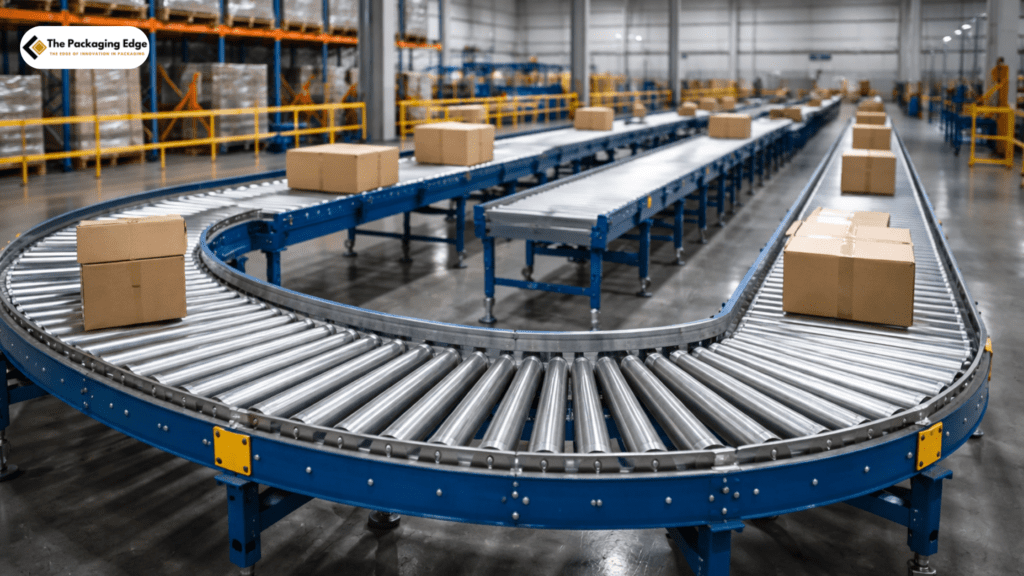
In today’s hyper-competitive global manufacturing and distribution landscape, efficiency is no longer optional—it is mission-critical. Businesses across warehousing, packaging, logistics, e-commerce, food processing, and manufacturing are under constant pressure to move products faster, safer, and more cost-effectively. This is where gravity roller conveyor systems emerge as one of the most reliable, scalable, and cost-efficient material handling solutions available worldwide.
At The Packaging Edge, we specialize in helping organizations design, select, and deploy conveyor solutions that directly improve throughput, reduce labor dependency, and streamline packaging and distribution operations. This in-depth guide is designed to give decision-makers, engineers, operations managers, and procurement teams everything they need to understand gravity roller conveyor systems—from fundamentals to advanced applications—so they can make informed, high-ROI investments.
What Are Gravity Roller Conveyor Systems?
Gravity roller conveyor systems are material handling systems that use the force of gravity—or manual push—to move items across a series of rollers mounted within a frame. Unlike powered conveyors, these systems do not rely on motors, electricity, or complex controls, making them exceptionally cost-effective and easy to maintain.
Products move along the rollers by:
-
A slight decline in elevation (gravity-driven)
-
Manual force applied by operators
-
Momentum generated from upstream processes
These systems are most commonly used to transport cartons, totes, pallets, and other flat-bottomed items across short to medium distances within a facility.
Why Gravity Roller Conveyor Systems Matter in Modern Operations
The global shift toward lean manufacturing, just-in-time inventory, and labor optimization has dramatically increased the demand for simple, efficient conveying solutions. Gravity roller conveyor systems align perfectly with these operational goals.
Key Drivers of Adoption Worldwide
-
Rising labor costs across global markets
-
Increased focus on ergonomic workplace design
-
Rapid expansion of e-commerce fulfillment centers
-
Demand for modular, scalable material handling
-
Need for low-maintenance, energy-efficient systems
For businesses looking to improve operational efficiency without massive capital investment, gravity roller conveyor systems provide an ideal balance between performance and cost.
Core Components of Gravity Roller Conveyor Systems
Understanding the anatomy of these systems is essential for proper selection and configuration.
1. Conveyor Rollers
Rollers are the heart of the system and vary based on:
-
Diameter
-
Material (steel, stainless steel, aluminum, or PVC)
-
Bearing type
-
Load capacity
At The Packaging Edge, we help customers select rollers that match their product weight, environmental conditions, and throughput requirements.
2. Conveyor Frame
Frames are typically constructed from:
-
Powder-coated steel
-
Galvanized steel
-
Stainless steel for washdown environments
Frame strength and rigidity directly affect system longevity and performance.
3. Axles and Bearings
Precision bearings reduce friction and ensure smooth, controlled movement. For high-cycle or heavy-load environments, bearing selection is critical.
4. Supports and Stands
Adjustable stands allow for precise pitch control, which is essential for gravity-driven flow. Proper incline prevents product damage and bottlenecks.
How Gravity Roller Conveyor Systems Work
Gravity roller conveyor systems operate on a simple yet highly effective principle: controlled movement using gravity and minimal force.
Incline-Based Flow
Products move from higher to lower elevations, typically using a decline angle between 1.5% and 5%, depending on:
-
Product weight
-
Roller spacing
-
Roller material
Manual Push Zones
In flat conveyor sections, operators manually push items, reducing strain compared to lifting or carrying.
Accumulation and Flow Control
Gravity conveyors can be configured to allow:
-
Zero-pressure accumulation
-
Controlled buffering
-
Sequential flow into packaging or sorting zones
This adaptability makes them ideal for packaging lines and order fulfillment operations.
Advantages of Gravity Roller Conveyor Systems
1. Cost-Effective Investment
Compared to powered conveyor systems, gravity roller conveyors:
-
Have significantly lower upfront costs
-
Require minimal installation time
-
Eliminate energy consumption
2. Low Maintenance Requirements
With no motors, belts, or electrical components, maintenance is limited to:
-
Occasional bearing inspection
-
Roller replacement (if damaged)
-
Frame alignment checks
3. Scalability and Flexibility
Gravity roller conveyor systems are modular by design. Facilities can:
-
Add sections as operations grow
-
Reconfigure layouts easily
-
Integrate with powered systems
4. Improved Workplace Ergonomics
By reducing manual lifting and carrying, these systems:
-
Lower injury risk
-
Improve worker productivity
-
Support ergonomic compliance standards worldwide
5. Environmentally Friendly
No electricity usage means:
-
Reduced carbon footprint
-
Lower operational energy costs
-
Alignment with sustainability goals
Industries That Rely on Gravity Roller Conveyor Systems
Warehousing and Distribution
Used for:
-
Carton flow lanes
-
Order picking
-
Sorting and consolidation
Packaging Operations
Ideal for:
-
Feeding products into case sealers
-
Accumulation before stretch wrapping
-
Post-pack inspection zones
Manufacturing
Supports:
-
Assembly line flow
-
Work-in-process transport
-
Finished goods handling
E-Commerce Fulfillment
Essential for:
-
Pick-and-pack operations
-
Returns processing
-
Order consolidation
Food and Beverage
With stainless steel configurations:
-
FDA-compliant designs
-
Washdown-ready systems
-
Hygienic material transport
At The Packaging Edge, we customize gravity roller conveyor systems for each industry’s unique regulatory and operational needs.
Gravity Roller Conveyor vs Powered Conveyor Systems
While both systems serve critical roles, understanding when to choose gravity over powered solutions is essential.
Gravity Roller Conveyor Systems Are Best When:
-
Product flow is consistent
-
Elevation changes are available
-
Budget efficiency is a priority
-
Low maintenance is required
Powered Conveyors Are Better When:
-
High-speed automation is required
-
Products need precise spacing
-
Long-distance transport is needed
Many of our clients choose hybrid systems, combining gravity roller conveyor systems with powered conveyors to achieve optimal efficiency and cost control.
Design Considerations for Optimal Performance
Load Weight and Dimensions
Roller diameter, spacing, and frame strength must align with product specifications.
Conveyor Pitch
Incorrect slope can cause:
-
Product stalling
-
Excessive speed
-
Product damage
Roller Spacing
A general rule: at least three rollers under each product at all times.
Environmental Conditions
Consider:
-
Temperature extremes
-
Moisture exposure
-
Corrosive environments
The Packaging Edge conducts detailed assessments to ensure every gravity roller conveyor system is engineered for long-term performance.
Custom vs Standard Gravity Roller Conveyor Systems
Standard Systems
-
Faster delivery
-
Lower cost
-
Suitable for common applications
Custom Systems
-
Designed for unique layouts
-
Optimized for specific products
-
Integrated with existing equipment
As an experienced solutions provider, The Packaging Edge offers both standard and fully customized gravity roller conveyor systems tailored to your operation.
Common Mistakes to Avoid
-
Underestimating load requirements
-
Using incorrect roller materials
-
Poor incline calculations
-
Ignoring future expansion needs
-
Choosing suppliers without engineering expertise
Avoiding these pitfalls can save significant time and capital—and this is where working with an expert partner makes all the difference.
Why The Packaging Edge Is the Trusted Authority
At The Packaging Edge, we go far beyond selling equipment. We deliver engineered solutions that solve real operational challenges.
What Sets Us Apart:
-
Deep expertise in packaging and material handling systems
-
Application-specific conveyor design
-
Global customer support
-
Focus on ROI-driven solutions
-
End-to-end consultation—from concept to deployment
Our team understands that no two operations are the same. That’s why every gravity roller conveyor system we provide is aligned with your throughput goals, floor space constraints, and long-term growth strategy.
The Future of Gravity Roller Conveyor Systems
As automation continues to evolve, gravity roller conveyor systems remain indispensable due to:
-
Their simplicity
-
Their integration capability with smart systems
-
Their unmatched cost-efficiency
Emerging trends include:
-
Smart sensors for flow monitoring
-
Hybrid gravity-powered systems
-
Sustainable materials and coatings
The Packaging Edge stays ahead of these trends, ensuring our clients benefit from both proven reliability and forward-thinking design.
Final Thoughts: Invest in Efficiency That Lasts
Gravity roller conveyor systems are not just a material handling solution—they are a strategic investment in operational efficiency, worker safety, and scalable growth. When designed and implemented correctly, they deliver exceptional returns with minimal ongoing costs.
If your organization is looking to optimize packaging lines, streamline distribution, or reduce labor strain, now is the time to act.
Partner With the Experts
The Packaging Edge is your trusted global partner for high-performance gravity roller conveyor systems designed to meet today’s demands and tomorrow’s growth.
Email us directly at thepackagingedge@gmail.com to discuss your application, request expert guidance, or start designing a conveyor solution that gives your operation a true competitive edge.
Your efficiency starts here—with The Packaging Edge.
Related Articles
- Belt Driven Live Roller Conveyor Systems: The Ultimate Guide for High-Performance Material Handling
- Motorized Roller Conveyor Systems: The Definitive Guide for High-Performance Material Handling
- Pallet Roller Conveyor Systems: The Complete Expert Guide to Efficient Pallet Handling and Warehouse Optimization
- Roller Conveyor Systems: The Ultimate Guide to Efficient, Scalable Material Handling
- Chain Driven Live Roller Conveyor: The Definitive Guide to Smarter, Stronger, More Scalable Material Handling
- Power Roller Conveyor Systems: The Definitive Guide for High-Performance Material Handling
- Heavy Duty Roller Conveyor: The Definitive Global Guide for Industrial Performance
- Live Roller Conveyor Systems: The Definitive Guide for High-Performance Material Handling
- Automated Material Handling Systems: The Definitive Guide for Modern Packaging & Logistics
- Milk Powder Packaging Machine: The Definitive Guide for Manufacturers Seeking Efficiency, Quality, and Scale