
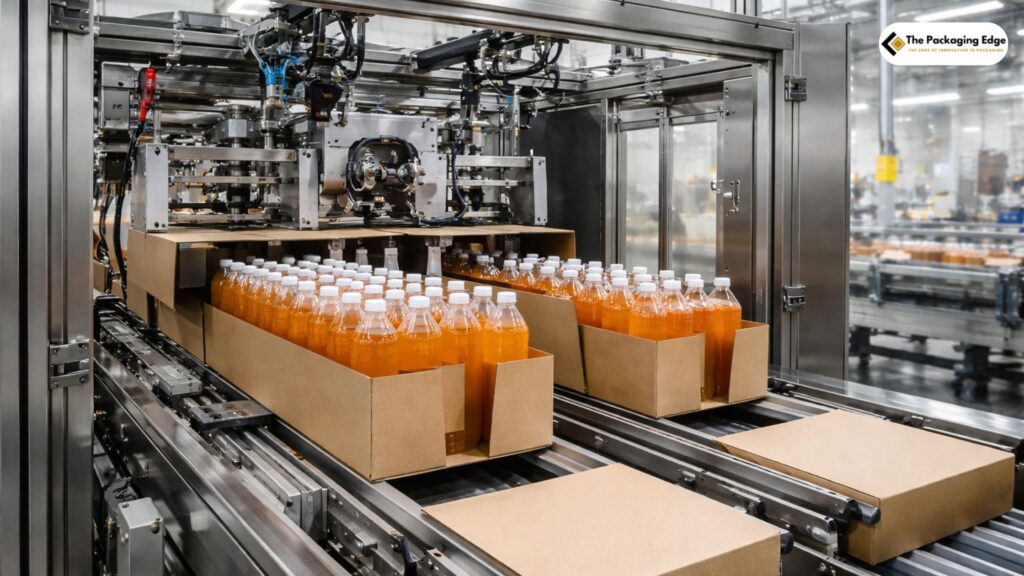
In today’s hyper-competitive manufacturing and distribution landscape, packaging is no longer a back-end operation—it is a strategic advantage. Speed, consistency, sustainability, and cost efficiency all converge at one critical point in the production line: secondary packaging. Among the most impactful solutions in this space is the wrap around case packer.
For manufacturers seeking higher throughput, reduced material costs, and improved load integrity, a wrap around case packer is not just a machine—it’s a transformation tool. Yet, despite its widespread adoption, many decision-makers still struggle to fully understand how wrap around case packing systems work, where they add the most value, and how to select the right solution for their specific application.
This guide is designed to eliminate that uncertainty.
As senior packaging strategists at The Packaging Edge, we work with manufacturers worldwide to design, specify, and implement wrap around case packer solutions that deliver measurable operational gains. This in-depth article distills that expertise into a single authoritative resource—whether you are upgrading an existing line or building a new one from the ground up.
What Is a Wrap Around Case Packer?
A wrap around case packer is an automated packaging machine that forms a corrugated blank around a pre-collated group of products and seals it into a finished shipping case. Unlike traditional RSC (Regular Slotted Container) case packers that rely on pre-erected boxes, wrap around systems create a custom-fit case around the product itself.
The result is a tighter, stronger, more material-efficient case that improves pallet stability, reduces corrugate usage, and enhances overall line efficiency.
Core Components of a Wrap Around Case Packer
A typical wrap around case packing system includes:
-
Product infeed and collation system
-
Corrugated blank magazine
-
Blank pick-and-place mechanism
-
Case forming section (wrap station)
-
Glue or tape sealing system
-
Discharge conveyor
Each component works in precise synchronization to ensure high-speed, repeatable packaging with minimal downtime.
How Wrap Around Case Packers Work
Understanding the operational flow of a wrap around case packer helps clarify why it outperforms many conventional case packing solutions.
Step 1: Product Collation
Products—bottles, cans, cartons, pouches, or trays—are grouped into a predetermined configuration using lane dividers, metering belts, or robotic collators.
Step 2: Corrugated Blank Feeding
Flat corrugated blanks are fed from a magazine and positioned precisely beneath or around the product group.
Step 3: Case Wrapping and Forming
The blank is wrapped tightly around the product using forming rails, compression belts, or rotating arms. This step creates a custom-fit case with minimal void space.
Step 4: Sealing
Hot melt adhesive or tape is applied to seal the case flaps securely. Glue sealing is most common due to its speed and structural strength.
Step 5: Case Discharge
The finished case exits the machine ready for downstream palletizing, labeling, or stretch wrapping.
This continuous, automated process enables high-speed secondary packaging with exceptional consistency.
Why Wrap Around Case Packers Are Replacing Traditional Case Packers
Manufacturers across food, beverage, personal care, pharmaceutical, and household goods sectors are increasingly shifting to wrap around case packers—and for good reason.
1. Reduced Corrugate Usage
Wrap around cases are engineered to fit the product precisely. This often results in 10–25% less corrugated material compared to RSC cases.
Lower material usage means:
-
Reduced packaging costs
-
Lower transportation weight
-
Improved sustainability metrics
2. Superior Case Strength
Because the corrugate is wrapped tightly around the product, wrap around cases offer:
-
Improved compression strength
-
Better pallet stability
-
Reduced product damage during transit
This is especially critical for high-speed distribution and export shipping.
3. Higher Line Speeds
Modern wrap around case packers routinely operate at:
-
20–40 cases per minute for standard applications
-
60+ cases per minute for optimized, single-SKU lines
This makes them ideal for high-volume production environments.
4. Cleaner, More Professional Presentation
Wrap around cases provide:
-
Uniform graphics alignment
-
Cleaner edges
-
Better shelf-ready and retail-ready packaging
This enhances brand perception across global markets.
Industries That Benefit Most from Wrap Around Case Packers
Wrap around case packers are remarkably versatile. At The Packaging Edge, we deploy them across a wide range of industries.
Food and Beverage Packaging
-
Bottled water and soft drinks
-
Canned beverages
-
Dairy products
-
Frozen foods
-
Snack foods
High speeds, moisture resistance, and strong cases make wrap around systems ideal for food-grade environments.
Personal Care and Cosmetics
-
Shampoo and lotion bottles
-
Cartoned cosmetics
-
Aerosol cans
Tight case control prevents product scuffing and leakage.
Pharmaceuticals and Nutraceuticals
-
Cartoned medications
-
Supplement bottles
Precision collation and gentle handling are key advantages here.
Household and Industrial Products
-
Cleaning products
-
Chemicals
-
Lubricants
Wrap around cases provide superior load containment for heavier items.
Wrap Around Case Packer vs RSC Case Packer
A common question we hear is: “Should I choose a wrap around case packer or a traditional RSC case packer?”
Here’s a clear comparison.
Wrap Around Case Packer
Pros
-
Lower corrugate usage
-
Stronger cases
-
Higher speeds
-
Better pallet stability
Cons
-
Higher initial investment
-
Requires blank-specific changeovers
RSC Case Packer
Pros
-
Lower upfront cost
-
Widely available boxes
-
Simple operation
Cons
-
Higher corrugate usage
-
Weaker cases
-
Slower speeds
For high-volume, long-run production, wrap around case packers typically deliver faster ROI despite higher initial costs.
Key Design Considerations When Selecting a Wrap Around Case Packer
Choosing the right wrap around case packer is not about buying a machine—it’s about engineering a solution. At The Packaging Edge, we evaluate several critical factors.
Product Characteristics
-
Shape and rigidity
-
Weight and center of gravity
-
Surface friction
These influence collation, compression, and case strength.
Required Throughput
Your target cases per minute determine:
-
Servo vs pneumatic systems
-
Single-lane vs multi-lane designs
-
Buffering requirements
Case Size and Variability
Frequent SKU changes may require:
-
Tool-less changeovers
-
Servo-driven adjustments
-
Recipe-based controls
Plant Layout Constraints
Floor space, ceiling height, and conveyor elevation must be factored into the design.
Integration with Existing Equipment
Wrap around case packers must interface seamlessly with:
-
Upstream fillers
-
Downstream palletizers
-
Vision systems and checkweighers
Automation Levels: Manual, Semi-Automatic, and Fully Automatic
Wrap around case packers are available across automation levels.
Semi-Automatic Wrap Around Case Packers
Best for:
-
Low to medium volumes
-
Frequent SKU changes
-
Budget-conscious operations
Fully Automatic Wrap Around Case Packers
Ideal for:
-
High-volume production
-
24/7 operations
-
Labor reduction initiatives
Fully automated systems offer maximum efficiency and consistency.
Sustainability Advantages of Wrap Around Case Packing
Sustainability is no longer optional—it’s a global mandate.
Wrap around case packers support sustainability goals by:
-
Reducing corrugate consumption
-
Lowering transportation emissions
-
Minimizing packaging waste
-
Supporting recyclable materials
Many global brands use wrap around packaging to meet ESG and regulatory requirements.
Common Challenges and How The Packaging Edge Solves Them
Despite their benefits, wrap around case packers must be engineered correctly to avoid common pitfalls.
Challenge: Product Instability During Wrapping
Solution: Precision collation systems and controlled compression designed by The Packaging Edge.
Challenge: Changeover Downtime
Solution: Servo-driven adjustments and recipe-based HMI controls.
Challenge: Adhesive Failures
Solution: Optimized glue patterns and temperature-controlled systems.
Challenge: Integration Issues
Solution: End-to-end line engineering and FAT/SAT validation.
Why The Packaging Edge Is the Trusted Authority in Wrap Around Case Packers
At The Packaging Edge, we don’t sell machines—we deliver packaging performance.
What Sets Us Apart
-
Deep technical expertise in wrap around case packing
-
Vendor-neutral system design
-
Custom-engineered solutions
-
Global project experience
-
Lifecycle support from concept to commissioning
We act as your strategic partner, ensuring the wrap around case packer you deploy aligns perfectly with your production goals.
The Future of Wrap Around Case Packing
The next generation of wrap around case packers is already taking shape.
Emerging trends include:
-
Industry 4.0 connectivity
-
Predictive maintenance
-
AI-driven quality monitoring
-
Lightweight corrugate optimization
Manufacturers who invest now gain a competitive edge that compounds over time.
Final Thoughts: Turn Packaging into a Competitive Advantage
A wrap around case packer is more than a piece of equipment—it’s a strategic investment in efficiency, sustainability, and scalability. When properly specified and integrated, it delivers measurable gains in throughput, cost reduction, and supply chain resilience.
But success depends on expertise.
At The Packaging Edge, we specialize in designing and delivering wrap around case packer solutions that work not just on paper, but on the factory floor. If you’re evaluating a new system, upgrading an existing line, or simply exploring your options, now is the time to act.
Transform your packaging line with confidence. Partner with the experts who understand every edge of packaging performance.
Email us directly at thepackagingedge@gmail.com and let The Packaging Edge help you engineer a wrap around case packer solution that drives real results—today and into the future.
Related Articles
- The Complete Guide to Automated Material Handling Equipment: Transforming Warehouse Operations
- The Complete Guide to Automated Material Handling Solutions: Transforming Modern Warehouse Operations
- Gravity Spiral Conveyors: The Ultimate Guide to Efficient Vertical Material Handling
- Vertical Spiral Conveyor Systems: The Ultimate Guide to Efficient, Space-Saving Material Handling
- Motorized Drive Roller Conveyor Systems: The Ultimate Guide to Smarter, Faster, and More Efficient Material Handling
- Belt Driven Roller Conveyor Systems: The Complete Global Guide to Efficiency, Reliability, and Scalable Material Handling
- Expandable Roller Conveyor Systems: The Complete Expert Guide for Efficient, Scalable Material Handling
- Powered Roller Conveyor Systems: The Ultimate Guide to Smarter, Faster, and Scalable Material Handling
- Gravity Roller Conveyor Systems: The Definitive Guide for Efficient, Scalable Material Handling
- Belt Driven Live Roller Conveyor Systems: The Ultimate Guide for High-Performance Material Handling