
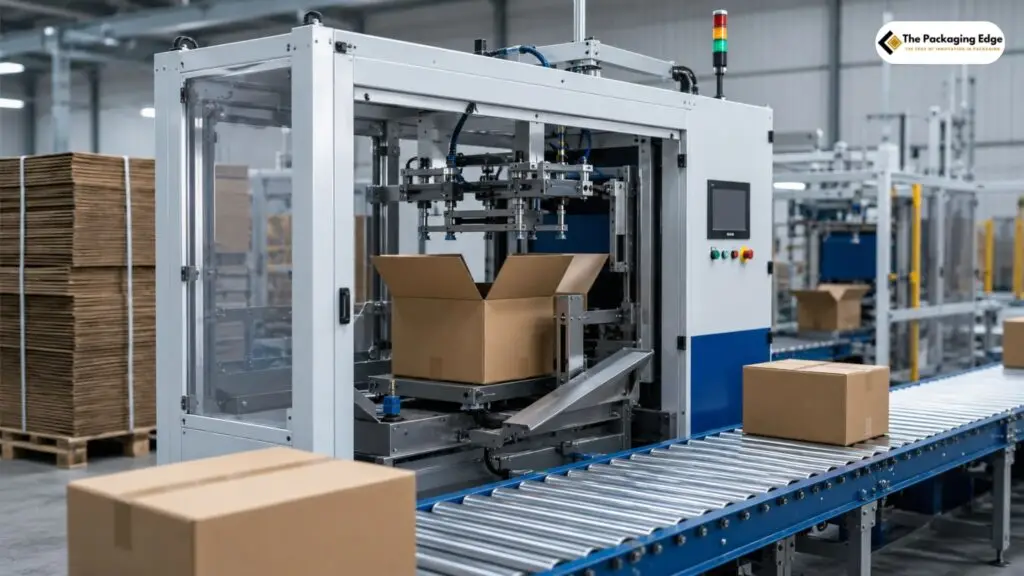
Every second a worker spends hand-folding a flat blank is a second your line is operating below capacity. In high-volume manufacturing, food processing, e-commerce fulfillment, and pharmaceutical packaging, those seconds add up to enormous costs — in labor, in throughput, and in the consistency that brand reputation depends on. The automatic carton erector was engineered to eliminate precisely that bottleneck.
This guide covers everything operations managers, plant engineers, and procurement specialists need to know about automatic carton erectors: what they are, how they work, the quantifiable business case for investing in one, the features that separate excellent machines from mediocre ones, and how to select the right solution for your specific line. It is written by the specialists at The Packaging Edge, a company that exists for one reason — to give industrial packagers a decisive competitive advantage through the right equipment, configured correctly, deployed with expert support.
What Is an Automatic Carton Erector?
An automatic carton erector — also called an automatic case erector, carton forming machine, or automatic box erector — is a piece of packaging machinery that takes flat-pack corrugated or RSC (Regular Slotted Container) blanks from a magazine hopper, opens them into their three-dimensional box shape, seals the bottom flaps with hot-melt glue or tape, and places the erected carton onto a conveyor, ready for filling. The entire cycle happens in a fraction of a second.
To appreciate what that means operationally, consider the manual alternative. A trained operator working at a comfortable pace can erect roughly 6–10 boxes per minute. A mid-range automatic carton erector handles 20–35 cases per minute. High-speed industrial case erectors used in beverage, FMCG, or e-commerce operations push 50 cases per minute and beyond. The math is immediate and undeniable.
But throughput is only part of the story. Manual erecting introduces variability — inconsistent glue lines, improperly squared boxes, and bottom flaps that aren’t fully sealed. Those defects cause downstream problems: product damage, rejected packs at the end of line, customer complaints. A quality automatic box erector eliminates that variability entirely.
— The Packaging Edge, Application Engineering Team
How an Automatic Carton Erector Works
Understanding the mechanics helps you evaluate machines intelligently and troubleshoot problems faster. While designs differ between manufacturers, the core process of any carton forming machine follows a consistent sequence:
1. Magazine Loading and Blank Separation
Flat blanks are loaded into a vertical or inclined magazine hopper. A suction-cup pick-and-place mechanism — typically vacuum-driven — grabs a single blank from the stack and begins to pull it forward. Sensors confirm separation and flag double-feeds or misfeeds before they cause a jam.
2. Opening and Squaring
The blank passes through a forming station where guides, rails, and mechanical formers force the blank to open into a square box profile. This is the most mechanically demanding step. On entry-level machines, fixed guides handle squaring. On servo-driven automatic carton erectors, programmable actuators ensure precise squaring across different box dimensions — critical when you run SKU variety on one line.
3. Bottom Flap Folding
Minor and major bottom flaps are folded in sequence. Cam-driven or servo-driven folding arms operate in a precise choreography. The order and timing matter: minor flaps fold first, then major flaps fold over them to create a clean, flat bottom surface.
4. Sealing
Most automatic case erectors seal the bottom using one of two methods. Hot-melt adhesive (HMA) glue is the dominant choice for high-speed lines — it cures rapidly, creates a strong bond, and has low cost-per-seal. The alternative is pressure-sensitive tape, used where adhesive residue is unacceptable (e.g., certain clean-room or food applications) or where boxes may be returned and reopened. Some machines offer both options.
5. Discharge and Transfer
The sealed, erected carton is discharged — either pushed onto a belt conveyor for vertical filling, or placed upright for top-load applications. Integrated sensors confirm box presence and orientation before the next cycle begins.
Types of Automatic Carton Erectors
Not every automatic carton erector machine is built for the same environment. Understanding the major categories will save you from a costly specification mismatch.
| Type | Speed Range | Best Suited For | Key Trade-off |
|---|---|---|---|
| Semi-Automatic | 6–12 CPM | Low-volume, flexible SKUs | Operator still feeds machine |
| Entry-Level Automatic | 12–25 CPM | SME manufacturers, single carton size | Limited size range adjustment |
| Mid-Range Servo | 25–40 CPM | Multi-SKU lines, food & beverage | Higher upfront cost |
| High-Speed Industrial | 40–80+ CPM | E-commerce, FMCG, pharma | Requires robust preventive maintenance |
| Robotic / Vision-Guided | Variable | Complex sizes, fragile products | Highest capital investment |
The right category depends on your current throughput requirements, your anticipated growth trajectory, the variety of carton sizes you run, and your available capital budget. This is precisely the kind of evaluation where working with an experienced packaging systems specialist — rather than relying solely on a manufacturer’s sales team — pays enormous dividends.
The Business Case: ROI of an Automatic Carton Erector
Numbers drive capital equipment decisions. Let’s walk through a realistic ROI scenario for a mid-volume operation to illustrate the economic power of an automatic carton erector.
Assume a facility currently uses two dedicated operators to erect cartons on a two-shift operation, five days a week. At a fully loaded cost of $18 per hour per person (wages, benefits, payroll taxes), the annual direct labor cost for box erecting alone is approximately $75,000. Add the cost of inconsistently erected boxes — rejected product, customer chargebacks, rework labor — and the real number climbs higher.
A quality mid-range automatic carton erector in the $45,000–$80,000 purchase range eliminates those two positions, redirecting labor to higher-value activities. Maintenance costs for a well-serviced machine of this class run approximately $3,000–$6,000 per year. The gross labor savings in year one alone approach or exceed the machine cost.
That is an 18-month payback in a conservative scenario. In high-volume operations — beverage, pet food, e-commerce fulfillment — where lines run 20+ hours a day, payback periods of 6–9 months are common.
Hidden Cost Savings Beyond Labor
- Reduced glue waste through precision applicator heads that use exactly the right bead size and placement
- Lower cardboard waste — consistent squaring reduces rejected or crushed boxes before filling
- Fewer downstream jams — a properly erected carton flows through fillers, sealers, and labelers without obstruction
- Reduced product damage claims from cartons that arrive structurally compromised at the customer
- Compliance readiness — consistent seal quality supports food safety and pharmaceutical documentation requirements
- Scalability — add a shift or increase line speed without proportionally increasing headcount
Key Features to Demand in a Modern Automatic Carton Erector
When evaluating automatic carton erector machines, the feature checklist below separates robust industrial equipment from machines that will frustrate your team within 12 months of installation.
Servo-Driven Axes
Cam-driven machines are mechanically simpler but inflexible. Servo-driven automatic carton erectors allow programmable size changes — operators can switch carton dimensions in minutes via the HMI rather than spending hours adjusting mechanical stops. If you run more than two carton sizes, servo drives are not a luxury.
Touchscreen HMI with Recipe Storage
A good HMI stores named product recipes — press a button, the machine reconfigures itself. Look for clear diagnostic fault displays in multiple languages if your workforce is multilingual. Downtime minutes are expensive; obscure fault codes cost you both.
Glue System Quality
The hot-melt glue system is one of the most maintenance-sensitive components of any carton erector machine. Prioritize machines that use well-supported glue heads (Nordson and Robatech are industry standards), have accessible nozzles, and include system monitoring for glue temperature and pressure. A glue failure at 3 a.m. on a Sunday should not require a specialist call-out.
Magazine Capacity and Auto-Feed
Larger blank magazines mean less frequent reloading and longer unattended run times. Some high-speed automatic case erectors include hopper extensions or automatic blank-feeding systems that allow a single operator to manage multiple machines simultaneously.
Safety and Compliance
Insist on CE marking (Europe), UL certification (North America), or equivalent regional standards. Look for guarding that meets current safety norms, emergency stops that are logically positioned, and interlocks on all access panels. This is non-negotiable.
Robust Frame Construction
Welded steel frames significantly outlast bolted frames in high-vibration environments. Stainless steel or powder-coated frames resist corrosion in food and beverage applications where washdown conditions are common.
Integration Capability
Modern automatic carton erectors should communicate. Look for machines with OPC-UA, Ethernet/IP, or Profinet interfaces that allow integration with your line’s SCADA system, MES, or overall equipment effectiveness (OEE) monitoring platform. A machine that reports its own downtime reasons is worth far more than one that doesn’t.
Industries That Rely on Automatic Carton Erectors
The automatic carton erector is one of the most sector-agnostic pieces of packaging automation available. Its value proposition applies wherever secondary packaging happens at volume. Key verticals include:
Food and Beverage
From dairy to dry goods to bottled beverages, food processors run high-speed lines where a manual erecting station is simply not viable. Hygienic design, stainless steel contact parts, and IP-rated electrics are critical specifications for food applications.
E-Commerce and Fulfillment
The explosion of online retail has created enormous demand for high-speed automatic box erectors. Fulfillment centres processing thousands of orders per hour need consistent, rapid box forming that integrates with pick-and-pack and void-fill systems. Some of the fastest automatic case erector deployments in the world are in major logistics facilities.
Pharmaceuticals and Healthcare
Pharma packaging demands precision, traceability, and compliance. An automatic carton forming machine in a pharmaceutical facility must support serialization and meet cGMP documentation requirements. Consistency and audit trails are as important as throughput.
Personal Care and Cosmetics
Brand appearance is paramount in beauty and personal care. Box quality at the point of sale reflects directly on brand perception. Consistent erecting ensures that premium packaging arrives looking premium.
Hardware and Home Goods
Heavy, irregularly shaped products place high structural demands on cartons. A correctly erected and sealed box is the first line of defence against product damage in transit. Automatic erectors with precision squaring and strong glue bonds significantly reduce damage claims in this sector.
Common Mistakes When Selecting an Automatic Carton Erector
Procurement decisions made without expert guidance lead to predictable and expensive mistakes. The most common ones seen in the field are:
Buying for today’s throughput, not tomorrow’s growth. A machine that is right-sized for your current volume but provides no headroom for growth will require replacement in 3–4 years. The incremental cost of selecting the next capacity tier up is typically 15–25% and saves the full replacement cost later.
Ignoring total cost of ownership. A low purchase price can mask high maintenance costs, expensive proprietary spare parts, or poor after-sales support. Always ask for the recommended spare parts list and price them before signing a purchase order.
Underspecifying size flexibility. Buyers who run a single carton size today often introduce new SKUs within 18 months. If the machine cannot accommodate the new sizes without costly mechanical conversion, you have a problem.
Neglecting integration planning. An automatic carton erector that delivers boxes faster than your filler can accept them creates a pile-up, not efficiency. Proper line-balancing analysis must happen before equipment selection, not after.
Skipping the factory acceptance test (FAT). Always run your actual carton blanks on the machine at the manufacturer’s facility before shipment. A FAT with your materials catches problems that generic testing does not.
Maintenance and Longevity: Keeping Your Automatic Carton Erector Running
A quality automatic case erector properly maintained will run reliably for 15–20 years. Maintenance is not complex, but it is non-negotiable. The key routines that operations teams should institutionalize are:
Daily checks: Glue temperature and pressure, vacuum cup condition and suction strength, sensor cleaning, and conveyor belt tension. Many modern machines perform self-diagnostics at startup and flag deviations automatically.
Weekly routines: Lubrication of specified drive components, inspection of folding arms and guides for wear marks, and review of glue consumption versus baseline to identify early nozzle wear.
Monthly and quarterly overhauls: Full mechanical inspection, servo motor and drive diagnostics, glue nozzle cleaning or replacement, and a full safety system check. These should be documented and tied to the machine’s OEE records.
The single biggest driver of premature machine failure is neglected glue system maintenance. Char buildup in glue tanks and blocked nozzles cause inconsistent sealing and accelerate wear throughout the application system. Staying on top of this one area alone dramatically extends machine life.
— The Packaging Edge, Technical Services
The Packaging Edge Difference: Expert Guidance at Every Stage
There is no shortage of suppliers willing to sell you an automatic carton erector. What is far rarer is a partner with the expertise to help you specify the right machine for your exact application, integrate it into your existing line without disrupting throughput, train your team to operate and maintain it correctly, and stand behind the solution long after the commissioning engineer has left.
That is what The Packaging Edge provides. Our team brings deep application knowledge across food and beverage, pharmaceutical, e-commerce, and industrial manufacturing sectors. We have matched hundreds of operations with the right automatic carton erector configuration — and more importantly, we have helped facilities avoid the expensive mismatch of buying the wrong machine.
Our approach is consultative before it is transactional. We begin by understanding your carton range, your line speed targets, your labor situation, your integration requirements, and your capital budget. Only then do we recommend solutions — and we recommend them from a position of technical neutrality, focused entirely on what performs best for your operation, not on what generates the highest margin for us.
Whether you are investing in your first automatic carton erector, upgrading ageing equipment, expanding into new markets, or building an entirely new packaging line from the ground up, The Packaging Edge has the expertise and the network to deliver the right result.
Ready to Automate Your Carton Erecting?
Stop losing throughput and labor dollars to manual box forming. The team at The Packaging Edge is ready to assess your line, recommend the right automatic carton erector solution, and guide you from specification through commissioning — with expert support every step of the way.
Email Us: thepackagingedge@gmail.com
We respond to all enquiries within one business day. No hard sell — just expert answers to your real questions.